
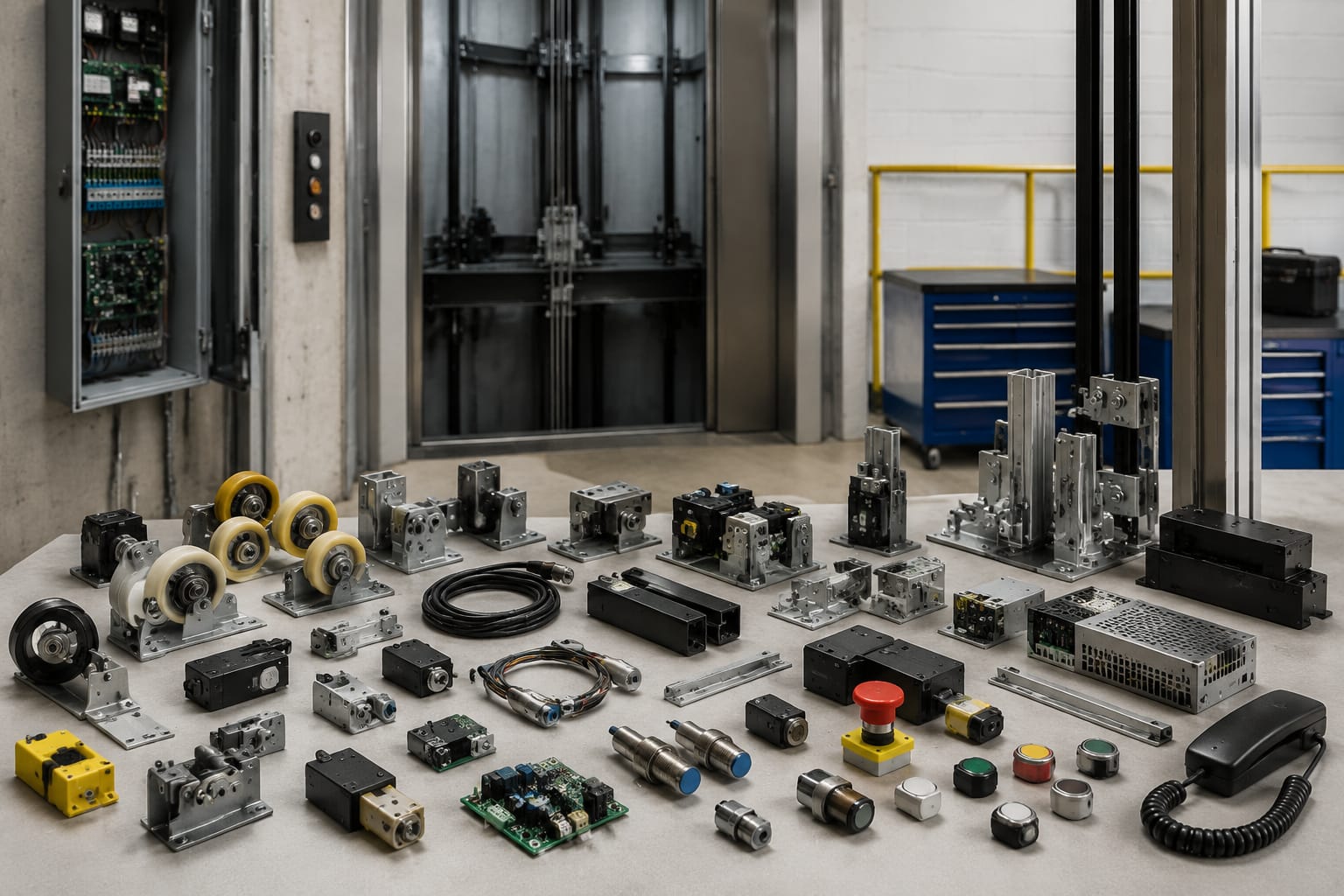
Elevator accessories are the supporting electrical, mechanical and cabin components that keep a lift controllable, safe to operate and serviceable. They range from sensors and switches to buttons, door hardware, guide components and maintenance tools. The right part is not simply one that looks similar: it must match the lift system, mounting arrangement, electrical rating and operating conditions.
For maintenance contractors, distributors and sourcing teams, the practical task is to identify whether a part is system-specific, dimension-specific or a standard service item. Confirming this before ordering reduces site delays, repeat freight and the risk of fitting a component that performs unpredictably.
What qualifies as an elevator accessory?
The term “elevator accessories” covers parts that support the function, usability, monitoring or maintenance of an elevator, without necessarily being the main traction machine, controller or car frame. In practice, the category includes both electrical and mechanical lift accessories.
Common examples include:
- Position, levelling, limit and turning detection switches
- Magnetic, inductive and photoelectric sensors
- Car operating panel buttons, key switches and indicators
- Landing displays, direction arrows and annunciators
- Intercoms, emergency alarm components and speaker units
- Door rollers, guides, hangers, locks and seals
- Cabin handrails, mirrors, skirting and protective fittings
- Guide shoe liners, lubrication devices and mechanical fasteners
- Inspection controls, service tools and temporary protection items
The boundary between an accessory and a critical safety component is not always neat. For example, a door contact or levelling sensor may be described as an accessory in a catalogue, but it can affect normal operation and should always be selected and installed according to the applicable equipment documentation and competent maintenance procedures.
A useful first distinction is whether the replacement item is:
| Part type | Typical role | Main selection priority |
|---|---|---|
| Electrical sensing part | Sends position, movement or status information | Electrical interface, sensing principle and switching behaviour |
| User-interface part | Lets passengers or technicians operate the lift | Panel fitment, wiring and system protocol |
| Door or cabin part | Supports door travel, passenger use or car finish | Dimensions, material and mounting points |
| Mechanical running part | Guides, supports or lubricates moving equipment | Profile, load, wear material and adjustment range |
| Service accessory | Helps inspection, cleaning, protection or maintenance | Intended use, safety suitability and site conditions |
This classification helps determine what information must accompany an enquiry. A cabin handrail may be selected mainly by length, finish and mounting. A levelling sensor normally requires the original part number, controller or system details, operating voltage and a clear image of its connector and bracket.
Electrical switches and sensors
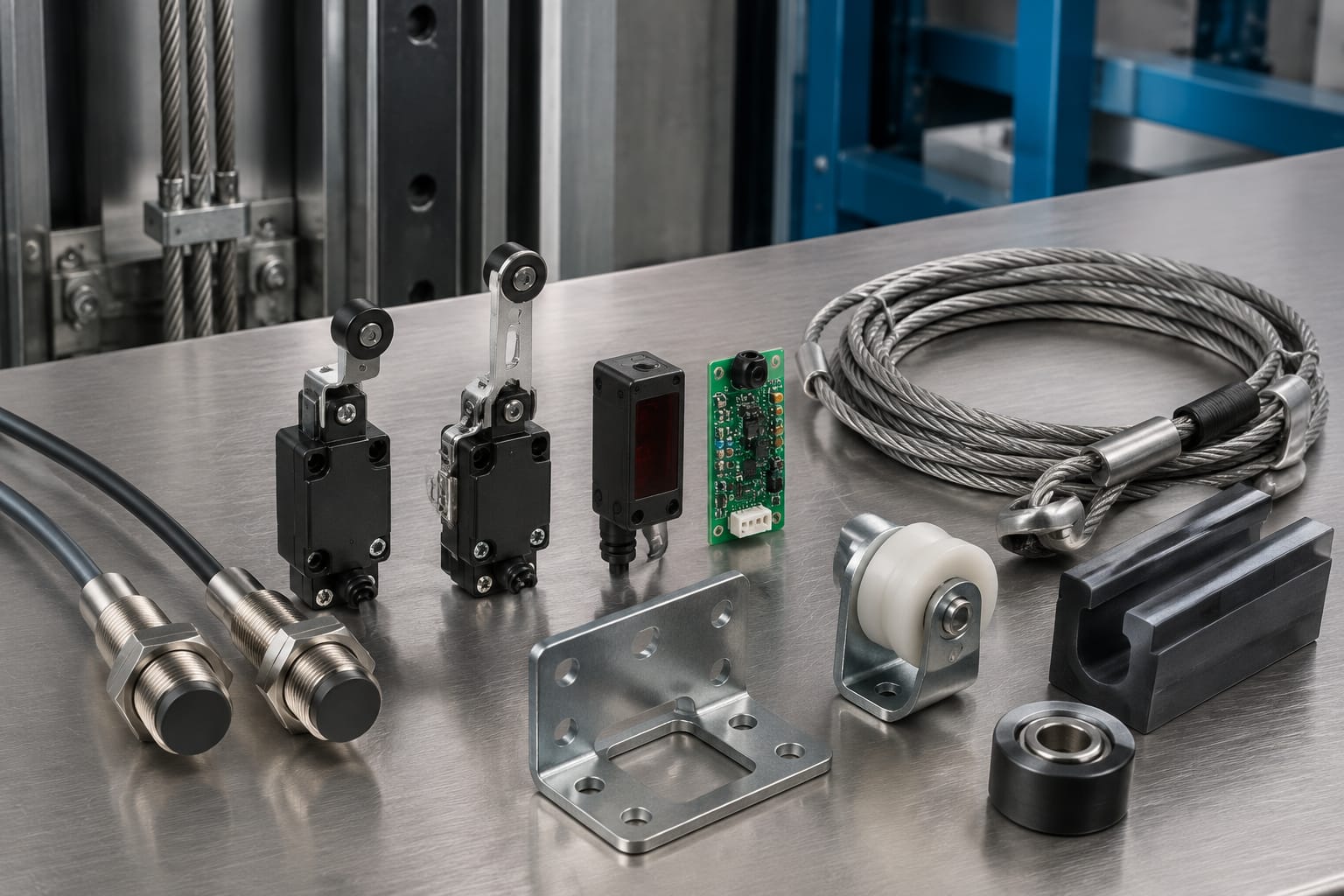
Electrical switches and sensors allow the lift control system to detect where equipment is, whether a condition is met and when a sequence may proceed. Because their signals affect operation, a visually similar substitute is rarely sufficient evidence of compatibility.
Levelling and position sensors
Levelling sensors detect the car’s position relative to the landing zone. Depending on the lift design, they may work with vanes, magnets, cams or other targets. Their output supports accurate stopping, door-zone logic and travel control.
When reviewing a replacement, check:
- The original part number and manufacturer reference
- Sensor type, such as magnetic, reed, inductive or photoelectric
- Supply voltage and AC or DC requirement
- Output configuration, including normally open, normally closed, PNP or NPN where applicable
- Connector type, cable length and pin arrangement
- Mounting-hole position, bracket style and sensing face orientation
- Target material, target size and required sensing gap
A [cigarette rod levelling sensor switch for Otis lifts](/products/cigarette-rod-leveling-sensor-switch-otis-elevator-parts-lift-accessories-lift-accessories/) illustrates why the physical sensing arrangement matters. The correct electrical specification alone does not confirm that the sensor will align with the installed actuator or bracket.
Turning, slowdown and limit switches
Turning detection switches and travel limit switches confirm movement or position at key points in the lift’s operating range. Their configuration can vary by manufacturer and application. A switch may use a roller lever, plunger, cam, magnetic target or rotating mechanism.
For a [Mitsubishi elevator turning detection switch](/products/elevator-turning-detection-switch-mitsubishi-lift-parts/), confirm the switch reference, actuator form, mounting orientation and contact arrangement against the removed item or equipment documentation. Do not assume that a switch with the same housing dimensions has the same switching direction or terminal layout.
Door and safety-related switches
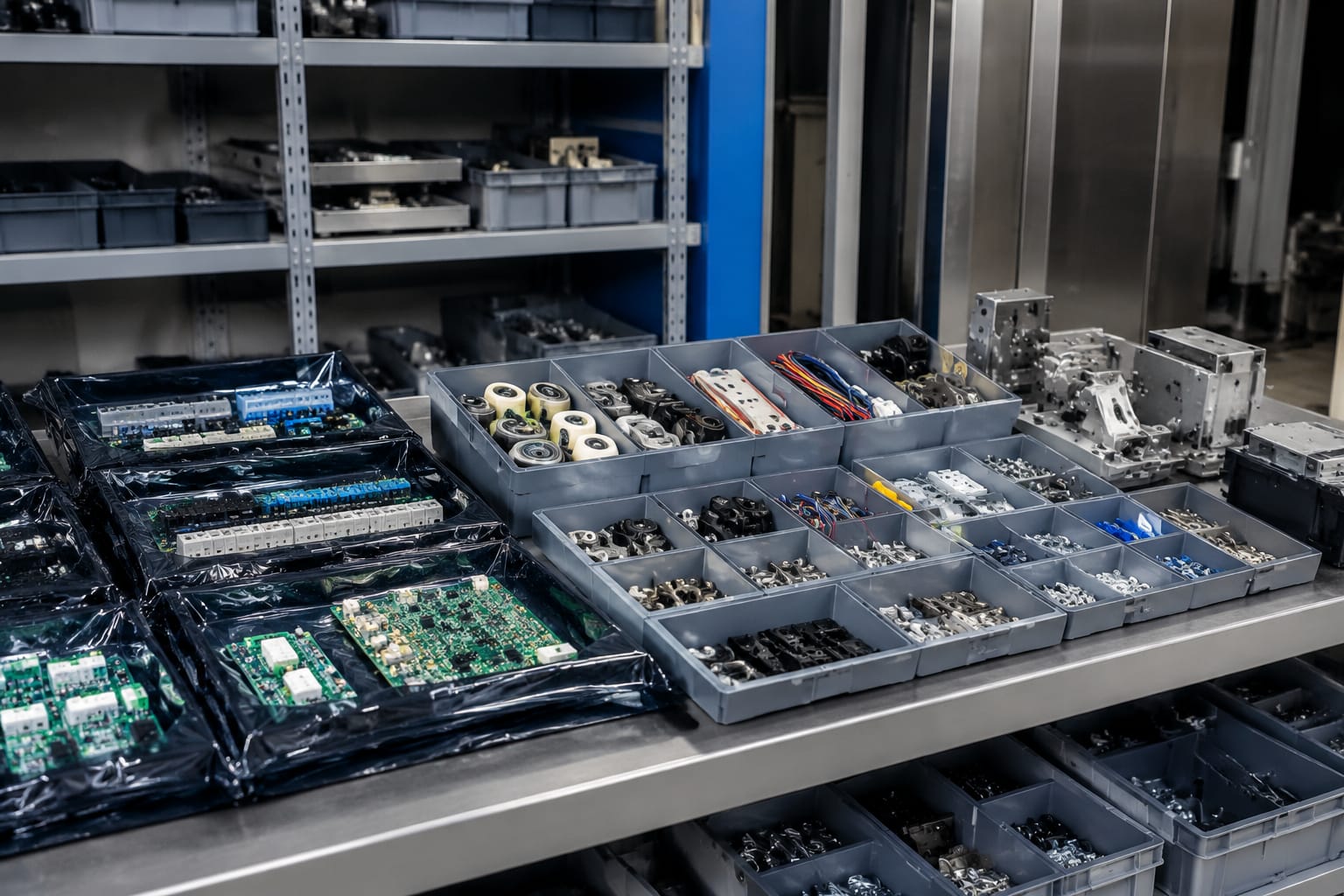
Door systems use various switches to prove closed, locked, open or obstruction-related conditions. These parts can be exposed to vibration, repeated cycling, dust and misalignment. Contact condition, actuator travel and mounting adjustment all affect reliability.
A chain-break switch used on escalator equipment is distinct from a lift component, but it shows the importance of matching a safety-monitoring part to its intended application. Where relevant to a mixed vertical-transport portfolio, refer to the [Otis escalator chain-break switch](/products/escalator-chain-break-switch-otis-elevator-parts-lift-accessories/) by its exact application rather than treating it as a generic switch substitute.
Never bypass, bridge or alter safety circuits merely to keep equipment running while waiting for a replacement. A temporary workaround can mask the original fault and introduce a more serious operational risk.
Buttons, displays, and communication parts
Passenger-facing elevator accessories are often selected for appearance as well as function. Yet the panel cut-out, illumination voltage, wiring method and controller compatibility remain equally important.
Push buttons and key switches
Car and landing buttons may be mechanical, capacitive, touchless or vandal-resistant designs. Their faceplate diameter, bezel profile, legend, illumination colour and braille arrangement can vary. In an existing installation, matching the original panel format may be necessary to avoid drilling, blanking plates or an inconsistent user interface.
Check the following before choosing buttons:
- Cut-out diameter and panel thickness
- Fixing method and rear clearance
- Button travel or touchless operating method
- Illumination type, voltage and colour
- Contact block configuration
- Connector, terminal or harness arrangement
- Engraving, symbols, floor markings and braille requirements
- Compatibility with the existing car operating panel or landing station
A button may be electrically serviceable but unsuitable where it cannot fit behind a compact car operating panel. Conversely, a matching stainless-steel face can conceal a different plug arrangement or lamp supply.
Indicators and displays
Landing indicators and car displays communicate floor position, travel direction, messages and fault information. Replacing them requires more than matching display size. Some units accept simple discrete signals, while others rely on manufacturer-specific serial communication.
Confirm:
- Visible aperture and fixing centres
- Display technology and required viewing angle
- Supply voltage and current requirement
- Communication protocol or signal input
- Direction-arrow arrangement
- Floor naming convention and character format
- Whether programming, addressing or configuration is required
A display ordered for a modernisation project should be assessed alongside the controller interface. If no converter, compatible board or correct protocol is available, the display may power up but not communicate useful information.
Emergency communication equipment
Emergency alarm buttons, intercoms, telephones, speaker units and alarm indicators serve a critical passenger-support role. Requirements for communication arrangements can differ by building, maintenance contract and installed system. Confirm the existing wiring, power source, telephone or communication interface, and the required test process before selecting a replacement.
For these items, confirm whether the device is a direct replacement or part of a larger emergency communication upgrade. A replacement speaker or alarm button may be straightforward; changing the complete communication unit can require compatibility checks with remote monitoring or building systems.
Door and cabin accessories
Door accessories experience high cycle counts and are commonly replaced because of wear, impact damage or adjustment limitations. Cabin accessories may be selected for refurbishment, accessibility, durability or visual consistency.
Door equipment accessories
Common door-related items include:
- Door rollers and hanger rollers
- Bottom guides and guide inserts
- Door vanes and couplers
- Lock contacts and lock-related fittings
- Gibs, shoes, seals and edge protectors
- Door sill cleaning brushes and fixings
- Clutch components and retaining hardware
The mating profile is crucial. A roller with the correct diameter but wrong bore size, groove profile or offset can create poor door travel. A bottom guide must match the sill channel and door panel arrangement. Material selection also matters: nylon, rubber, polyurethane and metal components have different wear, noise and environmental characteristics.
When replacing a door roller or guide, document the original part’s outside diameter, inside diameter, width, groove shape, axle or bearing size, and any offset between the wheel and mounting face. Include photographs from both sides, with a scale where practical.
Cabin fittings
Cabin accessories include handrails, mirrors, kickplates, ceiling components, fan grilles, skirting, protection pads and signage holders. These can support a refurbishment while retaining the main car structure.
Cabin parts should be evaluated for:
- Car wall material and fixing method
- Available internal clearance
- Edge finish and passenger-contact surfaces
- Corrosion resistance suitable for the environment
- Ease of cleaning and replacement
- Fire, electrical and building requirements applicable to the project
- Consistency with existing finishes where only part of the cabin is being renewed
In coastal or humid South African environments, finish and corrosion resistance deserve particular attention. However, material choice should be based on the actual location, cleaning products and installation conditions, not assumed from region alone.
Guide, lubrication, and mechanical items
Mechanical lift accessories keep moving equipment guided, aligned and protected from unnecessary wear. These components can appear simple, but incorrect tolerances or materials may increase noise, friction or rail wear.
Guide shoes and inserts
Guide shoe assemblies and liners help guide the car or counterweight along the rails. They may use sliding inserts, roller arrangements or a combination of adjustable parts. The correct choice depends on rail size, guide-shoe design, travel speed, load and the existing assembly.
Before ordering guide components, verify:
- Rail profile and dimensions
- Car or counterweight application
- Original guide-shoe assembly reference
- Insert material and shape
- Adjustment range and mounting arrangement
- Whether the order is for a complete assembly or replacement liner only
Do not replace only the visibly worn insert if the housing, springs, rollers or adjustment hardware are also damaged. Assess the complete assembly to determine whether a partial repair will restore stable guidance.
Lubrication equipment
Lubricators, wicks, reservoirs and mounting brackets deliver lubricant to guide rails where the system is designed to use it. Correct placement and adjustment are important. Excess lubricant can attract dirt and affect the hoistway environment, while insufficient lubrication may increase friction and wear.
Confirm the lubricant type specified for the equipment and avoid mixing products without checking suitability. The lubrication accessory itself must fit the rail and maintain controlled contact; an improvised wick or bracket is not a reliable replacement.
Springs, buffers, fasteners and brackets
Smaller mechanical items are often ordered with incomplete information because they are viewed as generic. In reality, spring rate, compressed length, thread pitch, material grade, bracket offset and hole spacing can all matter.
For any non-standard fastener, spring or bracket, provide a drawing or measured sample. State whether the component performs a structural, alignment or safety-related function. This prevents a replacement being selected solely on approximate size.
Maintenance and service accessories
Service accessories support inspection, troubleshooting, cleaning and protection work. They do not replace proper diagnostic procedures or the manufacturer’s maintenance instructions.
Useful categories include:
- Inspection and test leads appropriate to the equipment
- Labels, tags and identification markers
- Cabin and entrance protection materials for refurbishment work
- Door sill cleaning tools and non-damaging cleaning accessories
- Approved lubricating and cleaning application equipment
- Secure storage for small electrical spares
- Replacement lamps, lenses, fasteners and panel fittings held as planned stock
A practical maintenance stockholding approach separates frequently consumed, low-risk items from system-specific parts. Generic panel fixings and compatible lamps may be held as regular consumables once verified. Sensors, boards, specialist switches and door control items usually need stronger identification controls because an incorrect item can create delays or faults.
For distributors and importers, packaging and labelling are also part of the service accessory decision. Preserve the part number, batch identification where supplied, connector protection and any installation notes received with the item. Loose parts without traceable labelling are difficult to allocate correctly later.
Check model, dimensions, and ratings
The most dependable sourcing process combines documentary identification with physical verification. A part number is ideal, but it should be checked against the removed part and the installed system where possible.
Use this minimum checklist for elevator accessory enquiries:
- Record the elevator manufacturer, controller or door-operator details, and equipment model where available.
- Capture the original part number, revision or label information exactly as shown.
- Take clear photographs of the front, rear, connector, mounting face and cable entry.
- Measure critical dimensions in millimetres: hole centres, overall length, diameter, depth, slot size and offset.
- Note electrical ratings: voltage, current, AC/DC supply, contact type and connector pins.
- Describe the component’s function and where it is fitted.
- State whether the part is for a like-for-like repair, a planned upgrade or a stockholding requirement.
- Confirm required quantity, including whether paired left- and right-hand parts are needed.
For electronic parts, revision level can be as important as the main part number. For mechanical parts, a sketch with dimensions can be more useful than an incomplete name. When a sample is available, retain it until the replacement has been compared and accepted.
Avoid compatibility and ordering mistakes
Most ordering problems come from incomplete identification, assumptions based on appearance or failure to distinguish a component from its wider assembly.
Common mistakes to avoid
Ordering by manufacturer name alone. A single lift brand can have multiple controller generations, door operators and panel designs. The brand narrows the search but does not prove fitment.
Using a photo without measurements. Images reveal connector style and general shape, but perspective can conceal dimensions and offsets.
Ignoring handedness. Door-related brackets, rollers, vanes and panels may be left-hand or right-hand. Confirm the viewing direction used when identifying handed parts.
Matching voltage but not output type. Sensors and switches can share a voltage rating while using incompatible contact logic, transistor output or wiring arrangements.
Replacing one item in a worn set without inspection. A single roller, guide insert or spring may fail early if its mating components are already worn or misaligned.
Treating an accessory as a universal replacement. Some buttons, displays and sensors are purpose-built for a particular system. A universal-looking alternative may require modifications, interface equipment or programming.
Leaving out the application. A supplier needs to know whether a switch is used for levelling, door status, terminal limit or another function. Application information helps identify critical distinctions.
A practical approval process
For parts that affect operation, establish a simple technical approval step before releasing a purchase order:
- Compare the proposed reference against the original part number and photos.
- Verify electrical, mechanical and environmental requirements.
- Check whether additional brackets, plugs, programming tools or mating parts are required.
- Confirm that a competent person will install, adjust and test the component.
- Keep the approval record with the equipment or procurement file.
This process is particularly valuable for B2B importers and distributors who may not have direct access to the lift site. A structured enquiry form reduces back-and-forth and helps the buyer receive a part that can be identified and sold accurately.
FAQ
Are elevator accessories interchangeable between brands?
Some consumables and standard mechanical items may be interchangeable once dimensions and ratings are verified. Many sensors, displays, buttons, door components and electrical interfaces are brand- or system-specific. Treat interchangeability as something to confirm, not assume.
What information is most important when identifying a sensor?
Start with the original part number, clear images of the label and connector, supply voltage, output type, sensing method, mounting arrangement and the target it detects. The lift model and controller information provide useful supporting context.
Should I order a complete assembly or just the worn component?
Order the smallest replacement that restores reliable operation only after inspecting the related assembly. If multiple parts are worn, damaged or no longer adjustable, a complete assembly may be more appropriate. The decision depends on condition, availability of replacement sub-parts and the manufacturer’s intended service arrangement.
Can cabin accessories be selected only by appearance?
No. Finish matters, but wall construction, fixing points, passenger clearance, edge treatment and maintenance requirements also determine whether a cabin accessory is suitable.
A well-prepared parts enquiry is usually the fastest route to a correct match. Kelevator supplies multi-brand elevator spare parts for B2B importers, distributors, maintenance contractors and OEM buyers; provide the component’s reference, photographs, measurements and application details so the required elevator accessory can be assessed accurately.