
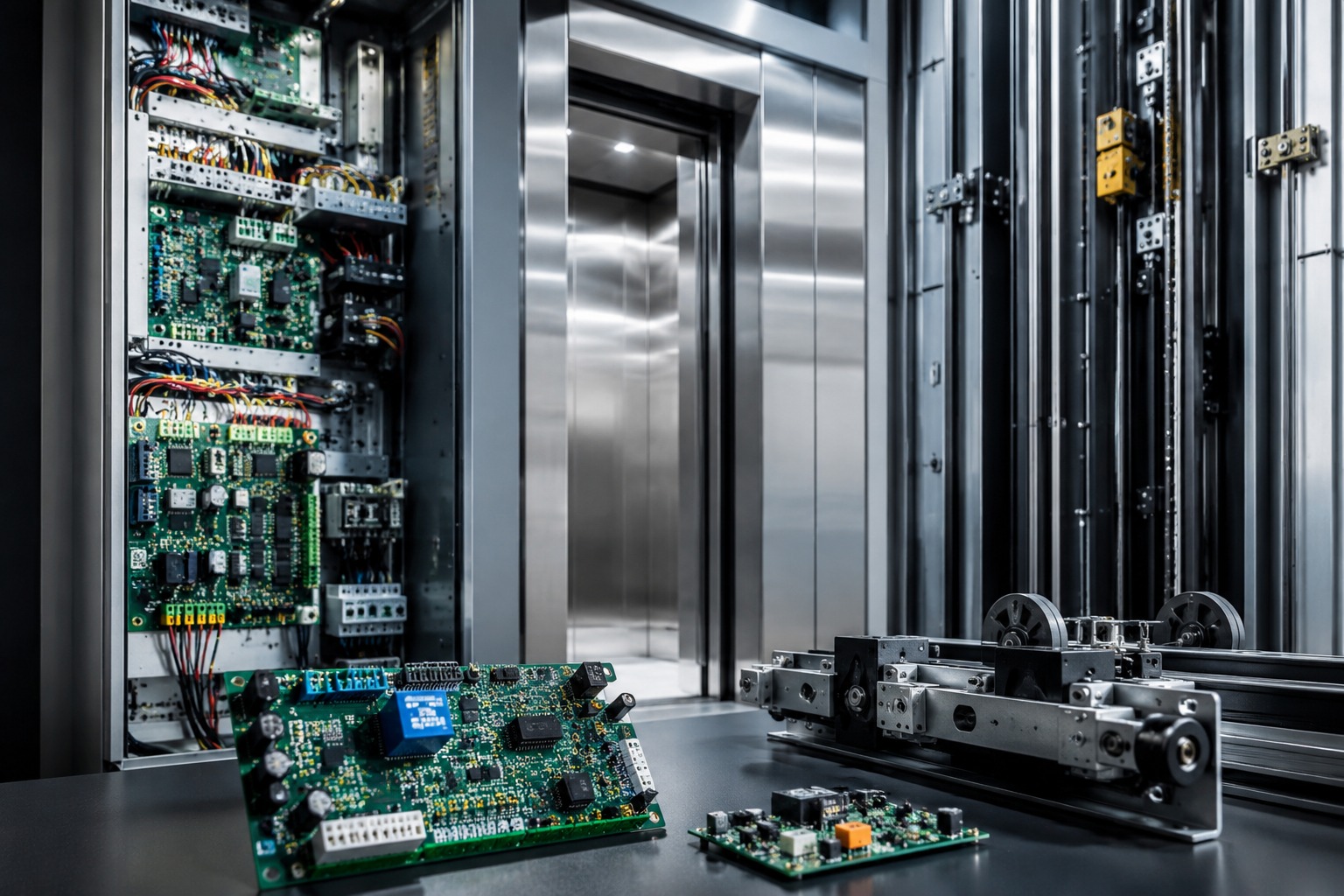
Elevator control boards sit at the center of lift logic, signal processing, safety communication, door coordination, and travel command execution. When a board begins to fail, the result is rarely limited to one obvious symptom. In South Africa, maintenance teams in Johannesburg, Cape Town, Durban, Pretoria, Gqeberha, and Bloemfontein often encounter intermittent faults that appear to be door problems, encoder problems, inverter alarms, or landing call issues, only to discover that the root cause lies in a failing motherboard, I/O board, communication board, or expansion board. For building owners and contractors, understanding the practical warning signs, diagnosis process, sourcing standards, and replacement steps helps reduce downtime and avoid costly repeat visits.
The South African lift market presents its own service conditions. Coastal humidity in Durban and Cape Town can accelerate corrosion. Voltage instability in some areas can stress sensitive components. Long transport distances between major urban service hubs and remote mining, industrial, and mixed-use developments can complicate urgent parts replacement. These realities make control board selection, protective packaging, and post-installation commissioning especially important.
As a practical rule, technicians should never treat a control board as a generic electronic spare. Exact model matching, firmware and revision checking, connector orientation, storage history, and bench inspection all matter. This is particularly true when ordering branded boards for legacy equipment, including Hitachi and Toshiba systems. If a maintenance company needs a compatible replacement for a Hitachi system, it is useful to review available Hitachi elevator control board options with attention to code, revision, and application. Where Toshiba systems are involved, teams often compare a Toshiba elevator motherboard against a specific Toshiba elevator expansion board to avoid ordering a board that solves only part of the fault chain.
This guide answers the direct question first: if a lift shows random resets, uncommanded shutdowns, missing hall calls, repeated communication alarms, inconsistent leveling, or door timing errors that do not stay fixed after normal mechanical service, the control board should be assessed early. However, diagnosis must be systematic. Replacing a board without proving the fault can waste money, extend downtime, and expose the new board to the same damaging condition.
Across South Africa, demand for replacement control electronics continues to rise because many buildings are operating mixed-age elevator portfolios. Office towers in Sandton, hospitals in Pretoria, residential complexes in Cape Town, logistics sites near Durban Harbour, shopping centres along the N1 and N3 corridors, and hotels near OR Tambo all depend on reliable lift uptime. This creates a strong market for carefully matched replacement boards, refurbishment evaluation, and fast-response supply support.
The line chart above reflects a realistic demand trend driven by modernization cycles, rising expectations for uptime, and the need to keep legacy lifts operational while major upgrades are phased over time. In South Africa, many property managers prefer targeted board replacement as a short- to medium-term strategy before committing to a full controller modernization.
Common signs of elevator control board failure
Control board faults are often deceptive because they mimic sensor, contactor, door, and drive problems. The most common signs involve intermittent or logic-related behaviour rather than total failure. A board may work well in the morning, trip during peak traffic, and recover after a power cycle. That pattern usually points to thermal stress, unstable power regulation, poor solder joints, memory corruption, or degraded communication sections.
In commercial buildings in Johannesburg and Cape Town, service companies frequently report callback patterns such as random car stoppage, repeated rebooting, floor indication loss, nuisance door reopen events, and unexplained faults that cannot be duplicated during a short visit. In coastal installations, oxidation at connectors and edge contacts can also contribute to unreliable logic signals.
| Failure sign | Typical field symptom | Possible board-level cause | Operational impact | Risk if ignored | First technician action |
|---|---|---|---|---|---|
| Random resets | Controller reboots without a clear pattern | Power regulation instability, capacitor ageing | Lift out of service during travel cycle | Entrapment risk and repeat shutdowns | Check supply quality and board voltage rails |
| Missing landing calls | Hall buttons illuminate but car does not respond | I/O processing fault or communication board issue | Service delays and passenger complaints | Escalating callback frequency | Trace signal path from button to main board |
| Door timing errors | Door reopens or closes unpredictably | Logic timing fault, damaged relay output | Longer loading times and nuisance alarms | Door operator stress and wear | Separate mechanical checks from controller checks |
| Leveling inconsistency | Car stops above or below floor at random times | Signal processing or encoder input conditioning fault | Passenger discomfort and compliance concerns | Safety shutdowns or access issues | Compare encoder health with board input readings |
| Loss of communication | Drive, COP, LOP, or group control alarms | CAN, serial, or interface section failure | Reduced lift function or no dispatch | Multiple subsystem errors | Inspect comm lines and board ports |
| Fault appears when warm | Lift runs when cold, trips later | Cracked solder joints or heat-sensitive ICs | Intermittent reliability during peak periods | Growing instability over time | Thermal observation and bench inspection |
The table shows why symptom-based diagnosis alone is not enough. One visible fault may have several causes, and one weak board can affect many subsystems at once. In practice, the technician should document whether the fault is intermittent, load-related, temperature-related, time-related, or tied to power events.
Another warning sign is repeated “successful” temporary repairs. If connectors are cleaned, settings are reset, or power is cycled and the lift returns to operation for a short period but then fails again, the board should move higher up the suspicion list. This is common in older residential and commercial installations where electronic ageing has progressed well beyond the ideal replacement window.
How technicians diagnose control board faults
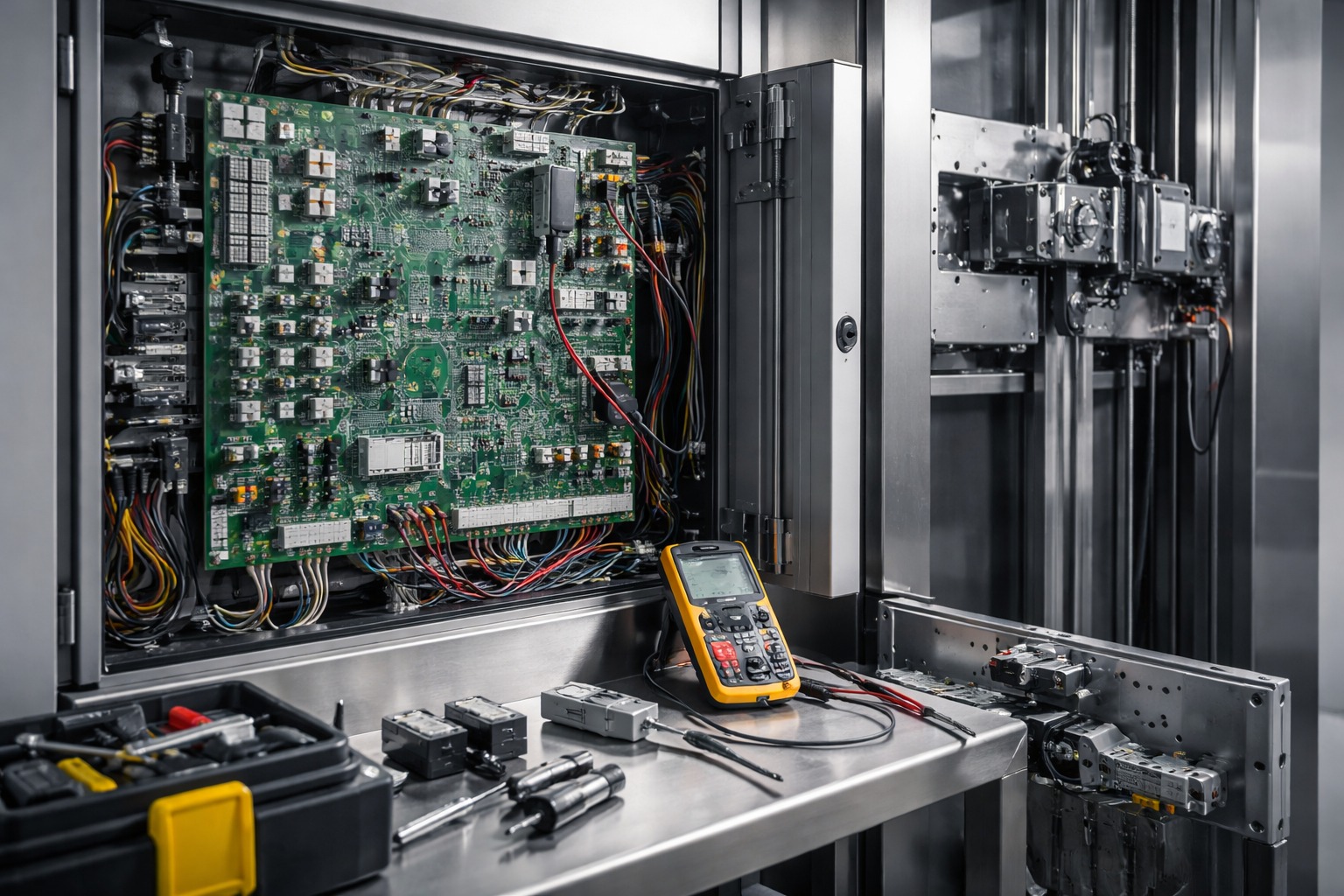
Good diagnosis starts before any board is removed. The objective is to prove whether the board itself has failed, whether it was damaged by another component, or whether a peripheral issue is merely being reflected by the controller. In South Africa, where urgent breakdown response can involve travel between city centres, industrial estates, and regional properties, a disciplined method saves both time and return visits.
Technicians usually begin with fault history, event logs, visual inspection, supply verification, and connector checks. They then isolate external causes such as unstable incoming power, faulty limit inputs, damaged wiring looms, wet shaft conditions, failed door boards, or inverter communication loss. Only after these are assessed should a board be condemned. This matters because replacing a healthy board into a system with a hidden grounding problem can damage the new unit immediately.
| Diagnostic step | What is checked | Tools used | What confirms suspicion | What can mislead diagnosis | Recommended action |
|---|---|---|---|---|---|
| Event log review | Recurring alarms and sequence of faults | Controller interface, service tool | Repeating logic or comm alarms | Historic faults unrelated to current issue | Focus on the latest reproducible sequence |
| Visual board inspection | Burn marks, bulged capacitors, corrosion | Light, magnifier, ESD-safe bench | Physical damage on board | Invisible micro-cracks or hidden layer damage | Combine with electrical testing |
| Power quality check | Input voltage and board rails | Multimeter, oscilloscope | Fluctuating or low regulation | Short spot checks during stable periods | Monitor under load and at fault time |
| Connector and harness test | Loose, oxidized, or reversed connections | Continuity meter, inspection | Intermittent open or poor contact | Temporary improvement after reseating | Record before-and-after condition |
| Substitution test | Known-good compatible board | Matched spare board | Fault disappears under same conditions | Wrong revision or firmware mismatch | Verify codes and settings before swap |
| Peripheral isolation | Sensor, encoder, drive, door links | Manual tracing and service data | Fault remains after external items proven good | Multiple simultaneous failures | Test one subsystem at a time |
This table highlights a central diagnostic principle: no single test should be trusted in isolation. The best field decisions come from pattern matching across history, inspection, and controlled substitution. For critical sites such as hospitals, hotels, or high-traffic retail centres, many contractors keep known-good boards or validated spares on hand to reduce downtime during diagnosis.
Technological capability matters here. A reliable supplier should be able to support model matching through part numbers, photos, connector confirmation, revision comparison, and basic compatibility review. In complex cases, technicians benefit from cross-checking motherboard codes, expansion board references, and communication interfaces before shipment. That technical support is especially useful where brand generations overlap and older controllers remain in service.
For sites with recurring board damage, technicians should investigate root causes beyond the board itself: poor cabinet ventilation, contaminated machine rooms, moisture ingress, grounding faults, unstable control power supplies, and surge events. In parts of South Africa where thunderstorms and supply disturbances are more common, surge history should not be ignored.
The industry demand chart shows where board replacement pressure is strongest. Office towers, hospitals, and retail centres typically have heavier duty cycles, making fast troubleshooting and accurate spares especially valuable.
What to consider when sourcing Hitachi control boards
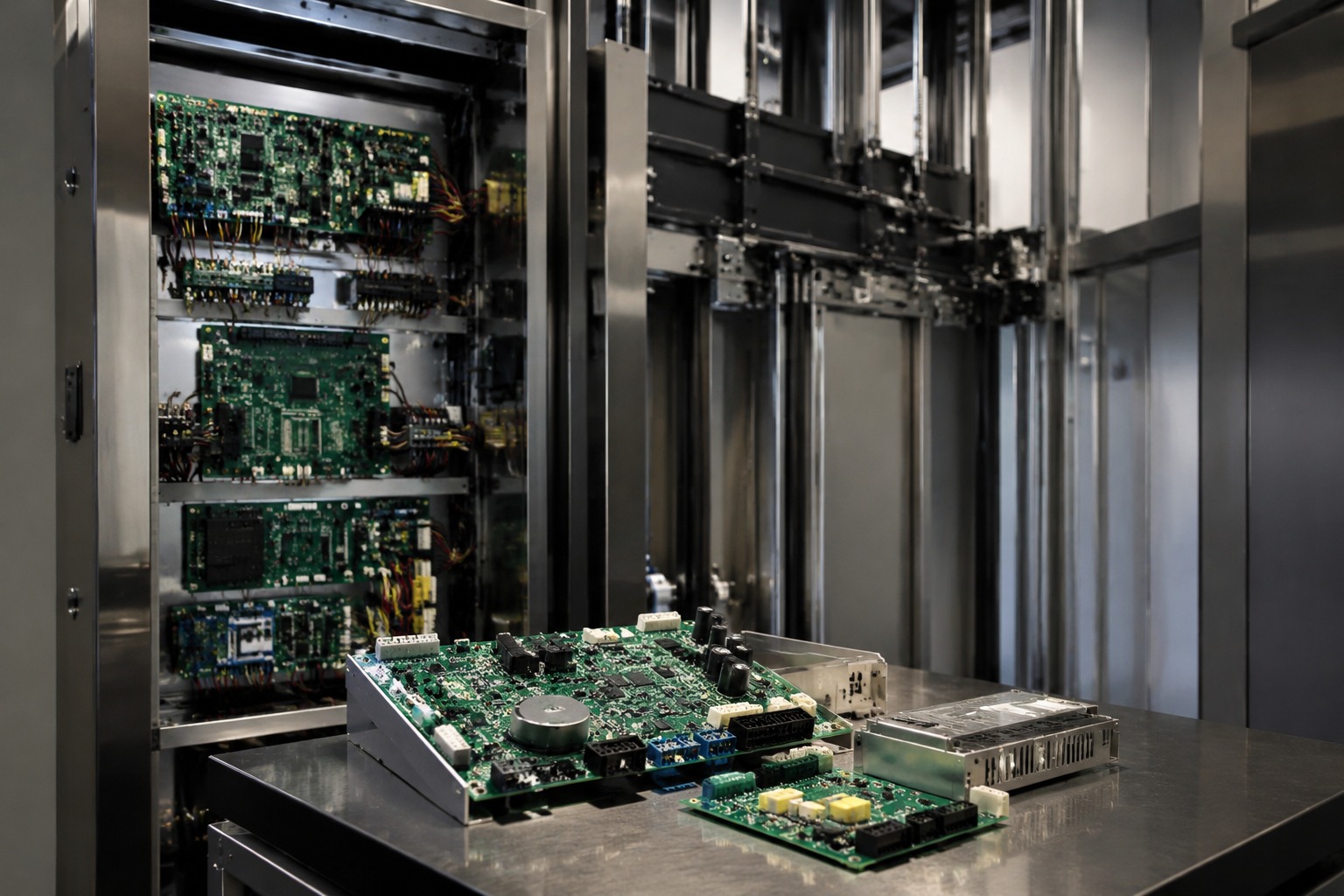
Hitachi systems are known for precise logic coordination and application-specific board configurations, which means sourcing requires care. The technician or buyer should confirm the exact board code, board revision, connector layout, software dependency, and the controller family involved. In many cases, the visible fault may be on a daughter board or interface board while the main controller remains healthy. Ordering based only on a general description such as “Hitachi control board” is risky.
For South African buyers, lead time is often a deciding factor. A building in Sandton may require same-week replacement, while a mining camp or logistics site outside a major metro may need extra shipping time. Buyers should therefore ask not only whether the board is available, but whether it has been visually inspected, electrically screened where appropriate, and packed for long-distance transit. Access to a documented source for Hitachi lift control boards can reduce uncertainty when urgent faults arise.
| Sourcing factor | Why it matters | Common buyer mistake | Best practice | Impact on downtime | Impact on cost |
|---|---|---|---|---|---|
| Exact part number | Ensures electrical and logic compatibility | Ordering by controller brand only | Match complete code including suffix | Reduces wrong-part delays | Avoids repeat freight |
| Revision level | Different revisions may not be interchangeable | Ignoring PCB version marking | Confirm revision from board photo and label | Improves first-time fit rate | Prevents unusable stock |
| Application position | Main board, interface board, I/O board differ | Misidentifying the failed board | Verify board function in cabinet | Faster repair planning | Prevents unnecessary purchases |
| Condition grade | New, original, refurbished differ in risk | Choosing by lowest price only | Balance urgency, warranty, and testing data | Stabilizes post-repair reliability | Improves lifecycle value |
| Packaging quality | Electronic parts can fail in transit | Accepting non-ESD packing | Use anti-static and cushioned packaging | Prevents shipping damage | Avoids claims and delays |
| Supplier response speed | Technical confirmation is often urgent | Waiting days for code verification | Work with responsive parts support | Shortens downtime window | Reduces site penalties |
The table makes clear that sourcing is not merely a purchasing task; it is part of technical risk control. A strong supplier can help with technological capability by reviewing code labels, connector photos, and board role identification. That support is valuable when maintenance companies are dealing with mixed portfolios and need confidence before placing an order.
South African import and logistics realities also matter. Boards may move through air freight channels tied to OR Tambo, or sea freight flows linked to Durban and Cape Town ports for larger shipments and stock replenishment. For urgent service, verified stock availability and dispatch discipline can matter as much as the board price itself.
Toshiba motherboard replacement notes
Toshiba elevator systems often require close attention to motherboard and expansion board relationships. A motherboard may manage the primary logic, while an expansion board handles specific input/output or communication functions. Replacing only the most obvious board without checking dependent modules can leave the original fault unresolved. That is why buyers should review the precise application when considering a Toshiba original motherboard or a Toshiba expansion board replacement.
Before replacement, technicians should record all parameter settings, switch positions, firmware labels, and cable locations. Photographs taken before removal can prevent installation mistakes. In older sites, labels may be faded, and one disconnected plug can create a false impression that the new board is defective.
| Replacement point | Why it is important | Typical risk | Recommended procedure | Effect on commissioning | Notes for South Africa |
|---|---|---|---|---|---|
| Backup of settings | Protects controller logic configuration | Loss of parameters after swap | Record settings before power-down | Speeds recommissioning | Useful where repeat site visits are costly |
| Board function check | Motherboard and expansion board differ | Replacing wrong module | Trace fault to exact board role | Avoids partial repair | Important for legacy mixed systems |
| Connector orientation | Prevents installation error | Misplugged or offset connectors | Label cables and photograph positions | Reduces startup faults | Essential in low-light machine rooms |
| Firmware or revision check | Compatibility can vary | Board powers on but behaves incorrectly | Confirm revision before shipment | Improves first-pass success | Helpful for imported stock planning |
| Peripheral inspection | Other faults may damage new board | Repeat failure after installation | Check drives, sensors, power supplies | Stabilizes service restoration | Needed in areas with power fluctuations |
| Static-safe handling | Boards are ESD sensitive | Latent damage during installation | Use grounded ESD handling methods | Protects new electronics | Critical during dry inland conditions |
The table shows why a motherboard replacement should be treated as a controlled engineering task rather than a basic swap. In many South African buildings, service windows are tight and access may be limited. Better pre-replacement preparation reduces site downtime and protects the replacement investment.
Manufacturing capability also shapes confidence. Buyers generally prefer suppliers that can support consistent model verification, organized inventory control, careful inspection routines, and protective packing standards. Even when supplying branded spare parts rather than manufacturing the OEM board itself, a professionally managed supply chain improves traceability and reduces dispatch errors.
Why refurbished boards need careful testing
Refurbished elevator control boards can be a practical solution for discontinued models, urgent legacy repairs, and budget-sensitive projects, but they must be approached with discipline. A refurbished board that has only been cleaned and visually improved is not the same as a board that has been inspected, repaired where necessary, screened, and verified for stable operation. In South Africa, where site access and return visits can be expensive, under-tested refurbished boards can create major service risk.
The key issue is latent failure. A board may power up successfully on the bench yet still contain weak capacitors, stressed relays, hairline solder cracks, or intermittent communication faults that appear only after heating or vibration. That is why careful testing matters more than appearance.
The area chart reflects a market shift toward better-tested refurbished and screened boards. As more older lifts remain in service, the market increasingly values validation over simple low-cost availability.
| Testing item | Purpose | What a weak supplier may skip | Why it matters in service | Preferred evidence | Buyer takeaway |
|---|---|---|---|---|---|
| Visual inspection | Find obvious heat or corrosion damage | Checking only front surface | Hidden faults remain in use | Clear board photos and notes | Ask for actual condition details |
| Connector integrity | Confirm stable mating surfaces | Ignoring worn edge contacts | Intermittent field disconnects | Inspection record or replacement note | Important for older boards |
| Power-on test | Verify startup response | Very brief no-load test | Fault appears later on site | Basic power verification data | Power-on alone is not enough |
| Functional screening | Check outputs, inputs, or communication | Testing only indicator lights | Board fails under real use | Application-based test confirmation | Prefer validated logic checks |
| Thermal stability review | Catch heat-related intermittence | No warm-run observation | Peak-hour failures return | Extended screening statement | Crucial for intermittent history |
| Packaging after test | Keep tested board protected | Loose packing after screening | Transit damage cancels test value | ESD-safe sealed packing | Testing and packing must work together |
This table explains why the word “refurbished” should always be qualified by the testing process. Buyers should ask what was actually checked, whether the board was screened for stable function, and how it was protected after inspection. A board that was tested but shipped carelessly may still arrive compromised.
Service capability becomes especially important with refurbished stock. Responsive communication, quick code confirmation, and clear condition disclosure help buyers make the right call between new, original, refurbished, or alternative modernization pathways. In urgent breakdown scenarios, accurate information often has more value than a low headline price.
ESD packaging and shipping requirements
Electrostatic discharge protection is not a minor packaging detail. Elevator control boards are sensitive electronic assemblies, and poor handling can create immediate failure or latent damage that only appears after installation. For shipments into and across South Africa, packaging must also account for long routes, multiple handling points, vibration, and varying climate conditions.
Best practice is to use anti-static bags, cushioning that prevents movement, rigid outer cartons, and clear labeling. Moisture control may also be appropriate for coastal delivery routes and storage environments. If boards are moving through Durban Harbour, Cape Town port channels, or air freight hubs linked to Gauteng, package integrity must survive more than one transfer stage.
| Packaging requirement | Reason | Minimum standard | Common failure | Shipping impact | Buyer check |
|---|---|---|---|---|---|
| Anti-static bag | Protects against ESD exposure | Sealed ESD-safe bag per board | Board wrapped in plain plastic | Latent electronic damage | Ask for packing photos |
| Cushioning | Absorbs vibration and shock | Foam or structured protective insert | Board moves inside box | Broken components or cracked solder | Confirm internal fixation |
| Rigid outer carton | Maintains shape in transit | Strong export-grade carton | Soft box compression | Mechanical damage | Specify export packaging |
| Moisture protection | Limits humidity exposure | Dry packing when needed | Condensation during transit | Corrosion and contamination | Important for coastal routes |
| Labeling and identification | Prevents mix-ups and mishandling | Part code visible on package | Generic unlabeled carton | Wrong-site or wrong-part delays | Match code before dispatch |
| Shock-conscious handling | Protects tested condition | Secure stackable packing method | Loose multi-board shipment | Transit damage and claims | Review packing for consolidated orders |
The explanation behind this table is simple: a correct board can still become a failed board if it is packed incorrectly. For maintenance contractors serving remote provinces or coordinating stock between Johannesburg warehouses and regional service teams, reliable packaging protects both repair timelines and warranty confidence.
Commissioning steps after replacing a control board
Board replacement is not complete when power is restored. Commissioning must confirm that the lift operates correctly across safety, travel, door, leveling, and communication functions. A rushed restart may return the elevator to service with hidden problems that emerge during passenger traffic. In South Africa, where some sites may have heavy daily use and limited maintenance windows, structured commissioning is essential.
After installation, the technician should confirm correct mounting, all connectors, grounding, parameter restoration, and any required initialization process. This should be followed by controlled tests at inspection speed where applicable, then normal operation tests across multiple floors and calls. Door performance, leveling accuracy, car calls, hall calls, indicators, alarms, and communication with related subsystems should all be checked.
The comparison chart illustrates why supplier quality directly affects commissioning success. Better matching, inspection, packaging, and after-sales support reduce the chance that a replacement job becomes a second fault event.
| Commissioning step | What is verified | Expected result | Common post-swap issue | Corrective action | Service note |
|---|---|---|---|---|---|
| Connector confirmation | All cables seated and aligned | Stable startup with no immediate alarms | Offset or loose plug | Power down and reseat correctly | Use pre-removal photos |
| Parameter restoration | Settings match original application | Correct logic and floor response | Wrong timing or travel behavior | Reload or re-enter settings | Double-check saved values |
| Safety chain verification | Critical safety inputs recognized | System allows controlled operation | Safety lockout remains active | Trace safety input status | Do not bypass verification |
| Door operation test | Open, close, dwell, reopen logic | Smooth consistent door cycles | Nuisance reopen or timeout | Check board outputs and door system status | Test under repeated cycles |
| Travel and leveling test | Floor stops and ride logic | Accurate floor landing | Mislevel or delayed response | Review encoder and control inputs | Verify with multiple loads if needed |
| Communication and call test | COP, LOP, indicators, group links | All commands processed correctly | Missing calls or display faults | Check bus communication and expansion boards | Include every served floor |
The explanation for this commissioning table is practical: a board replacement should end with evidence of stable operation, not just successful power-up. Good service companies document fault cleared status, settings restored, functions tested, and any remaining observations for the building owner or facility manager.
Our service capability in this area is centered on responsive model confirmation, practical sourcing support, and protective dispatch processes that help maintenance companies reduce avoidable repeat work. For professional buyers, this matters as much as the product itself because downtime costs are measured in tenant complaints, service penalties, and reputational risk.
FAQ about elevator control boards
How long does an elevator control board usually last?
There is no universal lifespan. Service life depends on duty cycle, cabinet temperature, power stability, humidity, vibration, and design generation. In many South African buildings, boards can remain in service for years, but ageing components and environmental stress gradually increase fault risk.
Can a bad control board cause door faults?
Yes. A failing board can create door timing errors, nuisance reopen events, missing commands, or false input interpretation. However, mechanical door problems are also common, so proper diagnosis is essential.
Should I choose a new board or a refurbished board?
If a new original board is available and the budget supports it, that is often the lowest-risk choice. A carefully tested refurbished board can still be a practical option for discontinued models or urgent legacy repairs, provided condition and testing are properly verified.
Why is exact model matching so important?
Even within the same brand, different revisions, firmware generations, or application positions may not be interchangeable. A board that looks similar may still be incompatible with the controller logic.
What information should I send when asking for a quote?
Provide clear photos of the board front and back, all labels and part numbers, the elevator brand and model, the board location in the cabinet, and a brief fault description. Photos of connectors and the surrounding controller can also help speed up confirmation.
Can a control board be damaged by another component?
Yes. Power supply faults, grounding problems, moisture ingress, surge events, and failed peripherals can damage a board. The root cause should be checked before installing a replacement.
How should spare boards be stored?
Store them in ESD-safe packaging, in a dry and clean environment, away from heat, dust, and uncontrolled humidity. Do not leave boards loose in workshop drawers or vehicles.
Are expansion boards as important as the main board?
Absolutely. Expansion boards often handle communication, floor inputs, door signals, or other critical functions. A main board replacement may not solve the issue if the real fault is on an auxiliary board.
South African market outlook, applications, and buying advice for 2026
Looking toward 2026, South Africa is expected to see continued demand for control board replacement and controller-related modernization across office, residential, healthcare, hospitality, logistics, and public-use buildings. Three forces are driving this trend. First, many installed elevators are ageing but still economically viable with targeted parts support. Second, uptime expectations are rising, especially in premium residential developments, hospitals, and mixed-use commercial sites. Third, sustainability goals are encouraging building owners to extend equipment life responsibly rather than replace whole systems prematurely.
Technology trends for 2026 include stronger interest in condition-based maintenance, better remote fault visibility, cleaner communication between controller subsystems, and more selective replacement of boards, power modules, and door electronics rather than full controller swaps at the first sign of age. Policy and compliance pressure will also push building owners toward better documentation, safer repairs, and more traceable parts sourcing. On the sustainability side, professionally tested refurbishment and component-level repair strategies may gain ground where they can reduce waste without compromising safety or reliability.
Applications remain broad. High-rise office buildings need stable dispatch and reduced callbacks. Residential estates want lower downtime and fewer resident complaints. Hospitals require dependable lift availability for patient movement. Hotels need smooth guest-facing operation. Industrial and mining facilities often demand robust service planning because emergency access can be more complex. Retail centres and transport-linked properties need fast turnaround because passenger traffic is constant.
For buyers, the best advice is to define the need clearly before ordering. Is the goal an urgent breakdown fix, a strategic site spare, a phased modernization, or a recurring fleet maintenance solution? Is the equipment Hitachi, Toshiba, KONE, Mitsubishi, or another brand? Is the required item a main controller board, communication board, I/O board, or expansion module? Are you comparing new original stock with tested replacement options? A well-defined request usually leads to faster confirmation and better outcomes.
Local supplier choice also matters. In South Africa, many buyers prefer suppliers that understand how parts move through Johannesburg, Durban, and Cape Town logistics channels, and that can communicate clearly with maintenance teams, distributors, building owners, and modernization contractors. The strongest partners combine technological support for model matching, organized handling and inspection capability, and service responsiveness from inquiry to dispatch.
In summary, elevator control board troubleshooting and replacement is not just about finding an electronic part. It is about accurate diagnosis, correct board identification, controlled handling, safe shipping, disciplined commissioning, and support that fits the realities of the South African market. When these steps are done well, maintenance teams reduce downtime, protect service reliability, and make smarter long-term decisions for the lifts under their care.