
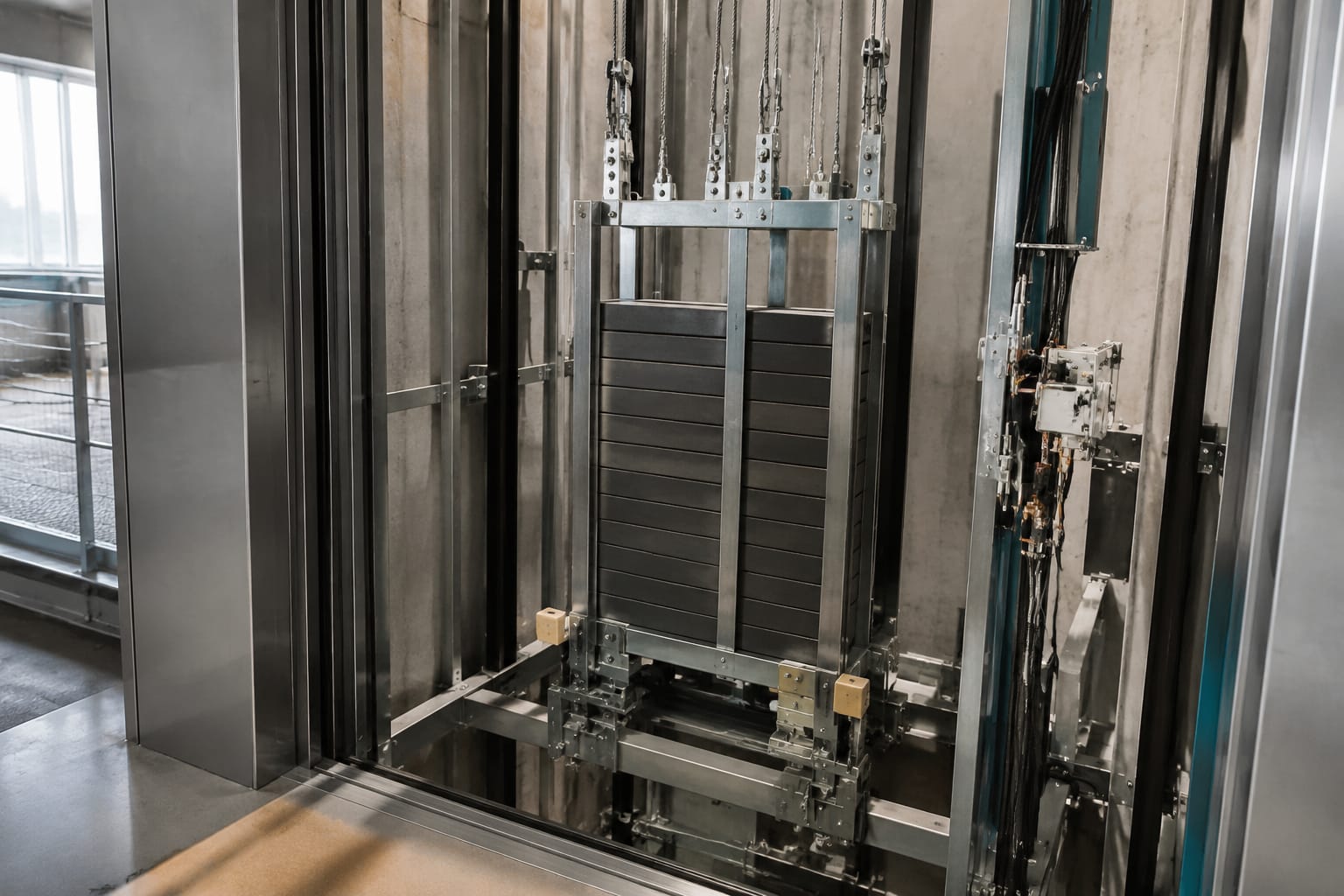
An elevator counterweight is the mass that balances the car and a portion of its rated load in a traction elevator. By reducing the work the motor must do when moving the car, it supports efficient travel, controllable traction and predictable braking behaviour.
The counterweight is more than a stack of heavy blocks. Its frame, filler weights, guide shoes, suspension connections, compensation equipment and clearances all affect safe operation. For maintenance teams and buyers, correct identification matters because a poorly matched component can create excessive wear, interference or a serious safety risk.
Why traction elevators use counterweights
A traction elevator lifts the car using ropes or belts that pass over a traction sheave. The car hangs on one side and the elevator counterweight hangs on the other. The drive moves the difference between their masses rather than lifting the full car weight on every journey.
In general, the counterweight is designed to balance:
- The empty car mass
- A defined proportion of the rated load
- In some designs, the mass contribution of suspension media and travelling cables
The exact balance point is set by the lift design. It is not a universal percentage that can be assumed during repairs or modernisation. Changing car finishes, adding equipment, replacing a machine or altering rated load can affect the balance calculation and may require engineering review.
What the balance achieves
A correctly configured counterweight reduces motor torque demand in normal service. It also helps maintain adequate traction between the sheave and the suspension media, particularly under varying passenger or goods loads.
However, a counterweight does not make an elevator self-balancing under every condition. A heavily loaded car and an empty car require the drive to work in opposite directions. The braking system, traction system, safety gear and control system each retain their own safety roles.
Counterweight versus hydraulic lifting systems
Counterweights are characteristic of traction lifts. Hydraulic elevators use a cylinder and hydraulic power unit to raise the car, so they generally do not use a conventional travelling counterweight. Before ordering parts, confirm that the installation is a traction system and establish whether the component belongs to the counterweight, car, governor or compensation arrangement.
Counterweight frame and filler weights
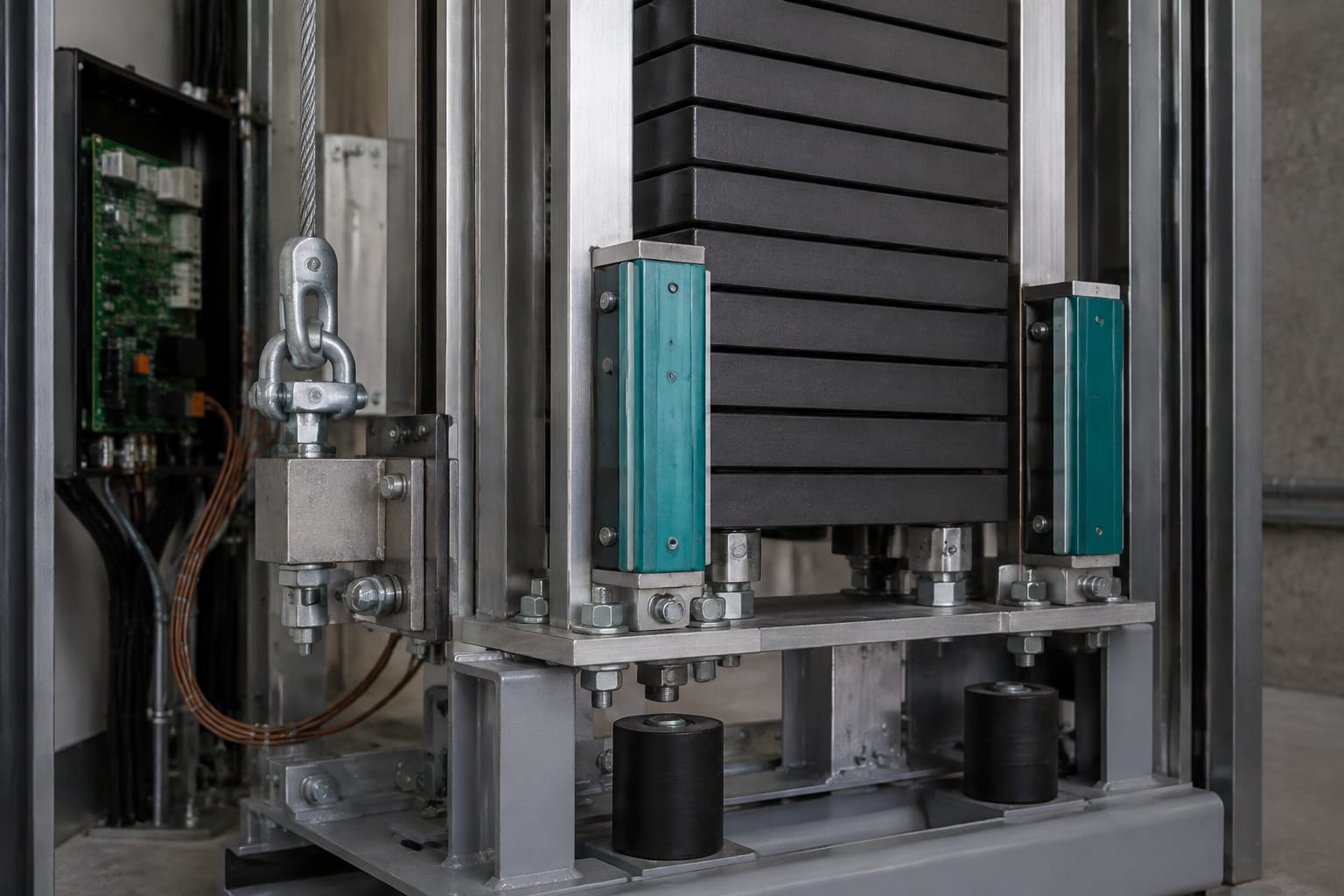
The counterweight frame, sometimes called the counterweight assembly or sling, holds the filler weights and transfers load to the suspension connections. It must retain its contents securely while travelling within the hoistway.
A typical assembly includes vertical stiles or channels, upper and lower members, a means of retaining filler weights, and mounting points for guide shoes. Designs differ substantially by manufacturer, rated load, travel, rail arrangement and suspension configuration.
Filler weights
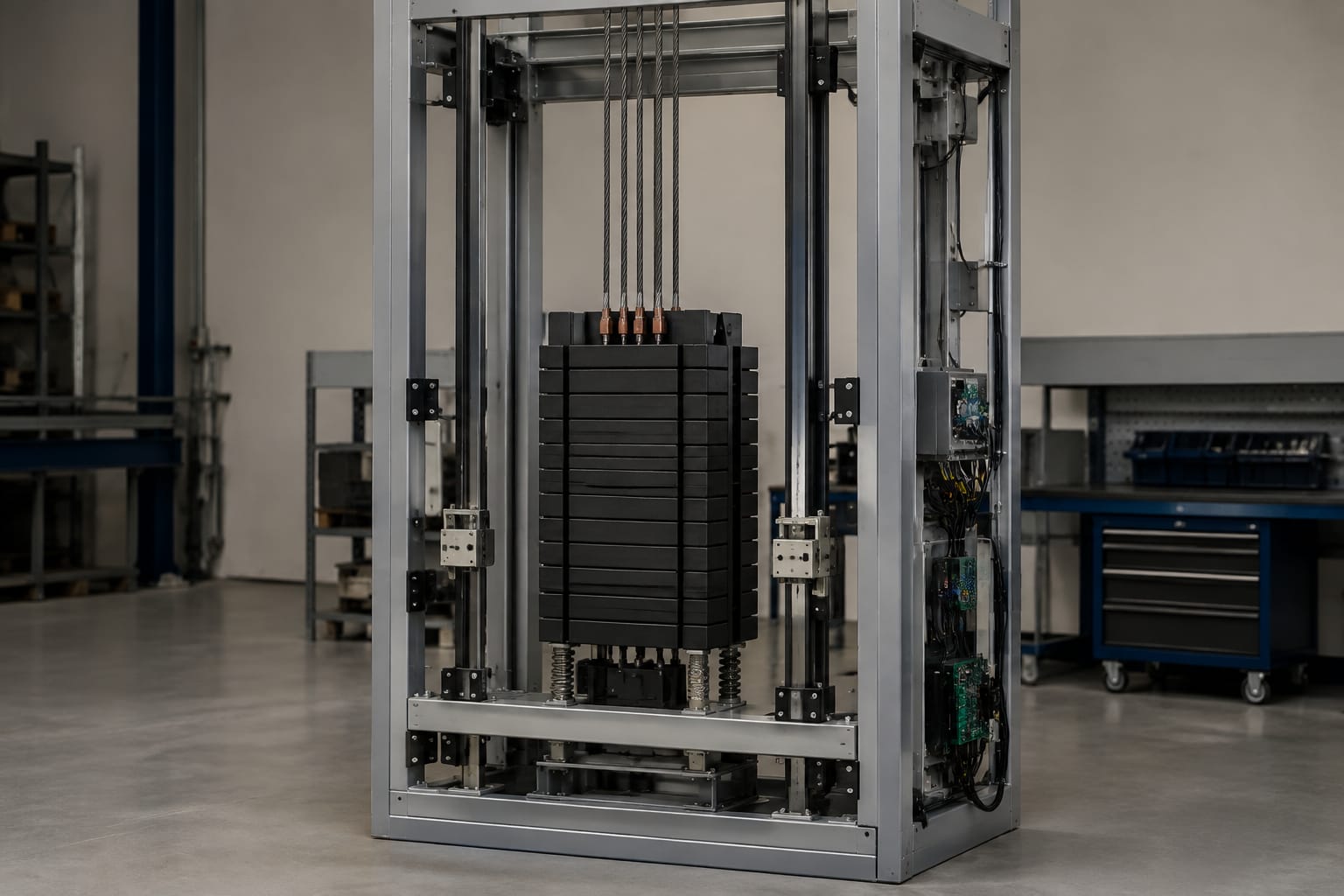
Filler weights are the individual masses installed within the frame to achieve the required counterweight mass. They may be cast iron, steel or another material specified for the particular lift. Their dimensions, thickness, mass and retaining method vary.
Do not select filler weights solely by overall mass. The following must be compatible with the existing frame:
| Check | Why it matters |
|---|---|
| Width, height and thickness | Incorrect dimensions can prevent proper seating or leave damaging movement in the frame. |
| Individual mass | The total counterweight mass must match the approved lift calculation. |
| Material and condition | Cracked, badly corroded or damaged weights may not remain reliable in service. |
| Retention method | The frame’s locking plate, tie rods, clips or other retainers must secure the exact weight stack. |
| Stack height | An over-height stack can prevent correct installation of the top retainer. |
Mixing arbitrary weights, loose steel pieces or improvised packing into a counterweight frame is unsafe. It can shift the centre of mass, compromise retention and invalidate the original arrangement.
Frame inspection points
During planned maintenance or a shutdown inspection, examine the frame for:
- Bent stiles, cross-members or weight retainers
- Loose, missing or damaged fasteners and locking devices
- Corrosion, particularly at lower members exposed to hoistway moisture
- Cracked welds or distortion around suspension connection points
- Evidence that filler weights are moving, chipping or rubbing
- Damage after a buffer engagement or car/counterweight overtravel event
Any concern at a load-bearing connection warrants assessment by a competent lift professional. Do not straighten, weld or modify a counterweight frame as a routine site repair unless this has been authorised under the applicable engineering process.
Guide shoes and guide rails
Counterweight guide shoes keep the assembly aligned on its guide rails. They limit lateral movement while allowing the counterweight to travel vertically with controlled clearance. The shoes also help prevent direct metal contact between the frame and rail under normal conditions.
Counterweight guide shoes can be sliding types with liners, or roller types, depending on the lift design and travel requirements. A sliding shoe usually has a replaceable liner or insert that bears against the rail. Roller guide shoes use wheels adjusted to contact the rail running surfaces.
The shoe must match the rail profile, mounting arrangement and counterweight frame. A product described as a guide shoe may look similar to another part but still be unsuitable because of its fixing centres, liner geometry, rail size or intended load.
For examples of component categories, Kelevator lists [counterweight hollow rail guide boots with toe boot lining](/products/counterweight-hollow-rail-w-boot-toe-boot-lining-lift-parts-elevator-accessories/) and [M-type counterweight rail guide boot linings](/products/counterweight-hollow-rail-w-m-type-boot-lining-lift-accessories-elevator-spare-parts/). Confirm the actual drawing, measurements and application before treating any listed part as interchangeable.
Signs of shoe or rail problems
Common field findings include:
- Worn liners or rollers causing increased side play
- Scoring, pitting or contamination on rail running surfaces
- Uneven shoe wear indicating rail alignment or frame issues
- Loose shoe brackets or damaged fixing bolts
- Abnormal noise as the counterweight travels
- Binding near rail joints, clips or bracket positions
Lubrication requirements differ by guide-shoe type and manufacturer. Adding lubricant where a dry-running liner is specified can collect dust and worsen wear. Conversely, operating a system intended to be lubricated without the required lubrication can damage both liner and rail. Follow the equipment documentation and maintenance procedure.
Compensation and suspension connections
The counterweight suspension connections carry a significant load and are safety-critical. Depending on the system, ropes, coated steel belts or other approved suspension media terminate at the car and counterweight through specified shackles, hitch plates, wedge sockets or other terminations.
The components must be installed in the correct orientation, with the specified retention hardware and equalisation arrangement. A visually similar socket or shackle is not necessarily compatible with the rope diameter, termination method, load path or manufacturer’s system.
Where the lift has substantial travel, compensation equipment may be installed to offset the changing weight of suspension media as the car moves. This can include compensation ropes or chains, tensioning devices, pulleys and their connections. Compensation components must have adequate clearance throughout travel and must not foul buffers, rails, brackets, travelling cables or pit equipment.
What to verify during inspection
Inspectors should check, within the maintenance scope and access conditions:
- Condition and security of suspension terminations
- Equal seating and tension where the system requires it
- Wear, corrosion or deformation of connection hardware
- Security and condition of compensation rope or chain attachments
- Free movement of compensation tensioning equipment
- Damage, rubbing or entanglement at the bottom of travel
- Correct position of guards where fitted
Suspension media inspection and replacement criteria are manufacturer-specific. Do not rely on a general visual check alone to decide that ropes or belts are fit for continued operation.
Clearance and retention considerations
A counterweight must remain within its designed travel path without contact with the car, landing equipment, hoistway walls, brackets or other lift components. Clearances are part of the overall lift design, and they can change after alterations such as rail replacement, car refurbishment, machine replacement or buffer work.
The bottom of the counterweight travel requires particular attention. In a traction lift, the counterweight approaches its buffers when the car is at or near the top landing. The buffer type, location, stroke and condition must correspond to the lift design. The counterweight must not reach the buffer unexpectedly during normal operation.
Retention is not optional
The filler-weight retainer and associated locking arrangement must remain fully installed and secure. Counterweight frame parts are exposed to repeated vibration, movement and environmental contamination, so a retaining component that is loose, corroded or incorrectly fitted can become a serious hazard.
Never remove a retainer, guide shoe, suspension connection or filler weight while the counterweight is unsupported. The apparent stability of an idle lift does not prove that the assembly is safely secured.
Common clearance mistakes
Problems commonly arise when teams:
- Fit a replacement shoe without checking rail profile and fixing dimensions
- Add or remove weights without confirming the approved balance requirement
- Install a thicker liner that changes running clearance
- Overlook debris, water damage or stored materials in the pit
- Assume car and counterweight buffers are interchangeable
- Modify a frame to make an unverified part fit
A practical inspection should assess the full route of travel, not only the component that first appears worn.
Common wear and inspection findings
The interval and depth of inspection should follow the lift’s maintenance plan, site risk profile and applicable requirements. The following findings are common indicators for closer assessment:
| Finding | Likely concern | Practical response |
|---|---|---|
| Polished rail edges or metal swarf | Guide shoe liner or roller wear, misalignment, inadequate clearance | Inspect shoes, rail alignment and frame condition before replacing parts. |
| Cracked or missing liner | Reduced guidance and possible rail damage | Remove the lift from service if safe operation is in doubt; replace with a verified compatible liner. |
| Loose filler weights | Failed retention, incorrect stack or frame distortion | Secure the area and investigate the complete frame and retainer arrangement. |
| Corroded lower frame members | Loss of section, weakened fixings or water ingress | Assess severity and resolve the source of moisture as well as the damaged component. |
| Counterweight noise or vibration | Shoe wear, rail condition, loose parts or suspension concerns | Inspect through travel; do not assume adjustment alone will fix the cause. |
| Buffer marks or impact damage | Possible overtravel, incorrect clearances or abnormal event | Investigate cause before returning the lift to normal service. |
A part can show normal cosmetic wear without requiring immediate replacement, while a small crack at a connection point may require urgent action. The deciding factor is its effect on load retention, guidance, clearance or safe travel.
Replacement-part identification
The best replacement part is one confirmed against the installed equipment, not simply the closest visual match. This is especially important in modernisation projects, where a lift may contain original rails, replacement doors, a newer controller and non-original guide components.
Build a clear identification record before requesting quotations or ordering stock.
Information to record
For an elevator counterweight component, collect:
- Lift manufacturer, model and installation reference where available.
- Counterweight frame photographs from front, side, top and fixing locations.
- Part number, casting mark or label from the removed component.
- Overall dimensions, mounting-hole centres and thickness.
- Rail type and relevant rail-head measurements for guide shoes or liners.
- Quantity required and whether left- and right-hand parts differ.
- Filler-weight dimensions, quantity and total approved mass where weights are involved.
- Details of associated fasteners, retainers and shims.
- Reason for replacement, such as wear, impact damage or a modernisation change.
For a guide boot application that spans known multi-brand equipment, compare the component carefully with the [auxiliary rail guide boots for Mitsubishi and Otis applications](/products/auxiliary-rail-guide-boots-counterweight-hollow-rail-w-boot-head-boot-lining-suitable-for-mitsubishi-otis-elevator-accessories/). Brand references in a listing do not remove the need to verify the rail, fixing arrangement and specific lift configuration.
Questions to ask a supplier
A supplier can assess compatibility more effectively when the request includes measured evidence. Ask whether the proposed part is intended for the identified rail and mounting arrangement, whether liners and fasteners are included, and whether any adjustment or matching components are required.
For frames, filler weights and suspension-related parts, also confirm the approved design mass, load capacity and connection arrangement. A supplier should not be expected to infer a counterweight calculation from a photograph alone.
Kelevator supplies multi-brand elevator spare parts for B2B importers, distributors, maintenance contractors and OEM buyers. For sourcing work, a complete identification record helps compare suitable options without relying on a generic product name.
Safety precautions for counterweight work
Counterweight work exposes technicians to suspended loads, moving equipment, restricted hoistway access and potential crushing hazards. It should only be performed by competent, authorised personnel working under a suitable site procedure.
Key precautions include:
- Isolate the lift, prevent unintended operation and establish effective control of access.
- Position the car and counterweight only as required by the approved work method.
- Use properly rated lifting and support equipment for the expected load.
- Treat filler weights and frame components as heavy loads; plan manual handling and exclusion zones.
- Never stand beneath, reach beneath or work beneath an unsupported counterweight.
- Confirm that counterweight retainers, suspension connections and guide shoes are secure before restoring operation.
- Keep the pit clear, dry and adequately lit where practicable.
- Check that tools, loose hardware and temporary supports have been removed before testing.
- Carry out functional checks only after the assembly, guards and clearances have been verified.
Do not use the car as an improvised support for counterweight work, and do not bypass safety circuits merely to gain movement. The exact isolation, access and testing method must reflect the lift design and site rules.
FAQ
How heavy is an elevator counterweight?
Its mass depends on the car mass, rated load, suspension arrangement and the balance selected for that lift. There is no single correct counterweight weight across traction elevators. Confirm the approved calculation before adding, removing or replacing filler weights.
Can worn counterweight guide shoes cause ride problems?
Yes. Excessive clearance, damaged liners or worn rollers can allow movement that produces noise, vibration and rail wear. Similar symptoms can also result from rail alignment, loose frame parts or other hoistway issues, so inspect the full system before replacing shoes alone.
Are counterweight filler weights interchangeable?
Not automatically. Even where two weights have a similar mass, their dimensions, material, stack height and retention compatibility may differ. Use weights approved for the frame and lift design.
When should a counterweight frame be replaced?
Replacement or repair decisions depend on the extent and location of damage. Cracks, distortion, serious corrosion, damaged suspension connection points or failed retention features require competent technical assessment. Do not rely on cosmetic repair for a load-bearing frame.
For planned replacement work, start by documenting the installed counterweight assembly, rail and connection details. That record provides the basis for selecting compatible parts and determining whether a worn component points to a wider alignment, clearance or balance issue.