
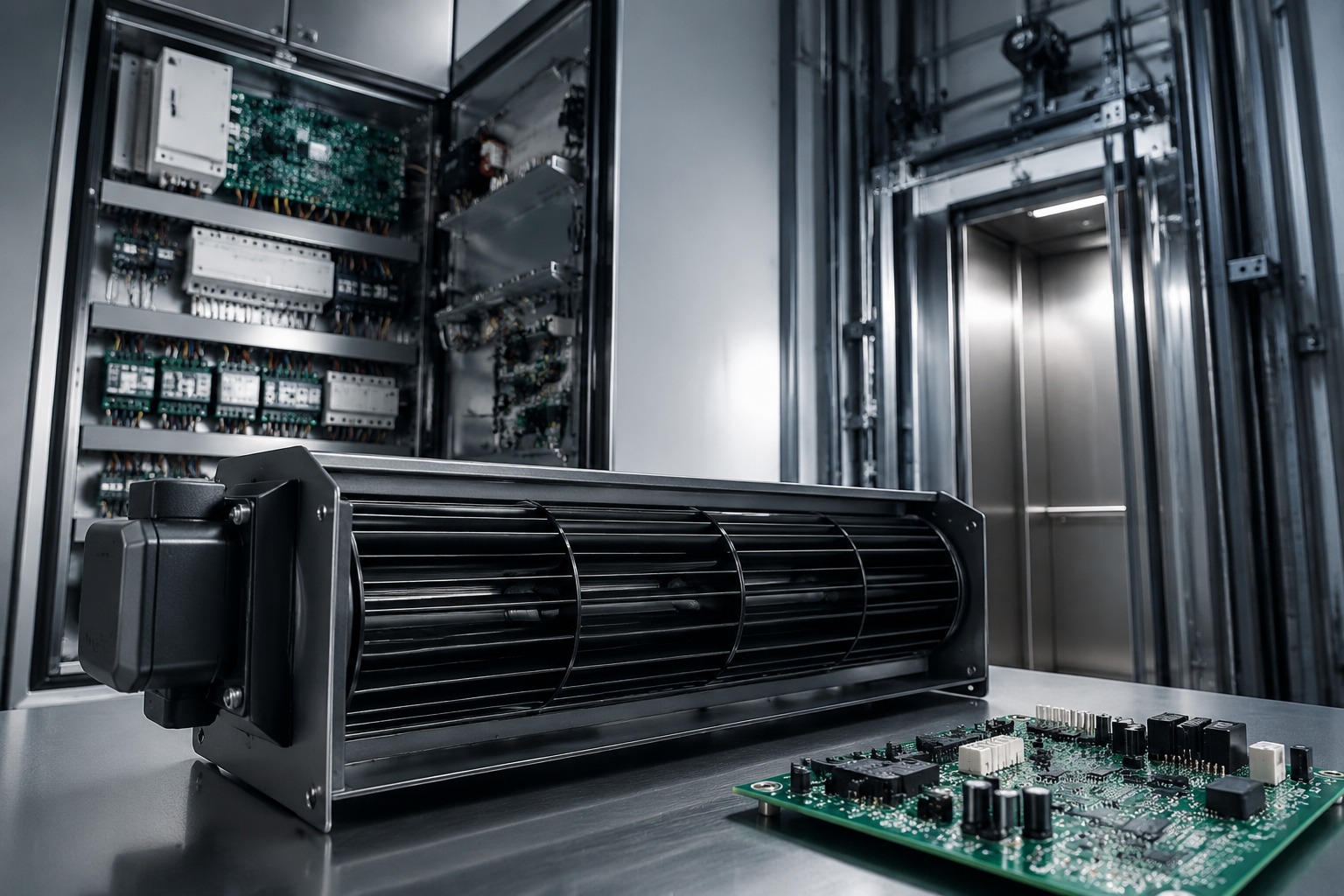
Elevator fans are small components with a large impact. In passenger lifts, they improve cabin comfort, support air circulation, and help reduce heat build-up during hot weather. In machine spaces, inverter cabinets, and control panels, they help remove warm air that can shorten the life of electronic parts. In South Africa, where building operators manage lifts in coastal humidity, inland dust, summer heat, and mixed power conditions, choosing the right fan is not just a comfort decision. It is a reliability decision.
The short answer is simple: cross flow fans are commonly chosen for elevator cabins and slim spaces where even air distribution matters, while axial fans are often used where direct high-volume airflow is needed, especially in cabinet ventilation. Correct selection depends on voltage, fan size, airflow requirement, mounting space, noise limits, and the operating environment. If a lift maintenance company or building owner matches these factors well, the result is better passenger comfort, longer component life, fewer nuisance shutdowns, and easier planned maintenance.
Across Johannesburg, Cape Town, Durban, Pretoria, Gqeberha, and Bloemfontein, lift service companies are seeing more demand for dependable replacement parts that are easy to match and quick to install. Buildings near the Port of Durban or Cape Town harbour may need more frequent dust and corrosion checks. Inland commercial towers in Sandton or Midrand may focus more on heat load, uptime, and stable airflow in modernised control cabinets. Residential towers often prioritise quiet operation, while hospitals, hotels, retail centres, and office parks need a balance of comfort and service continuity.
For buyers comparing lift ventilation parts, it helps to understand the product types. A cabin can use a long, slim blower such as a cross flow fan for elevator cabins when smooth air distribution is needed above the ceiling panel or behind a diffuser. Compact projects may use an H type cross flow fan for lift applications where mounting dimensions are specific. For direct air exchange in cabinets or openings, an axial flow fan for elevator equipment can be more suitable. Where the main need is cooling the drive and electronics, an inverter control cabinet fan is often the practical replacement choice.
Buying advice for the South African market should always start with model matching and operating conditions. The right fan is not only the one that physically fits. It must also match supply voltage, frequency, airflow direction, static pressure needs, mounting pattern, cable termination, and environmental exposure. A fan that looks similar but rotates at the wrong speed, draws the wrong current, or has poor bearing quality can create more downtime than the original fault.
Demand for elevator cooling and ventilation parts is rising with ongoing modernisation work in commercial buildings, mixed-use developments, public infrastructure, and older residential towers. Maintenance contractors often replace fans during larger repair work involving control boards, inverters, door operators, light curtains, power supplies, and COP parts. This is why many buyers prefer suppliers that can support broader lift spare parts sourcing, check compatibility carefully, and package fragile items securely for delivery across South Africa and neighbouring markets.
The growth trend above reflects a practical market reality: fan replacement demand often grows alongside equipment ageing, refurbishment of older lift systems, and increased awareness of preventive maintenance. In 2026, the market is expected to focus even more on energy efficiency, quieter operation, better dust resistance, and stronger attention to electronic cooling as inverter-driven lifts remain standard in many projects.
Where cross flow fans are used in elevators
Cross flow fans are used in elevators where long and even airflow is more important than a narrow blast of air. Their impeller design allows air to move across a wider length, making them well suited to lift cabin ventilation. In many elevators, the fan is mounted above the cabin ceiling panel, behind an air grille, or within a slim enclosure where space is limited but passenger comfort still matters.
In a passenger cabin, a cross flow fan can distribute air more uniformly from one side to the other. This helps reduce hot spots and improves the perceived comfort of occupants, especially during summer in cities such as Durban and Pretoria, where cabin heat can build quickly during frequent stops. Because airflow is spread over a longer outlet, the fan can often feel less harsh than a small high-speed axial unit.
Cross flow fans are also used in decorative cabin ceiling modules and modernised lift interiors where aesthetics matter. Hotels in Cape Town, office buildings in Sandton, and premium residential towers may prefer airflow that feels softer and creates less audible turbulence. In some lift designs, the fan works with a filter, grille, or lighting panel, so the slim linear format of a cross flow fan becomes a practical advantage.
Beyond the passenger area, some equipment spaces with restricted geometry may also use cross flow designs if a broad and low-profile air curtain effect is needed. However, for most cabinet cooling duties, axial or dedicated cabinet fans remain more common.
| Elevator location | Typical use of cross flow fan | Main benefit | Common concern | Recommended check | Typical priority in South Africa |
|---|---|---|---|---|---|
| Passenger cabin ceiling | Primary cabin ventilation | Even airflow across cabin width | Dust on grille | Air outlet cleanliness | Passenger comfort |
| Cabin decorative panel | Ventilation hidden behind trim | Low-profile installation | Limited service access | Panel removal clearance | Modernisation fit |
| Small residential lift cabin | Quiet air movement | Reduced harsh airflow sensation | Low ceiling space | Mounting dimensions | Noise control |
| Hotel passenger lift | Comfort-focused circulation | Better guest experience | Appearance and noise | Fan balance and grille finish | Premium comfort |
| Hospital lift cabin | Steady ventilation during high use | Improved ride comfort | Hygiene and filter upkeep | Cleaning schedule | Operational continuity |
| Modernised older cabin | Replacement of outdated slim fan | Easy integration with existing layout | Model compatibility | Voltage and size matching | Fast retrofit work |
This table shows why cross flow fans appear so often in cabins rather than in general machinery cooling. Their shape and airflow pattern fit the realities of elevator interior design. When selecting a replacement, maintenance teams should measure the original fan length, diameter, bracket spacing, and wire exit direction before ordering.
Commercial offices and residential towers lead demand because they have large installed bases and steady maintenance cycles. Hospitals and hotels, while smaller in volume, often place a higher value on low noise and reliable climate control inside the lift cabin.
Cross flow fan versus axial flow fan
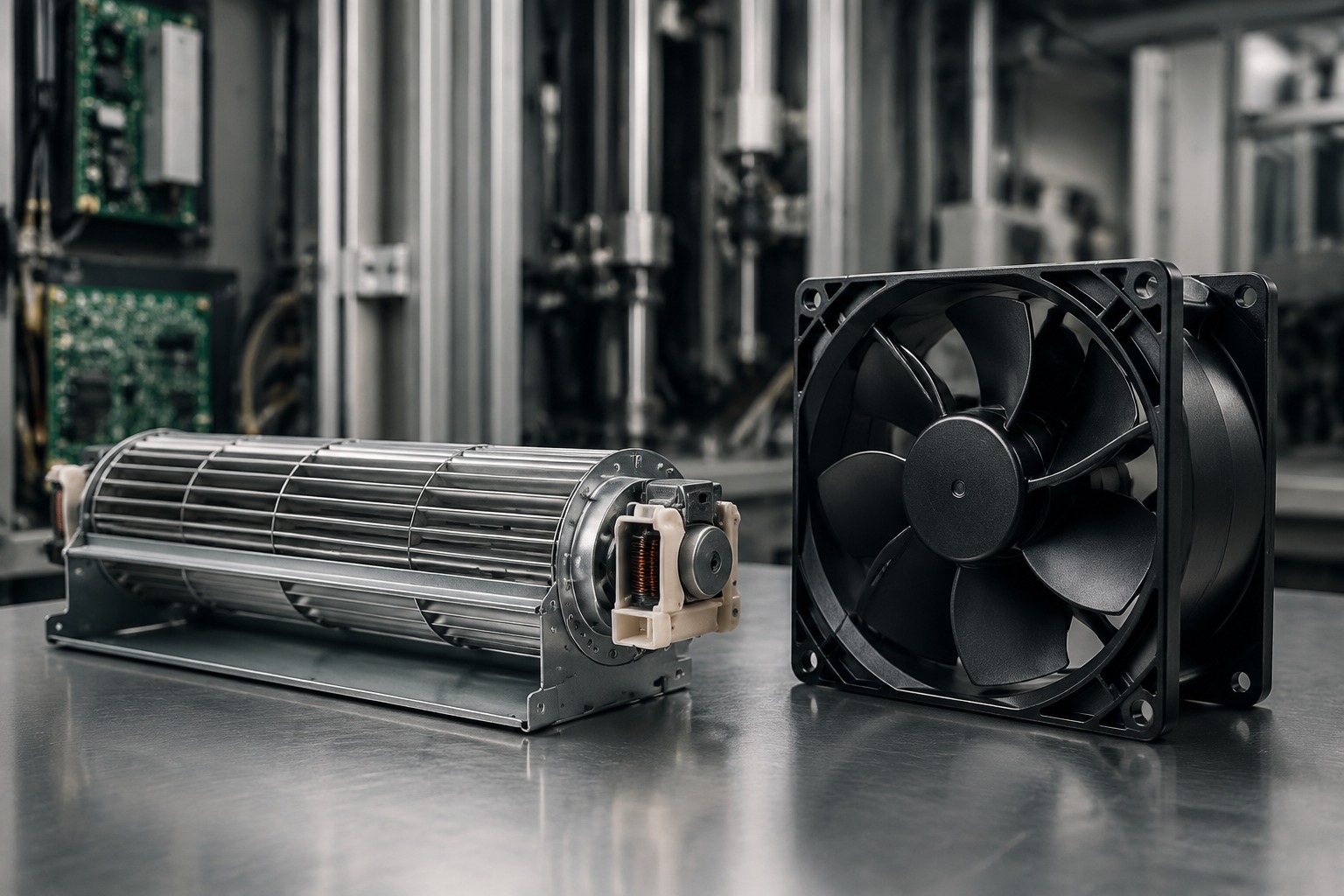
The difference between cross flow and axial flow fans is not only shape. It affects airflow pattern, pressure characteristics, mounting style, and the user experience inside the lift. A cross flow fan moves air across a long impeller and delivers a broad, curtain-like flow. An axial fan pushes air forward in line with its motor shaft and is usually more compact for direct ventilation openings.
For cabin comfort, a cross flow fan often wins because it spreads air more evenly and can suit a slim ceiling assembly. For cabinet cooling, an axial fan often wins because it can move air directly through a vent or across a heat source with simple mounting and replacement. However, the best choice still depends on the original design of the lift. Replacing one type with another without checking airflow path, fixing points, and electrical ratings can cause poor cooling or excessive noise.
Technically, cross flow fans are usually preferred when designers want a wider air outlet and a more distributed stream. Axial fans are usually preferred when airflow must move directly from intake to exhaust through a grille or cabinet opening. In dusty inland environments, axial fans may require more regular blade cleaning because build-up can affect performance and balance. Cross flow fans can also collect dust along the long impeller and should not be ignored.
| Comparison factor | Cross flow fan | Axial flow fan | Best use case | Main advantage | Main limitation |
|---|---|---|---|---|---|
| Airflow pattern | Wide and even | Direct and concentrated | Cabin comfort vs cabinet exhaust | Better distribution or direct flow | Depends on layout |
| Typical mounting shape | Long and slim | Round or square compact frame | Ceiling module or vent panel | Good fit for different spaces | Not always interchangeable |
| Noise perception | Often smoother in cabin use | Can be louder at higher speed | Passenger areas | Comfort or strong cooling | Noise increases with speed |
| Cabinet cooling suitability | Limited in most standard cabinets | Very common | Drive cabinet ventilation | Simple replacement | May need grille/filter check |
| Air outlet coverage | Long outlet area | Localised stream | Wide cabin ceiling opening | More uniform circulation | Lower direct throw |
| Replacement matching | Length and bracket accuracy important | Voltage and frame size critical | Maintenance sourcing | Easy if data plate is clear | Errors cause rework |
This comparison matters when buyers evaluate stock options. A professional supplier should help confirm not just the fan type, but also model dimensions, electrical details, bearing quality, and compatibility with the original lift brand or retrofit arrangement. That is especially useful when dealing with mixed portfolios containing Hitachi, Toshiba, KONE, Mitsubishi, and other systems in one service route.
The trend shift suggests that cabin modernisation projects are increasingly choosing refined airflow solutions, while axial fans remain dominant in control cabinet replacements. For 2026, sustainability goals are likely to push both categories toward better energy efficiency, longer bearing life, and improved recyclable materials in housings and packaging.
How to select voltage size and airflow
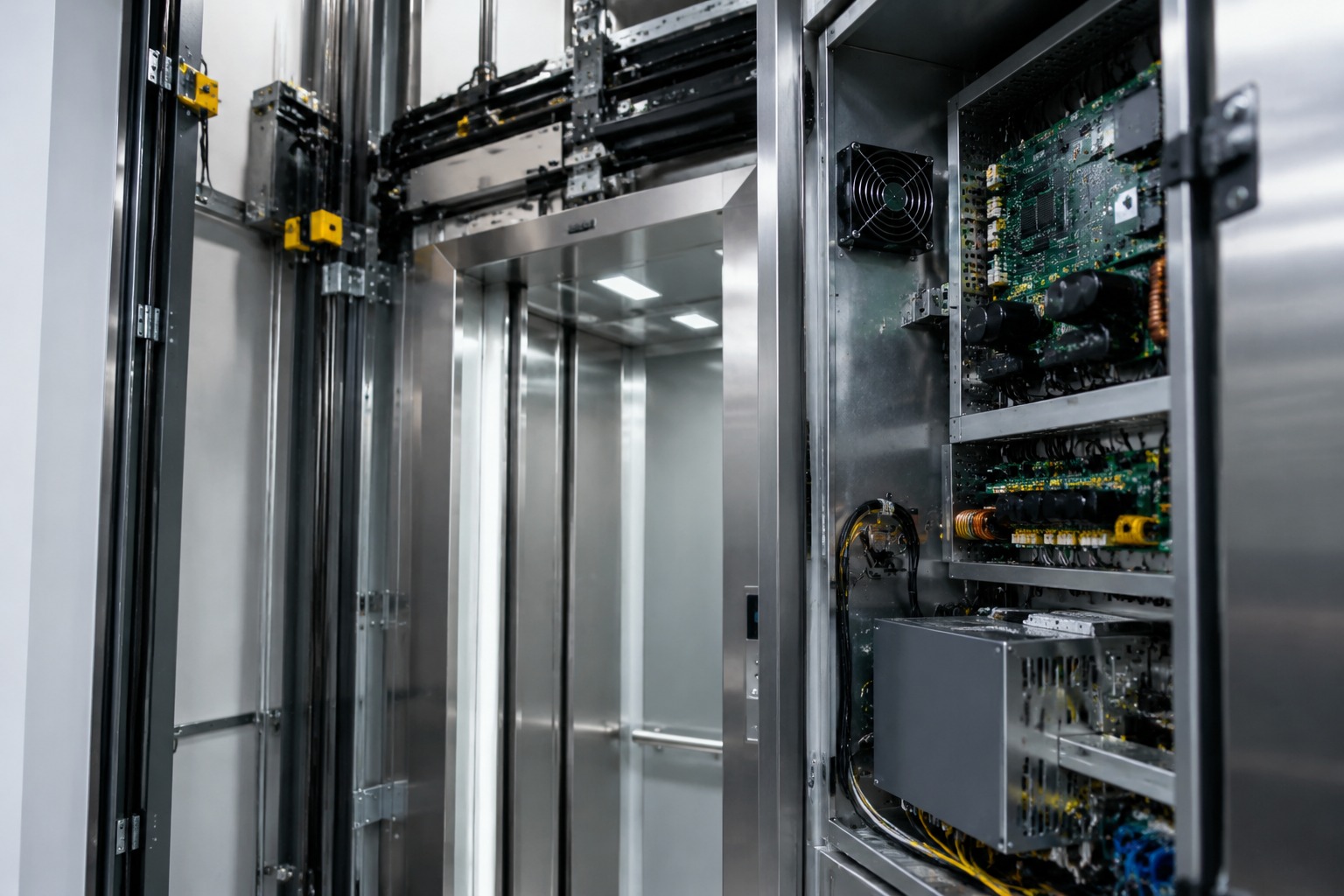
Correct fan selection starts with three basic questions: what is the supply voltage, what physical size fits, and how much airflow is required? In elevator work, these questions must be answered from the actual equipment, not from assumptions. A cabin fan and a cabinet fan may look similar but can operate on different voltages, frequencies, and current ratings.
Voltage is the first non-negotiable factor. Common ratings may include AC 110V, 220V, or 230V, and DC variants in some assemblies. South African buildings generally use local electrical standards that require proper verification at the lift side before replacement. Never install a fan on guessed voltage. An incorrect voltage can cause immediate failure, low speed, overheating, or dangerous wiring problems.
Size includes length, diameter, frame dimensions, hole spacing, thickness, and cable exit position. In a cross flow fan, even a small difference in total length or bracket offset can prevent proper fitting behind the cabin ceiling panel. In an axial cabinet fan, the frame size and airflow direction must align with the cabinet vent design.
Airflow selection depends on the cooling goal. For a cabin, the aim is comfort and fresh-feeling circulation, not extreme velocity. For an inverter cabinet, the aim is heat removal across drives, control boards, and power electronics. If airflow is too low, heat builds up and electronic life may reduce. If airflow is excessive or badly directed, it may increase dust ingestion without improving real cooling.
| Selection factor | What to verify | Why it matters | Common mistake | Result of mistake | Best practice |
|---|---|---|---|---|---|
| Voltage | Nameplate and measured supply | Electrical safety and proper speed | Assuming all fans are 220V AC | Burnout or underperformance | Check label and circuit drawing |
| Frequency | 50 Hz compatibility | Motor speed consistency | Ignoring frequency rating | Unexpected airflow level | Match original specification |
| Fan dimensions | Length, width, frame, hole spacing | Correct installation fit | Ordering by appearance only | Bracket mismatch | Measure and photograph old unit |
| Airflow direction | Intake and exhaust path | Effective ventilation | Installing reversed orientation | Poor cooling | Mark direction before removal |
| Airflow volume | Cabin comfort or cabinet heat load | Cooling effectiveness | Choosing highest airflow blindly | Noise or extra dust | Select balanced performance |
| Current draw | Rated amperage | Circuit protection compatibility | Ignoring load on control circuit | Fuse trips or stress | Confirm against original unit |
The table above is useful because fan replacement errors usually come from one of these six points. Good procurement practice is to collect a clear nameplate photo, overall dimensions, connector style, and installation photos. This reduces delay and avoids ordering a part that is close, but not actually compatible.
| Application | Typical fan type | Voltage examples | Selection priority | Noise target | Airflow target approach |
|---|---|---|---|---|---|
| Passenger cabin in office tower | Cross flow | AC 220V to 230V | Even airflow and fit | Low to moderate | Comfort based |
| Residential cabin | Cross flow | AC 220V to 230V | Quiet operation | Low | Gentle circulation |
| Inverter cabinet | Axial or cabinet fan | AC or DC by design | Heat removal | Moderate acceptable | Component cooling based |
| Controller panel | Axial | AC 220V or DC variants | Compact size and direct flow | Moderate | Targeted ventilation |
| Hotel cabin modernisation | Cross flow | Match original | Appearance and comfort | Very low | Uniform distribution |
| Industrial service lift | Axial or robust cross flow | Match original | Durability in dusty use | Less critical | Practical cooling priority |
For South African maintenance companies working across different regions, airflow needs may vary with building design and climate. A beachfront property in Durban may need close attention to corrosion protection and enclosure sealing. A mining-related facility in the Northern Cape may place greater emphasis on dust management and rugged maintenance intervals. The right supplier should help compare options and recommend suitable replacements instead of pushing a one-size-fits-all part.
Inverter cabinet fan replacement notes
Inverter cabinets are highly sensitive to heat. The fan inside the cabinet is not an accessory; it is part of the protection strategy for drives, control boards, power modules, and power supplies. When replacing an inverter cabinet fan, the technician should first inspect whether the fault is the fan itself, a clogged filter, a blocked vent path, a failed thermostat, a damaged connector, or a control issue.
Replacement should begin with safe isolation, verification of stored energy discharge, and inspection of the old unit. Important details include voltage, current, connector type, airflow direction, frame size, and whether the original uses sleeve bearings or ball bearings. In hotter duty cycles, higher quality bearings are often preferred because they tolerate continuous operation better.
Cabinet fan replacement in South Africa often requires extra attention to site conditions. Dust in inland commercial areas, cement dust on construction-related sites, and salty moisture in coastal environments can all reduce fan life. If the fan failed early, the team should ask why. Replacing the part without addressing dust loading, blocked filters, or cabinet temperature rise can lead to repeat failures.
| Replacement checkpoint | What to inspect | Reason | Risk if ignored | Action | Recommended outcome |
|---|---|---|---|---|---|
| Power isolation | Lockout and discharge status | Technician safety | Electrical hazard | Follow site procedure | Safe access |
| Fan label | Voltage, current, model | Correct sourcing | Wrong replacement | Record data before removal | Accurate order |
| Airflow direction | Arrow on housing or actual path | Cabinet cooling efficiency | Heat retention | Mark orientation | Correct circulation |
| Filter condition | Dust blockage and oil film | Maintains airflow | Repeat overheating | Clean or replace filter | Stable cooling |
| Connector and wiring | Terminal quality and insulation | Reliable operation | Intermittent fan fault | Repair damaged wiring | Secure electrical connection |
| Cabinet temperature | Signs of overheating | Checks root cause | Drive damage continues | Measure and log temperature | Longer electronics life |
This replacement checklist matters because cabinet cooling faults are rarely isolated events. In many cases, the failed fan is the visible symptom of a larger ventilation problem. A thorough approach reduces repeat callouts and protects expensive electronics.
Our role in this part of the supply chain is built on careful model matching. For maintenance contractors handling multiple elevator brands, technical support must focus on the exact fan specification, not only a generic description. We help buyers compare part markings, dimensions, and replacement conditions so that compatible sourcing is more reliable, especially when a control cabinet fan is needed urgently to reduce downtime.
Noise vibration and dust checks
Noise, vibration, and dust are the three most common warning signs that an elevator fan needs attention. In a cabin, passengers may report a rattling ceiling, humming, or an airflow noise that became worse over time. In a control cabinet, technicians may hear bearing roughness, fan imbalance, or a speed drop caused by contamination.
Noise can come from several sources: worn bearings, loose mounts, fan blade imbalance, grille interference, or resonance in the ceiling panel. Vibration can transfer into the lift cabin and create a poor passenger experience. Dust reduces airflow, increases motor load, and can unbalance the impeller. In cabinet fans, dust also makes electronics cooling less effective, especially around inverter heat sinks.
South Africa presents different dust and contamination patterns by region. Urban business districts may collect fine building dust through service openings. Industrial corridors can expose equipment to heavier airborne particles. Coastal sites near Durban and Cape Town may experience corrosion that affects fan housings, connectors, and bearing life. Because of these differences, inspection routines should be adapted to the environment rather than applied identically at every site.
| Observed symptom | Likely cause | Where common | Operational effect | Inspection method | Corrective action |
|---|---|---|---|---|---|
| Rattling sound in cabin | Loose bracket or panel contact | Cabin cross flow fan | Poor passenger comfort | Manual check of mounts | Tighten and isolate vibration |
| Grinding noise | Bearing wear | Cabin or cabinet fan | Impending failure | Listen during operation | Replace fan |
| Weak airflow | Dust build-up or low speed | All fan types | Reduced ventilation | Visual and airflow check | Clean or replace unit |
| Intermittent stopping | Connector fault or motor issue | Cabinet fan | Overheating risk | Electrical continuity test | Repair wiring or replace |
| Panel vibration | Imbalance or poor mounting | Cabin installation | Noise complaint | Observe at different speeds | Rebalance or remount |
| Corrosion marks | Humidity or salty air | Coastal buildings | Shorter service life | Visual surface inspection | Use better protected replacement |
For modern maintenance teams, a simple inspection log can make a big difference. Record fan noise level by observation, dust condition, fastening status, and airflow performance. Patterns across multiple lifts in the same building can reveal environmental causes that individual repairs might miss. This is especially helpful in shopping centres, public transport hubs, and hospitals where lift traffic is high.
Installation and wiring tips
Correct installation matters as much as correct selection. A high-quality replacement fan can still perform badly if it is mounted under stress, wired incorrectly, or blocked by a misaligned grille. Before installation, compare the new part with the old one side by side. Confirm the direction of rotation where relevant, the airflow direction arrow, terminal markings, and hardware length.
In cabin fan installations, avoid over-tightening brackets against thin sheet metal or decorative ceiling panels. This can create resonance and noise. If the original design used rubber isolation or spacers, reuse or replace them appropriately. Ensure that wires are secured away from moving parts and sharp edges. Verify that the air path is not blocked by insulation, lighting modules, or poor panel alignment.
For cabinet fans, wiring must match the control design. Some fans run continuously; others operate through a thermostat or control board output. Never bypass the intended control logic without checking the system design. If a cabinet uses filters, replace dirty filters when installing the new fan. A new fan placed behind a blocked filter will not solve the heat problem.
From a manufacturing perspective, consistency in fan frame accuracy, insulation quality, balancing, and packaging protection all affect installation success. Reliable sourcing is not only about supplying a part. It is about reducing the chance of bent frames, connector damage, or dimensional deviations that waste technician time on site. For buyers managing stock across South Africa, protective packaging is especially important when parts travel long distances to regional service points.
| Installation step | Cabin fan tip | Cabinet fan tip | Main risk | Check after fitting | Expected result |
|---|---|---|---|---|---|
| Compare old and new part | Match length and brackets | Match frame and airflow | Wrong part installed | Visual confirmation | Correct fit |
| Mounting | Avoid panel stress | Seat evenly on frame | Vibration and noise | Fastener torque check | Stable operation |
| Wiring | Secure away from grille | Follow circuit logic | Short circuit or misoperation | Continuity and insulation check | Safe energising |
| Airflow verification | Check cabin outlet spread | Check intake/exhaust path | Ineffective ventilation | Functional run test | Expected cooling |
| Noise check | Listen with panel closed | Listen under load | Hidden resonance | Short operational test | Quiet running |
| Final housekeeping | Clean grille and ceiling area | Replace filter and clean cabinet | Dust returns quickly | Visual inspection | Improved service life |
After installation, it is good practice to monitor the unit briefly during normal operation. In a cabin, listen with doors closed and during travel. In a cabinet, confirm that the cooling path is working after the inverter reaches operating temperature. A fast test at installation stage is far cheaper than a return visit.
Maintenance schedule for elevator fans
A maintenance schedule for elevator fans should match traffic level, environment, and criticality. A quiet residential building may only need routine cleaning and checks during scheduled visits. A high-use hospital, office tower, or coastal building may need more frequent inspection. Planned maintenance is usually cheaper than emergency replacement, especially for cabinet fans protecting costly electronic assemblies.
Technological capability is important here. Effective support goes beyond supplying a fan; it includes helping customers identify the right model, compare dimensions and labels, and reduce mismatch risk. For maintenance companies handling varied equipment portfolios, access to responsive technical checking can shorten diagnosis time and avoid ordering delays. This is particularly useful when fan replacement is part of a broader repair involving control boards, door operators, sensors, encoders, power supplies, or intercom parts.
| Maintenance interval | Cabin fan task | Cabinet fan task | Environment factor | What to record | Action threshold |
|---|---|---|---|---|---|
| Monthly visual check | Listen for unusual noise | Check fan running status | High traffic sites | Noise and operation status | Immediate if stopped |
| Quarterly cleaning | Clean grille and dust | Clean vent and filter area | Dusty urban or industrial areas | Dust level | Clean when airflow drops |
| Six-month inspection | Check mount tightness | Check wiring and airflow path | All sites | Fasteners and cable condition | Repair if loosened |
| Annual performance review | Assess comfort and noise | Check cabinet temperature trend | Commercial buildings | Passenger complaints and heat readings | Replace if degraded |
| Coastal extra check | Inspect corrosion on frame | Inspect terminals and housing | Durban, Cape Town coastal zones | Corrosion severity | Replace on material attack |
| End-of-life planning | Replace before failure in critical lifts | Plan preventive cabinet fan change | Hospitals and premium sites | Age and operating hours | Pre-emptive replacement |
This schedule gives maintenance teams a practical baseline. It should be adjusted based on actual site history. If a cabinet fan in a hot equipment room has already failed once in a short period, increase inspection frequency and investigate the wider cooling environment. If a cabin fan runs quietly and cleanly for years in a low-use residential block, routine checks may be sufficient without over-servicing.
This comparison shows what serious buyers usually value most in a supplier relationship: reliable model identification, stable quality control, secure packaging, and fast service. Service capability is especially important when maintenance teams need compatible replacement parts quickly to keep elevator systems operating safely and reduce downtime across multiple sites.
FAQ about elevator fans
How do I know whether my elevator needs a cross flow fan or an axial fan?
Check the original design first. Cabin ceiling ventilation commonly uses cross flow fans because they provide wide, even airflow. Control cabinets and inverter enclosures more often use axial or dedicated cabinet fans because they push air directly through the enclosure.
Can I replace a cross flow fan with an axial fan if the voltage is the same?
Usually not without redesign. Even if voltage matches, the airflow pattern, mounting, space requirement, and noise profile are different. Direct substitution may reduce comfort or cooling performance.
What is the most important data to send when asking for a replacement?
Send a clear photo of the nameplate, overall dimensions, mounting hole spacing, connector style, and installation photos showing the old fan in place. This greatly improves matching accuracy.
Why does a new fan still sound noisy after installation?
The cause may be loose brackets, grille contact, ceiling panel resonance, poor balance, or dust left in the system. Noise is not always caused by the fan alone.
How often should inverter cabinet fans be replaced?
There is no universal fixed interval. Replace based on running condition, heat exposure, site contamination, and criticality. In high-duty or dusty sites, preventive replacement may be justified before failure.
Are coastal buildings harder on elevator fans?
Yes. Salty moisture can accelerate corrosion on fan frames, terminals, and bearings. Buildings near Durban and Cape Town often need closer inspection intervals and attention to protective materials.
Do elevator fans affect component life?
Yes. Cabinet fans help control the temperature of inverters, control boards, and power-related electronics. Stable cooling can support longer service life and reduce nuisance faults caused by heat.
What should South African buyers expect in 2026?
The 2026 trend points toward quieter fans, higher efficiency motors, better dust management, improved cabinet airflow design, and stronger focus on sustainability. Building owners are likely to give more attention to preventive cooling checks as energy efficiency and system uptime become more important. Policy and procurement trends may also favour parts with consistent quality, traceable specifications, and reduced waste through better packaging and planned replacement cycles.
Can one supplier help with more than just elevator fans?
Yes, and that is often beneficial. Maintenance companies frequently need coordinated sourcing across control boards, inverter parts, door operator components, door locks, light curtains, guide shoes, oil cups, sensors, encoders, power supplies, buttons, COP panels, intercom parts, and other lift accessories. Working with a supplier that understands compatibility and service urgency can reduce procurement complexity.
In summary, elevator fan selection in South Africa should be practical, data-based, and environment-aware. Cross flow fans are widely used for cabin comfort and slim airflow distribution. Axial and cabinet fans remain essential for direct cooling of inverter and control spaces. The best results come from careful voltage and size matching, correct airflow selection, proper installation, and a maintenance schedule that reflects local dust, humidity, usage, and climate conditions. Whether the site is a residential tower in Johannesburg, a hospital in Pretoria, a hotel in Cape Town, or a coastal commercial building in Durban, the principles remain the same: choose the right fan, install it correctly, and maintain it before failure affects passengers or electronics.