
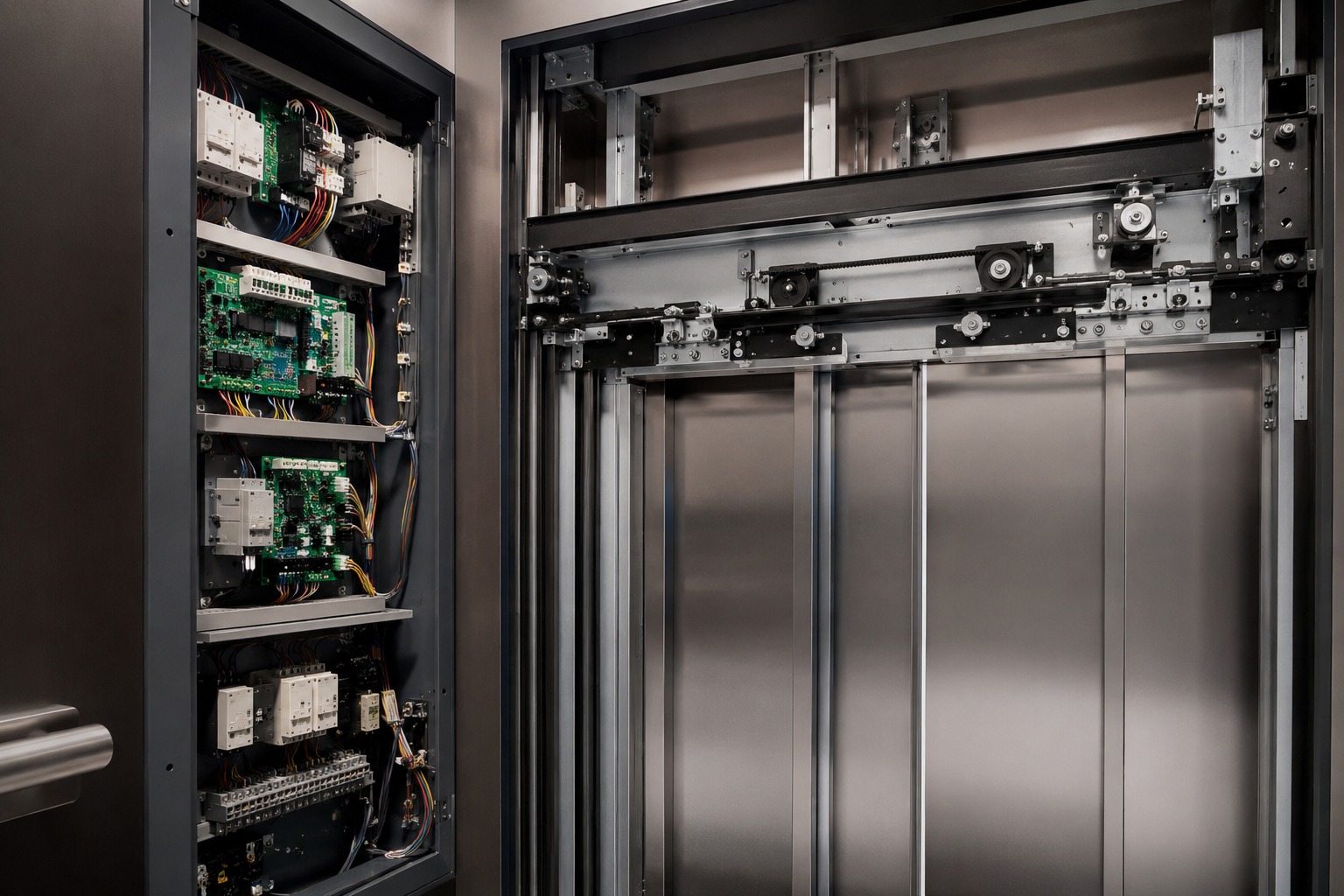
Elevator door control panels are the decision-making boards that coordinate the door motor, encoder or position sensor, limit inputs, lock circuits, and passenger protection devices so the lift doors open and close safely, smoothly, and at the correct speed. In South Africa, where maintenance teams often support mixed fleets in Johannesburg, Cape Town, Durban, Pretoria, and Gqeberha, a practical understanding of the door controller is essential for reducing downtime, avoiding repeat callouts, and matching the right replacement part the first time.
For technicians, building owners, modernization contractors, and distributors, the most important point is simple: when a door operator fails, the control panel is rarely working alone. The technician must evaluate the motor, track condition, hanger rollers, lock signals, light curtain, wiring harness, and controller parameters together. Replacing a board without checking field conditions can lead to the same fault returning within hours or days. This guide explains how to approach the full repair process, including Toshiba-specific replacement notes, speed and torque setup, signal verification, and post-replacement commissioning.
South Africa’s elevator service market includes commercial offices in Sandton, residential towers in Cape Town, hospitals in Pretoria, hotels in Durban, industrial facilities around Ekurhuleni, and public infrastructure near logistics corridors connected to the Port of Durban and Cape Town Harbour. Across these environments, the door system is one of the most frequently serviced elevator subsystems because it is the most exposed to dust, misuse, alignment drift, and high cycle counts. That is why door control panel knowledge has direct value for maintenance planning and spare parts purchasing.
Core Functions of Elevator Door Control Panels
An elevator door control panel manages the electrical and logical sequence of the door operator. In practical field terms, it receives commands from the main elevator controller, checks whether safety conditions allow movement, drives the door motor in the opening or closing direction, monitors travel feedback, adjusts speed transitions, and stops or reverses the door when a protection device is triggered. On modern systems, the board may also record faults, store parameter sets, and communicate operating status for troubleshooting.
When engineers ask what a door control panel actually does, the answer can be broken into seven tasks. First, it interprets commands such as open, close, nudge, dwell extension, and re-open. Second, it processes door lock and safety chain information before allowing motion. Third, it controls motor output through relays, transistors, or an inverter-based interface depending on the door operator design. Fourth, it uses encoder, hall sensor, or timing feedback to track door position. Fifth, it applies speed profiles so the doors accelerate, run, decelerate, and land smoothly. Sixth, it supervises current, torque, and obstruction response. Seventh, it reports faults when expected feedback does not match actual movement.
In high-traffic buildings, proper control panel operation affects more than comfort. Door timing directly influences handling capacity, queue times, and the number of nuisance callbacks. If opening force is weak, doors may stall. If torque is too high, the doors may slam or cause repeated obstruction events. If sensor inputs are noisy, the lift may remain out of service even though the mechanical parts appear normal. This is why experienced elevator technicians view the door controller as the interface between electronics, mechanics, and passenger safety.
For South African maintenance teams dealing with older installations, imported systems, and partial modernizations, one common challenge is mixed documentation. The lift may contain an original operator, a replacement motor from another series, and a locally repaired harness. In those cases, careful model matching is more important than assuming that any visually similar board will work. Our role as a professional elevator parts supplier is to help customers identify compatible boards, reduce mismatch risk, and protect sensitive electronics during delivery to sites across the country.
| Door Control Panel Function | What It Monitors or Commands | Typical Components Involved | Common Failure Symptom | Field Impact | Recommended Check |
|---|---|---|---|---|---|
| Open command processing | Signal from main controller or car station | Main controller I/O, relay input, wiring | Door does not open on arrival | Passenger delay | Measure input voltage and inspect connectors |
| Close command processing | Door dwell timer and close signal | Board logic, timer parameter | Door remains open too long | Reduced handling capacity | Verify close command and dwell setting |
| Motor drive control | Direction, voltage, current, PWM or inverter command | Drive stage, motor, contactors | Jerky or no movement | Frequent shutdowns | Check output stage and motor resistance |
| Position feedback | Door position or speed feedback | Encoder, hall sensor, limit switches | Stops midway or overshoots | Unsafe door travel | Read pulses and sensor stability |
| Obstruction detection | Current rise, sensor trigger, reversal logic | Light curtain, current sensing circuit | Repeated reopening | Service interruption | Test sensor beam and current threshold |
| Door lock supervision | Closed and locked status | Lock contacts, safety chain wiring | Lift will not run | Car immobilized | Check continuity and contact bounce |
| Fault recording | Error history and event logic | Memory, diagnostic LEDs, display | Intermittent faults hard to trace | Longer repair time | Read code history before power reset |
The table above shows why door controller repair should never start and end with only the board itself. Each function depends on field devices, wiring quality, and the actual mechanical load of the doors. In service environments with dust, fluctuating humidity, or heavy usage, a correct diagnosis saves both time and replacement cost.
Toshiba Door Control Panel Replacement Considerations
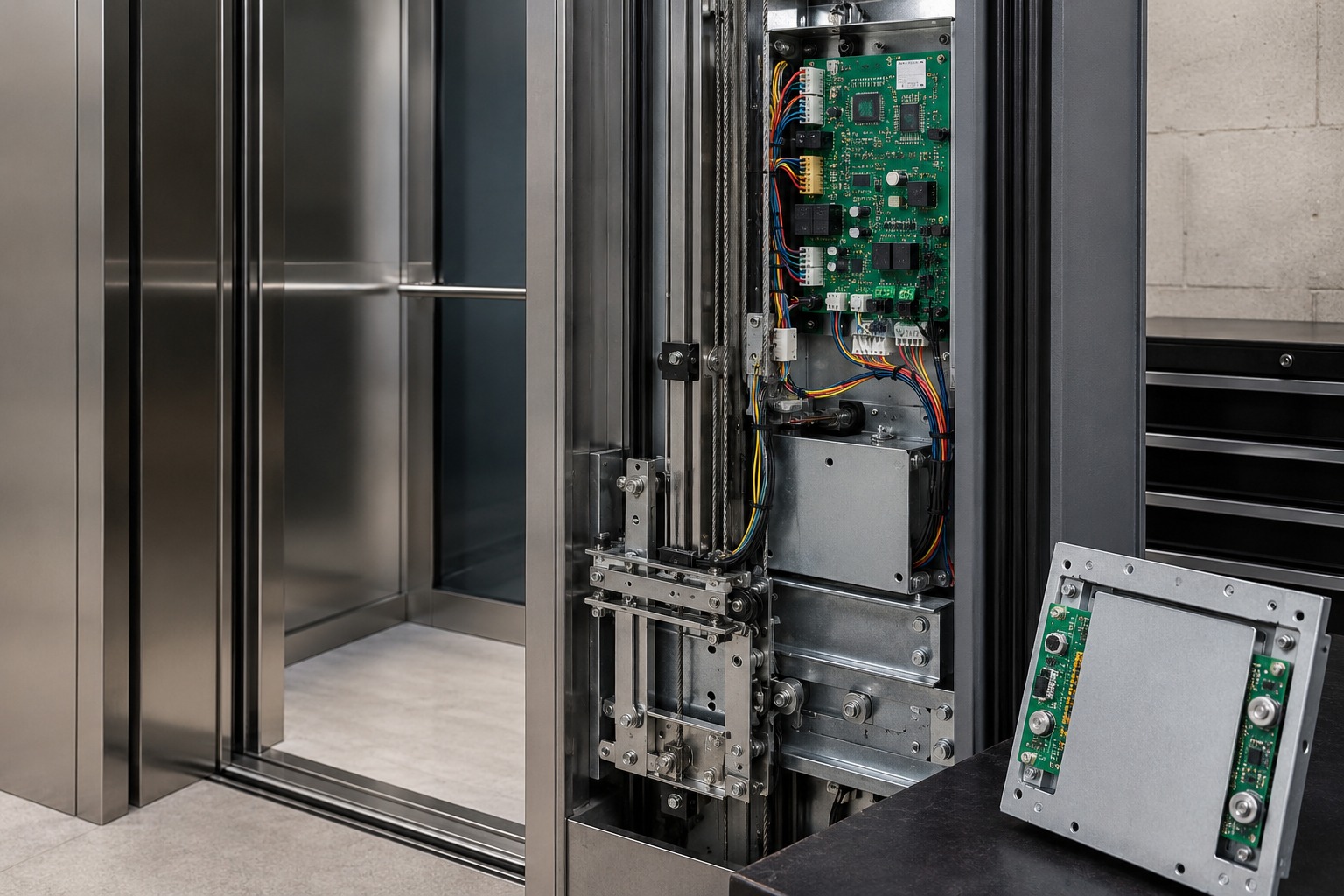
Toshiba elevator systems are widely respected for stable control logic, but replacement work must be handled carefully because board generations, firmware, connectors, and parameter structures can differ between models. A Toshiba door control panel may look similar to another version while having a different connector assignment, motor feedback method, or default operating profile. Before replacing the panel, the technician should confirm the board code, door operator model, motor type, rated voltage, sensor arrangement, and whether the installation uses original or modified harnesses.
Where available, photograph the original board in place before removal. Record connector labels, dip switch positions, terminal numbering, and all parameter values shown on a display or setup tool. If the old board still powers up intermittently, it is often worth extracting every readable setting before disconnecting it. This prevents avoidable delays during recommissioning, especially on sites where technical documentation is incomplete.
For customers sourcing Toshiba replacement parts, a dedicated product page such as Toshiba elevator door control panel replacement options can help narrow the board family, but field confirmation is still necessary. Technicians should compare plug shape, mounting hole spacing, heat sink layout, terminal functions, and software markings. If a system has been modernized in the past, the currently installed board may not match the original elevator shipment records.
Another important point is transport protection. Door control panels can be damaged by electrostatic discharge, rough packing, or moisture exposure while moving through long logistics routes. For customers supplied into South Africa via Durban, Cape Town, or air freight through OR Tambo, anti-static packaging, cushioning, and label accuracy matter almost as much as the board selection itself. Our manufacturing and packing process focuses on board protection, clear model matching, and shipment consistency to lower risk from warehouse to site.
Technological capability is especially important during Toshiba replacement work. We support customers by checking board codes, comparing circuit form factors, reviewing photos of old parts, and helping determine whether the application uses an original panel or a compatible replacement path. This reduces the trial-and-error that often causes repeat visits on office towers, hospitals, or residential blocks.
| Replacement Checkpoint | Why It Matters | What to Record | Risk If Ignored | Best Practice | Who Should Verify |
|---|---|---|---|---|---|
| Board model number | Confirms exact family | Label, barcode, revision | Wrong board supplied | Photograph and cross-check | Technician and purchaser |
| Connector layout | Prevents wiring mismatch | Terminal names and pin count | Signal damage or no operation | Map each plug before removal | Technician |
| Motor type | Defines drive method | DC, AC, PM synchronous | Incorrect control response | Read motor nameplate | Technician |
| Feedback device | Needed for motion control | Encoder, hall, switch logic | Travel instability | Confirm sensor type physically | Technician |
| Parameter backup | Restores site settings | Speed, torque, dwell, reversal | Long commissioning time | Save all values before replacement | Technician |
| Firmware or revision | Affects compatibility | Version code | Unexpected behavior | Match revision where possible | Supplier and technician |
| Environmental condition | May have caused original failure | Heat, dust, water ingress | New board fails again | Correct root cause first | Site manager and technician |
The replacement checklist above is useful because many “board failures” are really application problems. If a motor is binding, if the door vane alignment is poor, or if lock contacts are unstable, even a new Toshiba panel may appear faulty. Good replacement practice starts with documentation and ends with system-level verification.
Setting Door Speed and Torque Correctly
Door speed and torque settings must balance safety, reliability, noise control, and traffic performance. A door that opens too slowly frustrates users and reduces lift handling capacity. A door that closes too aggressively can trigger protection devices, wear mechanical parts faster, and increase safety risk. Proper tuning depends on door width, panel weight, track condition, motor type, counterbalance arrangement if applicable, and the sensitivity of the obstruction detection logic.
Most door operators use staged motion. The board commands acceleration from standstill, then a normal running speed, then a reduced speed near the fully open or fully closed point. Torque settings affect how strongly the motor responds during each phase. If the opening torque is too low, the door may hesitate when starting. If the closing torque is too high, the system may close harshly before the lock engages. If nudge mode is enabled, a separate reduced-speed profile may apply when the door is required to close after repeated obstructions.
Technicians replacing a board should avoid copying parameters blindly from another site. A shopping centre lift in Durban with high daily cycles may need different fine-tuning from a residential building in Pretoria or a hospital lift in Cape Town where stretcher traffic requires smooth, predictable movement. Environmental factors also matter. Dust from nearby construction, salt air in coastal regions, and temperature changes in machine spaces can affect drag, sensor reliability, and current draw.
If the door operator uses a permanent magnet synchronous motor, parameter matching becomes even more important. Selecting a compatible motor and board combination can improve smoothness and energy use, especially in modernization projects. For reference, permanent magnet synchronous door motors for elevator operators are increasingly considered where efficient replacement solutions are required.
From a manufacturing capability perspective, consistent quality inspection matters because accurate torque and speed control depends on electrical stability. Boards with weak components, inconsistent soldering, or poor connector quality can produce intermittent drive behavior that is difficult to diagnose on site. Our sourcing and inspection workflow focuses on reliable parts matching, stable quality control, and packaging that preserves electronic integrity before installation.
| Parameter Area | Typical Purpose | If Set Too Low | If Set Too High | Field Symptom | Tuning Advice |
|---|---|---|---|---|---|
| Open speed | Controls opening travel rate | Slow passenger flow | Harsh stop at end | Complaints about door delay or slam | Increase gradually and verify smooth deceleration |
| Close speed | Controls closing travel rate | Low handling capacity | Obstruction events or impact | Door reverses repeatedly | Balance with safety device response |
| Open torque | Starting force for opening | Hesitation or stall | Mechanical stress | Jerky launch | Adjust after checking track friction |
| Close torque | Starting force for closing | Incomplete closure | Hard closing behavior | Lock does not engage smoothly | Set for reliable closure without slam |
| Slowdown point | Distance before end stop | Late braking | Excessively long cycle time | Overshoot or sluggish approach | Match to door width and operator geometry |
| Reversal sensitivity | Response to obstruction | Poor passenger protection | Nuisance reopening | Frequent false obstruction | Test with actual doorway conditions |
| Nudge mode speed | Controlled close after delay | Extended open time | Uncomfortable closing behavior | Late traffic recovery | Use within code and site requirements |
The best tuning sequence is mechanical inspection first, electrical verification second, and parameter adjustment third. If rollers are worn or the sill is dirty, no amount of software tuning will create a stable door cycle. Once friction and alignment are corrected, current draw and cycle consistency usually improve quickly.
Checking Light Curtain and Door Lock Signals
Two of the most critical inputs for any door control panel are the light curtain and the door lock signal. The light curtain protects passengers by detecting objects in the doorway. The lock circuit confirms that the landing and car doors are fully closed and mechanically secured. If either input is unreliable, the elevator may not close properly, may reopen unexpectedly, or may refuse to run at all.
Light curtain faults are common in buildings with dust, strong sunlight at lobby entrances, damaged cables, or repeated door impacts. In South Africa, these problems often appear in mixed-use sites where traffic is heavy and cleaning schedules vary. A technician should verify power supply voltage, transmission and reception alignment, beam continuity, connector condition, and signal state at the controller input. If the board shows obstruction while the doorway is clear, the issue may be in the sensor, harness, or grounding rather than in the control panel itself.
Where replacement is needed, using a suitable elevator light curtain spare part with proper beam coverage and compatible power characteristics helps restore safe operation faster. However, after sensor replacement, the technician should still test actual re-open timing and ensure the door controller interprets the signal correctly.
Door lock checks are equally important. The controller expects a stable sequence: the doors close, mechanical engagement occurs, lock contact changes state, and the main controller recognizes a safe condition for motion. If the lock contact chatters, if vane alignment is poor, or if the wiring has high resistance, the lift may remain out of service even though the doors appear shut. This is a common source of intermittent complaints in older buildings.
Service capability matters most in this stage of repair. Fast response, accurate identification of compatible light curtains, lock-related accessories, and replacement boards can shorten outages significantly. Our support approach focuses on responsive communication, application review, and practical spare part recommendations for maintenance companies that need to keep passenger lifts moving in busy South African properties.
| Signal or Device | Normal Expected Status | Typical Fault | Likely Root Cause | Effect on Lift | Recommended Test |
|---|---|---|---|---|---|
| Light curtain power input | Stable rated voltage | No beam activity | Power supply issue | Door may close without proper detection or stay faulted | Measure supply at sensor head |
| Light curtain output | Changes when beam is blocked | Permanent obstruction state | Sensor damage or misalignment | Door reopens continuously | Monitor output while blocking beams |
| Door closed limit | Activates at full close | Never turns on | Misadjusted switch or sensor | No lock sequence | Observe activation point mechanically |
| Door lock contact | Stable closed circuit when locked | Intermittent opening | Worn contact or linkage | Lift cannot run | Check continuity under vibration |
| Safety chain wiring | Low resistance continuity | Voltage drop or unstable signal | Loose terminal or cable damage | Random shutdowns | Perform wiring integrity test |
| Grounding and shielding | Clean reference, low noise | False triggers | Electrical noise | Nuisance door faults | Inspect grounding path and routing |
| Connector seating | Firm, corrosion-free fit | Intermittent sensor loss | Oxidation or vibration | Repeated callbacks | Re-seat and inspect pins |
The table above highlights a key field lesson: stable signals are just as important as correct parameters. A door control panel can only make safe decisions if the light curtain and lock feedback are accurate and repeatable on every cycle.
Practical Workflow for Door Control Panel Fault Diagnosis
A disciplined fault diagnosis workflow reduces unnecessary parts replacement. When a door problem appears, many teams feel pressure to change the control board immediately because it is the “brain” of the operator. In reality, the best practice is to move from simple external checks to deeper electronic analysis in a clear order.
Step one is observation. Watch several open and close cycles if the door can still move. Note whether the fault occurs on opening, closing, final lock engagement, or only after prolonged operation. Listen for mechanical drag, belt slip, roller noise, or a harsh stop. Step two is safety and power verification. Confirm the correct supply voltage to the panel and inspect fuses, grounding, and terminals. Step three is signal input review. Check command inputs, light curtain state, closed limit, lock contact, and any encoder or position feedback. Step four is mechanical inspection. Clean the sill, inspect tracks, rollers, couplers, and vane alignment. Step five is parameter review. Compare speed and torque values against known acceptable ranges. Step six is board output testing. If all external conditions are correct but drive output remains abnormal, then the controller becomes the leading suspect.
Fault history should be captured before power cycling whenever possible. Many intermittent door controller problems leave clues in error memory, LED patterns, or transient alarms. Resetting the system too early can erase the evidence. On modern fleets, maintenance teams should document the failure code, timestamp, site condition, and corrective action so that patterns can be identified across a building portfolio.
The South African market increasingly values this type of structured maintenance because it lowers overall repair cost. Large property owners in Johannesburg and Cape Town are paying closer attention to uptime metrics, contractor response times, and repeat fault frequency. A maintenance partner that follows a formal door diagnosis process is more likely to minimize tenant complaints and avoid unnecessary imports.
| Diagnostic Step | Main Question | Tool Needed | What a Good Result Looks Like | What a Bad Result Suggests | Next Action |
|---|---|---|---|---|---|
| Visual observation | When does the failure occur? | None or video capture | Repeatable sequence identified | Random behavior without pattern | Move to power and signal checks |
| Power supply check | Is the board properly powered? | Multimeter | Stable rated voltage | Low or unstable supply | Repair supply path first |
| Input signal test | Are commands and safety inputs valid? | Meter or diagnostic display | Expected state changes | Missing or noisy input | Inspect sensors and wiring |
| Mechanical inspection | Is the door physically free to move? | Hand tools and cleaning kit | Smooth manual travel | Binding or contamination | Correct friction and alignment |
| Parameter review | Are settings reasonable? | Setup tool or board interface | Balanced speed and torque values | Extreme or corrupted settings | Restore proper parameters |
| Output stage test | Is the board driving correctly? | Meter, clamp, scope if needed | Consistent output behavior | No drive or unstable drive | Repair or replace board |
| Post-fix cycle test | Is the fault fully resolved? | Observation and log sheet | Multiple successful cycles | Intermittent return | Re-check root cause chain |
This workflow is effective because it separates cause from symptom. A door that “does not close” may actually have a light curtain issue, a low torque setting, contaminated tracks, or a failed output transistor. Good diagnosis prevents the wrong part from being blamed.
Commissioning Checks After Replacing the Panel
After installing a replacement door control panel, commissioning is the step that confirms safe return to service. Even when the new board powers up correctly, the job is not complete until motion, safety devices, and landing behavior are verified under real conditions. Commissioning should be documented, especially for commercial and institutional buildings where service records are reviewed by facilities managers and compliance teams.
Start by confirming all connectors are fully seated and no wire insulation is trapped under terminals. Restore saved parameters or enter the required defaults carefully. Verify board indicators, supply voltage, and communication status if applicable. Run the operator in inspection or test mode first. Observe opening direction, closing direction, end-of-travel slowdown, lock engagement, and re-open response. Test the light curtain across multiple beam heights. Simulate an obstruction if site procedures allow. Check that the lift will not run without proper lock confirmation.
Next, move to repeated cycling. A single successful open and close cycle does not prove reliability. Perform multiple consecutive operations with the car at a floor, then confirm normal behavior during actual landing calls. If the building has high traffic, test during realistic use. For example, hospital trolleys, luggage traffic in hotels, and retail trolley movement can expose sensor and timing issues that are not obvious during a basic static test.
For modernization contractors, commissioning is also the point to review future readiness. By 2026, more building owners are expected to demand better fault visibility, energy-efficient door motors, and electronic components that support long-term spares availability. Policy pressure around building safety, procurement transparency, and sustainable maintenance will continue to shape the replacement market. Choosing parts with dependable sourcing and practical technical support can reduce lifecycle risk.
| Commissioning Item | Acceptance Goal | How to Test | Common Issue Found | Risk If Unchecked | Record to Keep |
|---|---|---|---|---|---|
| Connector confirmation | All plugs secure and correct | Physical inspection and terminal tug test | Misplaced or loose connectors | Intermittent faults | Installation photos |
| Parameter loading | Correct site-specific settings | Review entered values line by line | Wrong defaults | Poor door behavior | Parameter sheet backup |
| Direction check | Open and close commands correct | Run operator in test mode | Reversed motor response | Unsafe operation | Start-up checklist |
| End-stop slowdown | Smooth approach at both ends | Observe several cycles | Overshoot or hard stop | Mechanical wear | Cycle observation note |
| Light curtain response | Reliable reopen on obstruction | Block beams across doorway | Dead zones or delayed reaction | Passenger safety risk | Safety test result |
| Lock confirmation | Lift runs only when locked | Monitor lock input and controller response | False lock state | Service shutdown or hazard | Input state log |
| Repeated cycle test | Stable operation over multiple runs | 10 to 20 consecutive cycles | Heat-related drift or intermittent stops | Repeat callback | Final handover record |
Commissioning records help maintenance teams later. If a fault reappears months after replacement, having the original start-up values and test observations can shorten the next diagnostic visit significantly.
Preventive Maintenance Tips for Door Operators
Preventive maintenance is the most cost-effective way to extend the life of elevator door control panels and the door operators they manage. Because the door system cycles far more often than most other elevator components, even small mechanical issues can create electrical stress over time. A dirty sill, a dragging hanger, or a poorly adjusted lock can increase motor load, cause current spikes, and eventually damage the control electronics.
A strong preventive program should include cleaning door tracks and sills, checking roller wear, inspecting belts or couplings, verifying lock alignment, testing light curtain operation, tightening terminals, and reviewing fault history. On older sites, technicians should also look for heat discoloration on connectors, brittle cable insulation, and signs of moisture ingress inside the controller enclosure.
Buildings near coastal areas such as Cape Town and Durban may require more frequent checks for corrosion and environmental contamination. Inland high-rise buildings in Johannesburg and Pretoria may experience different patterns, such as dust from construction or heavy peak-hour cycling in office towers. Maintenance intervals should reflect actual traffic and environment, not just a fixed calendar rule.
Buying advice is straightforward: do not select a replacement door control panel only by price. Compare model matching support, quality inspection, packaging standards, stock visibility, and responsiveness when technical questions arise. Local availability matters, but so does the supplier’s ability to help identify compatible alternatives when an original board is obsolete. For building owners and contractors, the cheapest part can become the most expensive if it causes repeat shutdowns.
Our company supports this need through a combination of technological capability, manufacturing discipline, and service responsiveness. Technologically, we help review model numbers, photos, and application details. From a manufacturing and sourcing perspective, we focus on stable quality inspection and protective packaging. From a service standpoint, we respond quickly to matching requests, help customers reduce downtime, and support maintenance teams, distributors, and modernization projects with practical spare parts guidance.
| Maintenance Task | Recommended Focus | Typical Frequency | Problem Prevented | Benefit to Door Panel | Site Example |
|---|---|---|---|---|---|
| Clean sill and track | Remove debris and dust | Monthly or by traffic level | Drag and stall | Reduces motor overload | Retail centres in Johannesburg |
| Inspect rollers and hangers | Check wear and alignment | Quarterly | Jerky movement | Stabilizes current draw | Residential towers in Cape Town |
| Test light curtain | Beam coverage and response | Monthly | False reopen or missed detection | Prevents sensor-related faults | Hotels in Durban |
| Check lock contacts | Engagement and continuity | Quarterly | No-run conditions | Ensures valid safety input | Hospitals in Pretoria |
| Tighten electrical terminals | Board and harness connections | Six-monthly | Intermittent signal loss | Improves voltage stability | Commercial offices in Sandton |
| Review fault history | Recurring alarms and trends | Every visit if available | Unseen intermittent issues | Supports predictive repair | Mixed-use sites in Ekurhuleni |
| Check environment | Heat, moisture, corrosion | Seasonally | Premature board failure | Protects electronics lifespan | Coastal properties near ports |
The explanation above shows that preventive maintenance is not just about avoiding immediate door faults. It directly protects the control panel from unnecessary thermal and electrical stress, which extends service life and reduces spare parts consumption over time.
Frequently Asked Questions About Elevator Door Control Panels
How do I know whether the door control panel is faulty or the problem is mechanical?
Start with observation and simple checks. If the door binds manually, makes grinding noise, or shows visible misalignment, mechanical issues are likely contributing. If all mechanics are smooth and the board has correct power but no proper drive output, the panel becomes a stronger suspect.
Can I replace a Toshiba door control panel with any similar-looking board?
No. Similar appearance does not guarantee compatibility. Confirm board code, revision, connector layout, motor type, feedback device, and parameter structure before replacement.
Why does a new door panel still show the same fault?
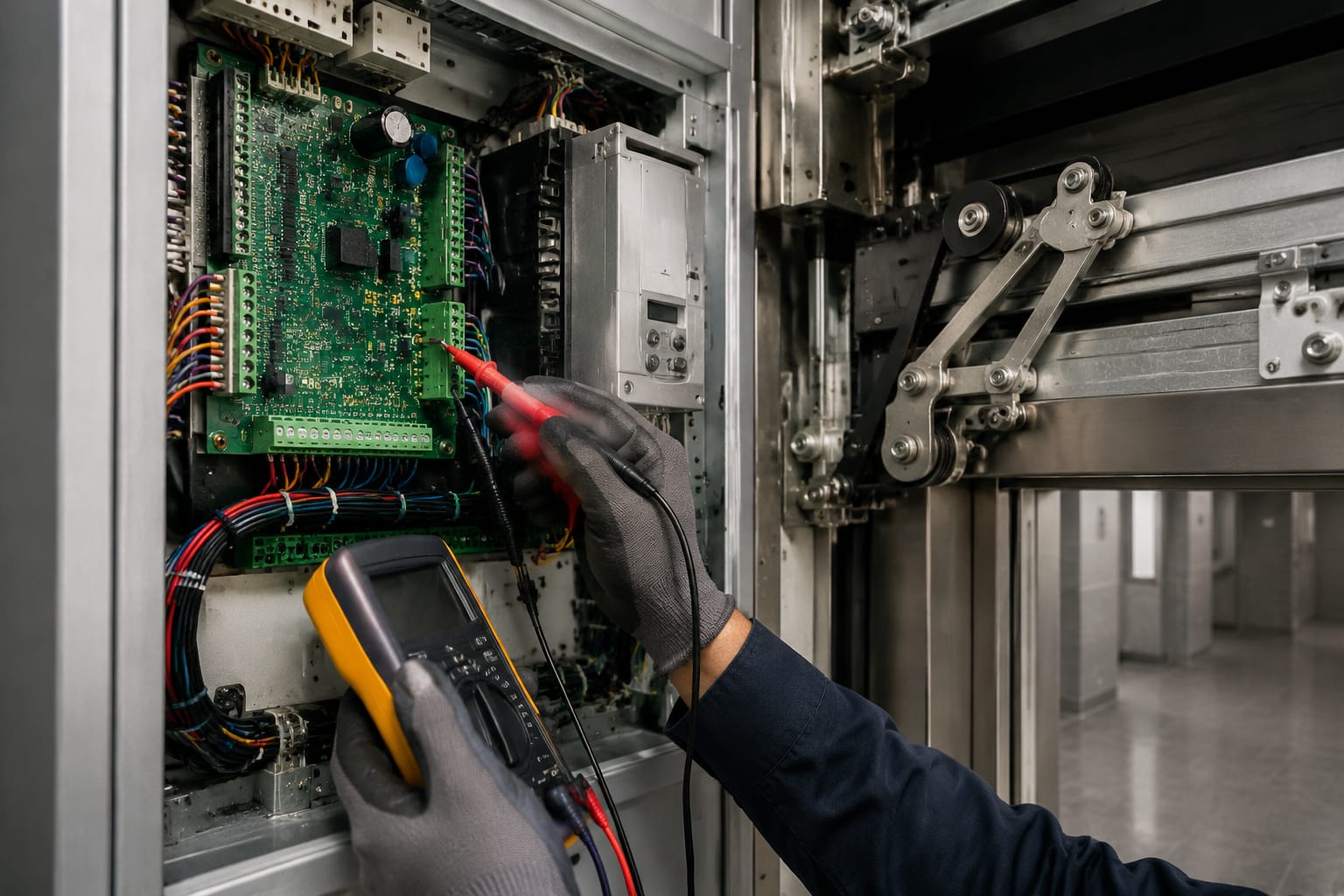
Because the original cause may be elsewhere. Common examples include a failed light curtain, unstable lock contact, excessive track friction, damaged harness, poor grounding, or incorrect parameters entered during commissioning.
What settings matter most after replacement?
The most important settings usually include open speed, close speed, acceleration and slowdown points, opening and closing torque, obstruction sensitivity, dwell timing, and any encoder or position calibration values.
How many cycles should be tested after commissioning?
At least 10 to 20 consecutive cycles is a practical minimum, plus normal operation under actual landing calls. High-traffic lifts should be tested under realistic site conditions.
Do coastal environments in South Africa affect elevator door electronics?
Yes. In cities such as Durban and Cape Town, salt air and humidity can affect connectors, terminals, and exposed metal parts. More frequent inspection for corrosion is recommended.
What should buyers ask a parts supplier before ordering?
Ask about model matching support, photos or drawings required for confirmation, quality inspection, packing method, compatible alternatives, lead time, and after-sales response.
Which industries need strong door operator spare parts planning?
Commercial offices, hospitals, hotels, retail centres, residential towers, and industrial facilities all benefit, but hospitals and high-rise commercial properties often require especially fast turnaround because downtime disrupts critical operations.
What trends should South African buyers watch through 2026?
Expect stronger demand for modernization-ready components, energy-efficient door motors, improved diagnostic visibility, sustainable packaging, and more disciplined procurement around compatibility and lifecycle support.
What makes a reliable supplier valuable for door panel repairs?
Reliable suppliers help match the right model, provide stable quality, pack electronics safely, respond quickly, and offer a broad range of related parts such as light curtains, motors, sensors, and door operator accessories. This shortens downtime and reduces repeat purchasing mistakes.
In summary, elevator door control panels coordinate the motor, feedback, and safety chain that keep lift doors moving correctly. Toshiba replacements require careful model confirmation. Speed and torque settings should be tuned only after mechanical and signal conditions are verified. Light curtain and lock checks are essential. A structured fault diagnosis workflow prevents wasted spending, while proper commissioning ensures safe return to service. For South African building owners, maintenance firms, and distributors, the most successful repair strategy combines accurate diagnosis, compatible parts sourcing, and preventive care that reflects local operating conditions.