
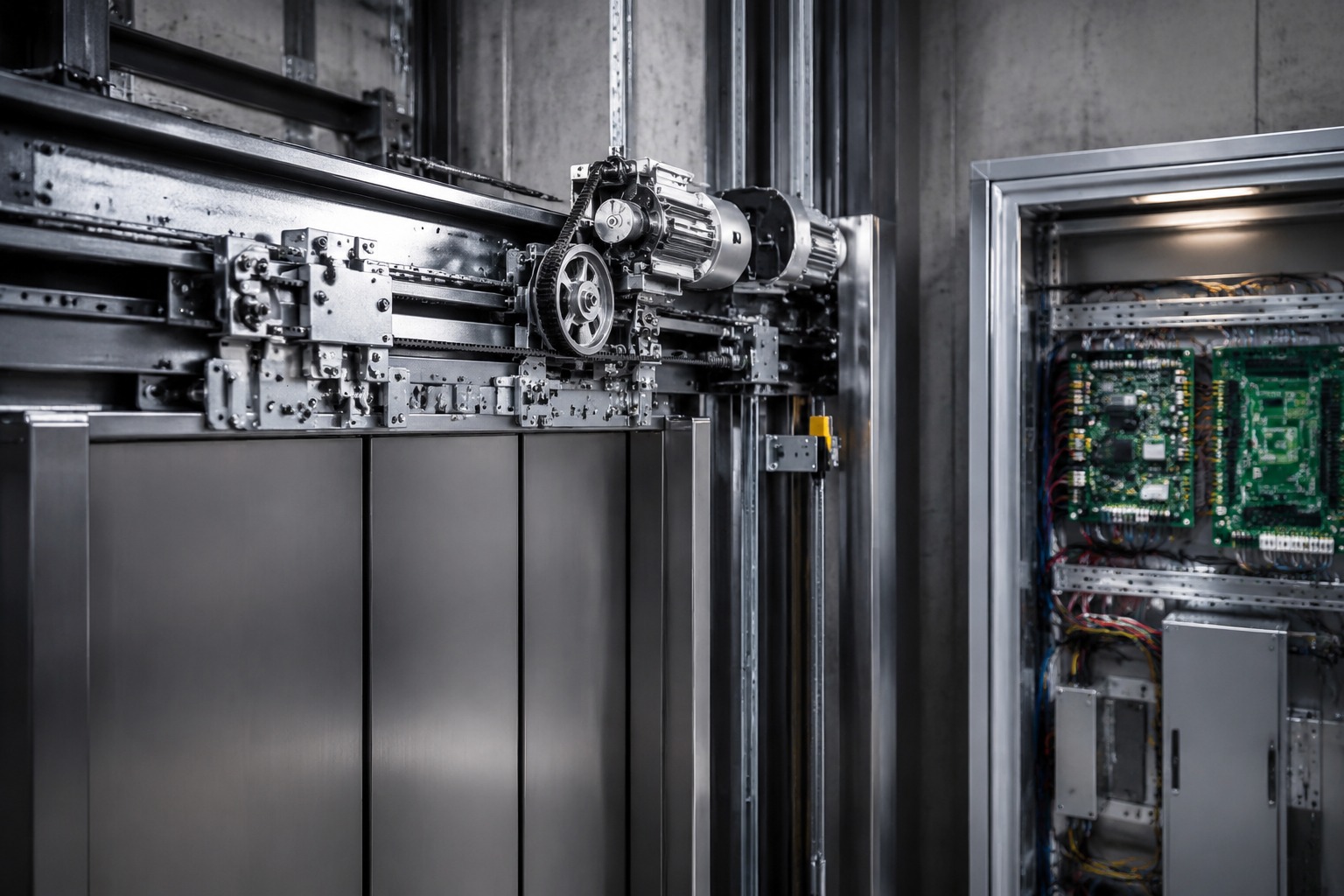
Reliable elevator door opening performance depends on more than the motor alone. In practice, the full door operator system determines whether passengers experience smooth opening, accurate re-levelling, quiet closing, and dependable obstacle response. The door motor, belt, pulley, controller, encoder feedback, hanging panels, guide shoes, landing locks, and mechanical alignment all work together as one motion system. When one part drifts out of tolerance, door cycle speed can become inconsistent, torque demand rises, and callbacks become more frequent.
For building owners, maintenance contractors, and modernization teams in South Africa, door system reliability matters because high traffic buildings in Johannesburg, Cape Town, Durban, Pretoria, Gqeberha, and fast-growing mixed-use developments cannot afford repeated downtime. In coastal areas near Durban and Port Elizabeth, humidity and corrosion can shorten the life of belts, pulleys, connectors, and exposed hardware. In inland commercial towers around Sandton and Midrand, heavy usage cycles often reveal controller tuning and belt wear issues earlier than expected.
The direct answer is simple: door motors, belts, and controllers affect door cycle speed by controlling acceleration, travel stability, torque output, and stopping accuracy. A healthy system opens at the correct programmed speed, slows smoothly near the end of travel, and closes with stable force while staying within safety parameters. A worn belt, slipping pulley, drifting encoder signal, or poorly commissioned controller changes that behaviour immediately.
This guide explains common elevator door motor problems, the benefits of permanent magnet synchronous technology, practical notes on Hitachi HGE and UAX door motor applications, signs that a door motor belt needs replacement, inspection steps for pulleys and hanging panels, commissioning advice for speed and torque, preventive maintenance routines, and frequently asked questions. It also includes market context for South Africa, buying advice, application examples, supplier evaluation criteria, and future trends through 2026.
For maintenance teams sourcing replacements, correct model matching is essential. A compatible permanent magnet synchronous door motor for Hitachi elevators can help restore smooth operation when an original unit becomes weak, noisy, or unstable. Where HGE-specific applications apply, a matched HGE permanent magnet door motor should be selected according to mounting, voltage, feedback, and operator arrangement. If the fault is mechanical rather than electrical, a door motor belt replacement for lift accessories may resolve slipping, hunting, or irregular opening speed.
Common elevator door motor problems
The most common elevator door motor problems are not complete failures but performance degradations. Many service calls start with complaints such as “doors reopen,” “doors close too slowly,” “door makes a chirping noise,” or “lift is stuck with door fault.” These symptoms can come from electrical, mechanical, or control-related causes.
Typical electrical issues include winding deterioration, overheating due to excessive load, unstable power supply from the operator drive, connector oxidation, and encoder feedback loss. Mechanical issues often include belt stretching, pulley wear, bearing roughness, door panel misalignment, contamination on tracks, damaged guide shoes, and friction in the hanger assembly. Control problems include poor learning parameters, torque set too low or too high, incorrect acceleration ramps, and mismatch between motor characteristics and door controller settings.
| Symptom | Likely Cause | Effect on Performance | Service Priority | Typical Check | Recommended Action |
|---|---|---|---|---|---|
| Door opens slowly | Belt slip, low torque, high friction | Longer cycle time and passenger delay | High | Inspect belt tension and controller speed setting | Retension or replace belt, review parameters |
| Door reopens during closing | Encoder drift, obstruction sensing too sensitive, panel drag | Repeated retries and nuisance faults | High | Review logs and inspect panel movement | Correct drag, recalibrate sensing |
| Jerky start or stop | Poor commissioning, worn pulley, controller ramp issues | Passenger discomfort and component stress | Medium | Observe motion profile during cycles | Retune acceleration and deceleration |
| Motor overheating | Excessive duty, binding panels, failing bearings | Shorter motor life and intermittent shutdown | Critical | Check current draw and mechanical resistance | Remove drag source, verify motor suitability |
| Squealing or chirping sound | Worn belt, misaligned pulley, contaminated track | Early warning of wear progression | Medium | Visual and acoustic inspection | Clean, align, and replace worn parts |
| Intermittent door fault code | Loose wiring, unstable feedback, inconsistent load | Random stoppages and callbacks | Critical | Check terminals and monitor live signals | Secure wiring and replace unstable components |
The table above shows why diagnosis should always begin with both motion observation and component inspection. Replacing the motor first may not solve the issue if the actual cause is drag from hanging panels or a hardened belt surface. In South African buildings with dust exposure, mining traffic, hospital trolley movement, or coastal air contamination, small mechanical resistance changes can quickly become control faults.
Another common problem is incorrect replacement selection. A motor that looks physically similar may still have different torque curves, encoder characteristics, shaft dimensions, or mounting points. This can lead to overspeed, weak closing force, unstable stopping, or long-term belt wear. Accurate model matching reduces repeated service visits and protects the operator drive from unnecessary stress.
Benefits of permanent magnet synchronous door motors
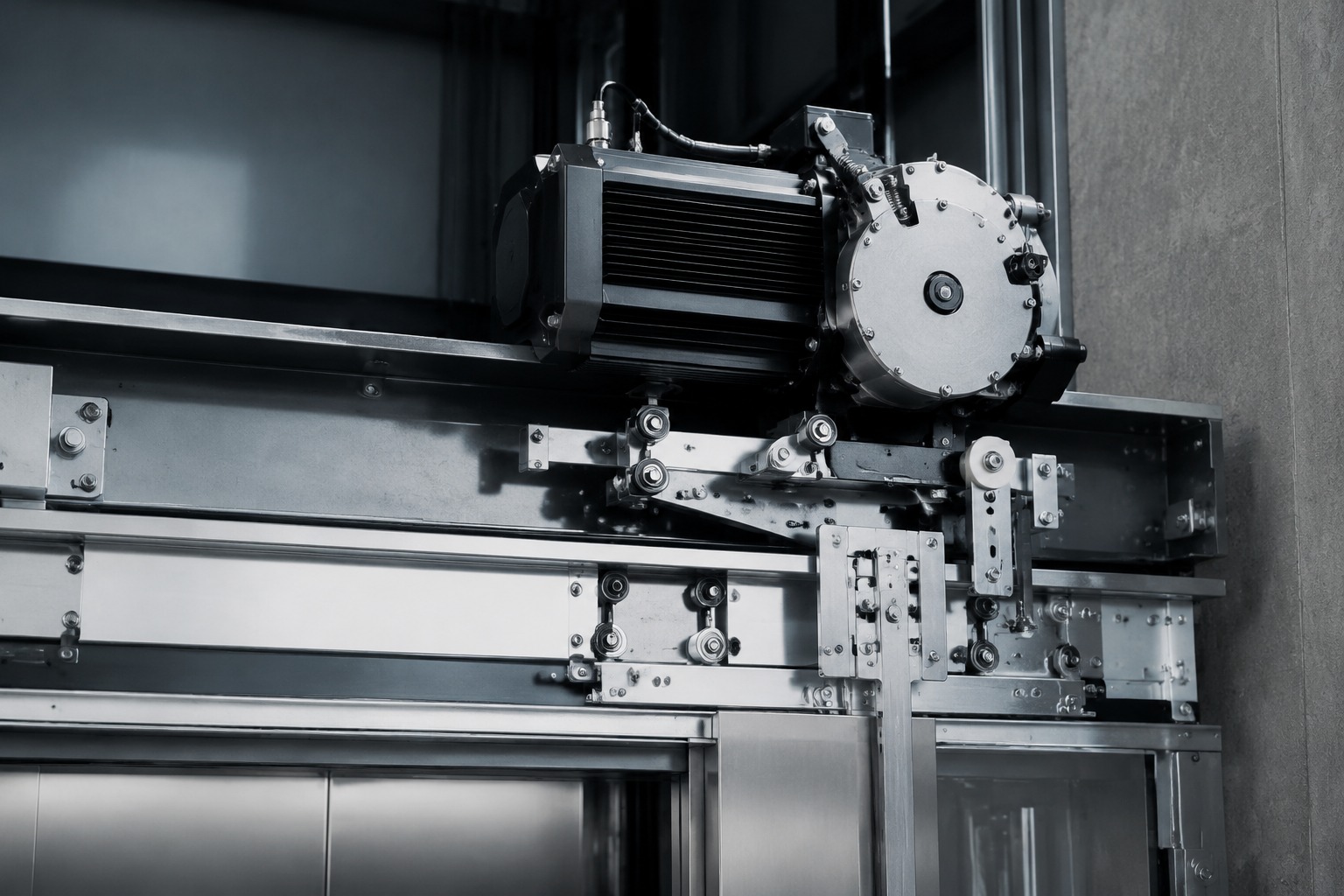
Permanent magnet synchronous door motors have become increasingly popular because they provide efficient torque delivery, compact size, smooth speed control, and stable low-speed performance. In elevator door systems, these advantages are especially useful during the start-stop cycles that occur hundreds or thousands of times per day.
Compared with older motor designs, permanent magnet synchronous models typically achieve better response at low speed and more precise control when paired with suitable operator electronics. That matters during the final approach to full open and full close positions, where the system must decelerate cleanly without bouncing or slamming.
| Feature | Operational Benefit | Maintenance Impact | Use Case | Energy Effect | Notes for South Africa |
|---|---|---|---|---|---|
| High efficiency | Lower electrical losses during frequent cycles | Less thermal stress | Office towers and malls | Reduced energy consumption | Useful in buildings managing operating costs |
| Good low-speed torque | Smoother final closing and opening control | Less retry behaviour | Hotels and hospitals | Indirect savings via fewer faults | Supports comfort-sensitive sites |
| Compact design | Easier integration in door operator layouts | Simplifies replacement planning | Modernization projects | Neutral | Helpful where operator space is tight |
| Stable speed control | Predictable cycle timing | Less wear from shock loading | High-traffic residential blocks | Improved system consistency | Good for buildings with heavy peak use |
| Fast dynamic response | Better reaction to command changes | Supports accurate commissioning | Commercial mixed-use sites | Moderate efficiency gain | Useful in premium developments |
| Reduced vibration | Quieter operation and less mechanical stress | Potentially longer component life | Premium apartments | Indirect benefit | Important for tenant satisfaction |
The explanation behind this table is straightforward: a better motor does not eliminate maintenance, but it improves the control window in which the operator can work safely and smoothly. That is why many modernization contractors prefer permanent magnet synchronous options when replacing legacy door motors in older buildings around Cape Town CBD, Rosebank, and Umhlanga.
From a buying perspective, decision makers should confirm rated torque, operating voltage, current draw, feedback type, shaft geometry, pulley compatibility, mounting bracket arrangement, and the controller’s ability to drive the selected motor. A good replacement should not only fit but also match the expected duty cycle of the site.
Notes on Hitachi HGE and UAX door motors
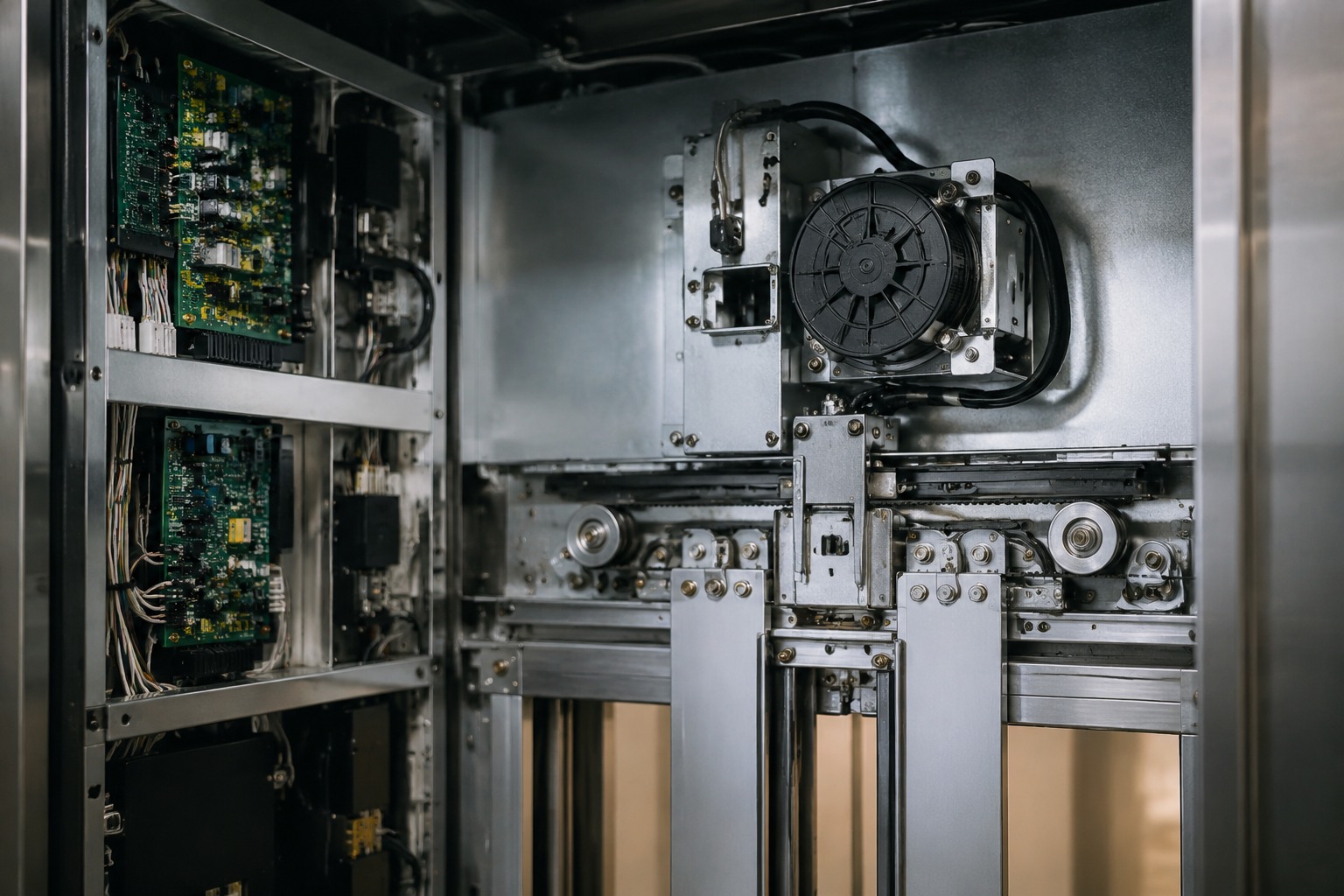
Hitachi elevator applications often require careful attention to model family differences, especially in HGE and UAX related door systems. While both are associated with recognized elevator applications, door operator details can differ by installation year, regional supply history, door width, controller revision, and modernization work carried out over time.
For technicians and purchasing teams, the key lesson is not to rely on appearance alone. Confirm part number, motor label data, photos of the connector and shaft, mounting dimensions, pulley arrangement, and the door operator assembly details. If the site is in Johannesburg but the equipment was originally supplied through another route or refurbished later in Durban or Cape Town, mixed component history is possible.
| Check Item | Why It Matters | HGE Focus | UAX Focus | Risk if Ignored | Best Practice |
|---|---|---|---|---|---|
| Nameplate data | Confirms electrical compatibility | Check voltage and current | Check voltage and duty | Drive mismatch | Record full label before ordering |
| Mounting pattern | Ensures physical installation | Bracket position may vary | Operator frame alignment may vary | Cannot fit on site | Measure hole centres and frame clearance |
| Shaft and pulley size | Determines belt tracking and torque transfer | Verify pulley interface | Verify shaft dimensions | Slip and abnormal wear | Share photos with caliper readings |
| Connector type | Affects wiring compatibility | Check pin layout | Check cable termination | Signal loss or rewiring error | Match connector images and pinout |
| Feedback method | Essential for speed control | Confirm encoder details | Confirm sensing arrangement | Unstable motion | Verify with controller data |
| Door operator revision | Installations may have updates | Older and later variants exist | Modernized sites may differ | Wrong spare supplied | Check site history and previous repairs |
The table explains why documentation matters. In the field, HGE and UAX replacement work becomes much easier when the technician captures clear photos and dimensional references before procurement. This is especially important when the site is remote, such as installations servicing logistics corridors between Gauteng and the ports, where return visits increase downtime cost.
Our role in these projects typically focuses on accurate model comparison, practical compatibility review, and responsive replacement sourcing. On the technology side, we support careful matching of motors, control boards, encoders, and door operator components to reduce the risk of ordering errors. On the manufacturing side, we emphasise stable inspection, protected packaging, and condition checks before dispatch. On the service side, we help maintenance companies and distributors review labels, photos, and application data so the supplied part better fits the site requirement.
Signs that a door motor belt needs replacement
The door motor belt is a small component with a large influence on operator performance. If the belt stretches, hardens, cracks, polishes, loses teeth integrity, or runs out of alignment, the entire opening and closing sequence becomes less predictable. In many cases, callbacks blamed on the motor are actually caused by the belt.
Common belt replacement signs include visible cracking, frayed edges, glazing on the contact surface, tooth wear, rubber dust around the pulley area, inconsistent belt tracking, squealing noise during startup, and a difference between commanded speed and actual panel movement. In high-traffic buildings, replacement should not wait until complete failure because a broken belt can stop the lift unexpectedly and create service disruption.
| Belt Condition | Visible Clue | Performance Symptom | Risk Level | Immediate Action | Long-Term Result if Ignored |
|---|---|---|---|---|---|
| Surface glazing | Shiny, polished finish | Slip during start or stop | Medium | Check tension and pulley condition | Progressive speed inconsistency |
| Cracking | Fine or deep splits | Noise and unreliable traction | High | Replace belt soon | Sudden failure |
| Frayed edges | Loose fibres or uneven sides | Mis-tracking and vibration | High | Inspect alignment and replace | Pulley damage and repeated faults |
| Missing or worn teeth | Deformed tooth profile | Position error and jerking | Critical | Stop delaying replacement | Loss of synchronization |
| Rubber dust buildup | Black residue near drive area | Accelerated wear and contamination | Medium | Clean and inspect full drive path | Broader operator wear |
| Excessive stretch | Tension no longer stable | Slow or uneven door travel | High | Replace and re-check tensioning parts | Repeated callbacks and retries |
This table shows that belt wear is not just a visual issue; each visible clue maps to a motion problem. For example, glazed belts often appear intact but slip under sudden acceleration. Frayed belts suggest alignment problems, which means simply fitting a new belt without checking pulley geometry may lead to the same failure again.
Buying advice for South Africa is to keep critical belt sizes available for high-traffic sites, especially retail centres, hospitals, and student accommodation. Waiting for a belt to fail can mean longer downtime if procurement lead time is affected by shipping schedules through Durban or Cape Town ports. A planned stocking strategy reduces emergency pressure and allows replacement during scheduled maintenance windows.
How to inspect pulley and hanging panels
Pulley and hanging panel inspection is essential when investigating poor door cycle speed. The motor can only perform as well as the mechanical load it is driving. If the pulley groove is worn, the shaft is loose, the bearing is rough, or the panel hangs out of level, the controller will compensate until it reaches its limit. After that, faults start appearing.
A proper inspection should begin with lockout procedures and safe access according to site safety requirements. Then observe panel travel by hand if permitted, check track cleanliness, verify that the panels move evenly, and listen for scraping or bearing noise. Inspect the pulley for groove wear, wobble, eccentric rotation, contamination, and evidence of belt mis-tracking. Look at the hanger rollers, guide shoes, sill, and panel edge clearances. Also check whether landing door coupling and locks are introducing drag.
| Inspection Point | What to Look For | Possible Fault Source | Impact on Door Speed | Inspection Tool | Recommended Response |
|---|---|---|---|---|---|
| Pulley groove | Wear, polishing, uneven profile | Belt slip and poor traction | Inconsistent acceleration | Visual check and caliper | Replace pulley if profile is degraded |
| Pulley bearing | Noise, roughness, play | Mechanical resistance | Higher torque demand | Manual rotation test | Renew bearing or assembly |
| Panel alignment | Uneven gap or tilt | Hanger or track issue | Drag and retry opening | Straight edge and visual line | Re-align panels and adjust hangers |
| Hanger rollers | Flat spots or stiffness | Rolling friction | Jerky motion | Hand movement test | Replace worn rollers |
| Guide shoes | Wear or cracking | Bottom drag or instability | Speed variation | Visual inspection | Replace and reset clearances |
| Track and sill | Dirt, debris, corrosion | Travel obstruction | Slower closing and opening | Cleaning tool and torch | Clean thoroughly and inspect for damage |
The explanation here is that door operator performance should always be assessed as a system. If a building in a windy coastal zone allows fine sand or salt-laden dust into the entrance, pulley wear and sill contamination can progress faster than expected. In warehouses and industrial properties, heavy trolley traffic can also affect landing door alignment over time.
Applications where detailed inspection is especially important include hospitals, shopping centres, office towers, residential high-rises, hotels, transport hubs, and industrial buildings with frequent passenger or service lift use. In each of these sectors, door faults are among the most visible lift problems because users experience them directly every time they enter or exit.
Commissioning door speed and torque
Correct commissioning is the bridge between a good replacement part and reliable field performance. Door speed and torque must be adjusted so the operator opens and closes efficiently without excessive impact, repeated obstruction response, or unnecessary mechanical stress. The goal is not simply to make the door faster. The goal is to achieve stable travel with safe force limits and consistent stopping points.
Commissioning usually involves setting open speed, close speed, acceleration, deceleration, nudging behaviour where applicable, torque or force-related parameters, learning travel distance, and confirming feedback stability. These values depend on door width, panel mass, friction level, operator design, and local safety requirements. A narrow apartment lift with light traffic may tolerate conservative settings, while a hospital or mall lift may require a more carefully balanced profile to manage frequent cycles efficiently.
When a new permanent magnet synchronous motor is installed, avoid copying old parameters without validation. The previous settings may have compensated for a worn belt, rough pulley, or aging motor. Once those mechanical issues are corrected, the controller may need retuning to avoid aggressive motion.
| Parameter Area | Target Outcome | If Set Too Low | If Set Too High | Commissioning Clue | Practical Advice |
|---|---|---|---|---|---|
| Open speed | Fast but stable opening | Passenger delay | Bounce near full open | Observe final approach | Increase gradually with test cycles |
| Close speed | Smooth and controlled closing | Long door dwell impact | Harsh closing and retries | Monitor obstacle behaviour | Balance safety and traffic flow |
| Acceleration | Clean startup without jerk | Sluggish cycle start | Belt shock and noise | Listen at first movement | Match to panel mass |
| Deceleration | Soft stop near limits | Creep and long cycle | Abrupt stop and rebound | Check landing accuracy of doors | Fine tune with repeated runs |
| Torque or force setting | Adequate drive without overload | Stalling or incomplete close | Wear, heat, and harsh response | Measure current and observe panel drag | Correct mechanical resistance first |
| Feedback calibration | Reliable position and speed reference | Uncertain travel control | Usually not applicable as “high,” but bad data causes faults | Review signal stability | Confirm encoder and connector health |
The table highlights why commissioning should never be rushed. Many repeat faults come from treating parameter adjustment as a substitute for mechanical repair. If torque is raised to overcome drag, the motor may run hotter and the belt may wear faster. Correct practice is to fix the drag first, then tune the controller.
In South African modernization projects, commissioning also needs to consider power quality variation, environmental conditions, and traffic patterns. Buildings near busy business districts may have intense morning and evening peaks, while beachfront hotels may show seasonal surges. Good settings are therefore those that remain stable under real operating conditions, not just during a few empty test runs.
Preventive maintenance tips
Preventive maintenance is the most cost-effective way to protect elevator door motors and keep door cycle speed within design expectations. Because the door operator cycles so frequently, even small inefficiencies multiply quickly into wear, energy loss, and passenger complaints.
A practical preventive maintenance plan should include scheduled cleaning, belt inspection, pulley inspection, panel alignment checks, fastener tightening, controller log review, connector inspection, lubrication where the manufacturer permits it, and trend comparison against previous service visits. High-use sites should have a shorter inspection interval than low-use residential buildings.
For maintenance companies, consistent documentation is valuable. If the opening time gradually increases over several months, or motor temperature rises after peak traffic periods, those trends provide an early warning before a fault shuts the lift down. This is especially helpful for service portfolios spread across Johannesburg, Durban, Cape Town, Pretoria, and Bloemfontein, where proactive planning can reduce emergency dispatch costs.
From our own company perspective, preventive maintenance is supported in three practical ways. First, our technological capability lies in careful model matching across motors, control boards, encoders, sensors, and door operator parts, helping customers source compatible replacements rather than forcing near-fit substitutions. Second, our manufacturing and quality capability focuses on stable inspection routines, part verification, and protective packaging that reduces transit damage during domestic distribution or import handling. Third, our service capability is built around responsive communication, application review, and support for maintenance firms, distributors, building owners, and modernization contractors trying to reduce downtime.
Local supplier selection also matters. A useful supplier is not just a seller of stock; it is a partner that understands the difference between a belt issue, motor issue, and controller issue. When reviewing local or international suppliers serving South Africa, buyers should ask about identification support, packaging quality, replacement compatibility checks, and how quickly they respond when the original label is incomplete.
The line chart above illustrates a realistic market growth pattern for modernization demand related to elevator replacement parts and door operator upgrades in South Africa. The growth is supported by aging equipment in commercial buildings, energy efficiency goals, and increased attention to lifecycle cost instead of emergency-only repair strategies.
This bar chart explains where demand is strongest. Retail and residential sectors often generate high demand due to heavy daily cycling. Hospitals rank high because smooth door operation is critical for patient movement, while office towers experience concentrated peak traffic that accelerates wear.
The area chart reflects the technology trend shift underway through 2026. Legacy replacement remains necessary, but there is a steady move toward permanent magnet synchronous motors, smarter controllers, and data-based maintenance planning. This trend is relevant for large property groups and facility managers seeking lower lifetime cost and improved uptime.
The comparison chart shows the criteria buyers use most often when assessing suppliers and products. Price matters, but it is usually not the only factor. In door operator parts, wrong selection causes delays, so buyers often value model matching and inspection support more than a small upfront saving.
FAQ about elevator door motors
What is the most common cause of unreliable door opening performance?
In many cases it is a combination of belt wear, panel drag, and poor parameter tuning rather than total motor failure. Start with a full mechanical and control inspection before replacing the motor.
How long should an elevator door motor belt last?
There is no universal life figure because usage, climate, alignment, and commissioning quality all matter. High-traffic buildings in busy urban locations may require much more frequent inspection than low-rise residential sites.
Can a permanent magnet synchronous door motor reduce callbacks?
Yes, when correctly matched and properly commissioned. The benefits come from smoother torque control, better low-speed behaviour, and more stable cycle performance, but only if the rest of the door operator is in good condition.
What should be checked before ordering a Hitachi HGE or UAX-related door motor?
Record the nameplate, voltage, current, connector, shaft dimensions, pulley details, mounting arrangement, and door operator photos. Also note any past modernization work because component history may vary.
Should a belt be replaced only when it breaks?
No. Replace it when clear wear signs appear, such as glazing, cracking, fraying, missing teeth, or unstable tension. Waiting for failure increases downtime risk and can damage related parts.
Why do doors become noisy after a motor replacement?
The cause may be misalignment, incorrect belt tension, pulley wear, or parameter settings copied from an old worn system. Noise after replacement often means the full operator was not reassessed.
How important is pulley inspection?
Very important. A worn pulley can cause belt slip, vibration, and rapid repeat wear. Replacing only the belt without checking pulley condition often leads to a short service life.
Can controller settings compensate for heavy door panels?
Only within limits. If the panels drag or the mechanical load is excessive, raising torque may create heat and wear. Mechanical correction should come first.
What industries need the strongest preventive maintenance focus?
Hospitals, retail centres, office towers, hotels, student accommodation, public facilities, and logistics-related buildings with frequent passenger or service lift use.
What trends should South African buyers watch through 2026?
Expect stronger demand for efficient permanent magnet synchronous motors, better compatibility verification, predictive maintenance, improved spare part traceability, and increased emphasis on sustainability, lifecycle cost, and reduced emergency downtime.
South Africa market, applications, and buying advice
In the South Africa market, buyers increasingly balance three needs: quick replacement availability, reliable compatibility, and total operating cost. Aging building stock in central business districts and rising user expectations in newer developments are pushing more owners toward planned modernization of door operator systems instead of waiting for repeated faults. Door motors, belts, sensors, and controllers are often among the first components reviewed because they directly affect passenger experience.
Industries with strong demand include commercial offices, healthcare, retail, hospitality, residential towers, transport-linked facilities, universities, and industrial complexes. Applications range from passenger lifts and service lifts to hospital beds lifts and goods lifts where stable door movement is required for operational flow.
Buying advice is simple but important. First, identify the full operator configuration before ordering. Second, compare not only motor ratings but also shaft, pulley, connector, and controller compatibility. Third, review whether the fault is mechanical, electrical, or parameter-related. Fourth, choose suppliers that can support application review, not just shipment. Fifth, keep critical consumables such as belts and selected sensors in planned stock for busy sites.
A practical case study can be seen in a mixed-use building near Sandton, where repeated door reopen faults were first blamed on the motor. After review, the real causes were a stretched belt, slight pulley wear, and panel drag from misalignment. Replacing the belt, correcting alignment, and retuning closing speed restored stable operation without a full operator replacement. In another coastal hotel project near Durban, corrosion on connectors and contamination in the track caused intermittent faults. There the solution required connector cleaning, replacement of worn mechanical parts, and a review of environmental protection practices.
These examples show why a supplier with broad elevator parts knowledge can add value. Beyond door motors, related components such as encoders, sensors, control boards, frequency converter parts, locks, light curtains, guide shoes, power supplies, buttons, COP panels, and intercom parts may all play a role in final system reliability. When these parts are sourced with careful matching and inspected before dispatch, maintenance teams can shorten diagnosis time and reduce return visits.
Looking toward 2026, future trends in South Africa point to smarter maintenance and sustainability-focused modernization. Property managers want lower downtime, lower wasted energy, and more predictable service intervals. Policy and procurement pressure are also likely to favour parts that support efficiency, reliability, and longer service life. Digital maintenance records, trend monitoring, and wider use of compatible upgrade components will probably become more common, especially in larger building portfolios.
For that reason, the most effective approach is not reactive replacement but system thinking. When door motors, belts, pulleys, hanging panels, controllers, and safety devices are maintained as one integrated unit, elevator door performance remains smoother, safer, and more economical over time.