
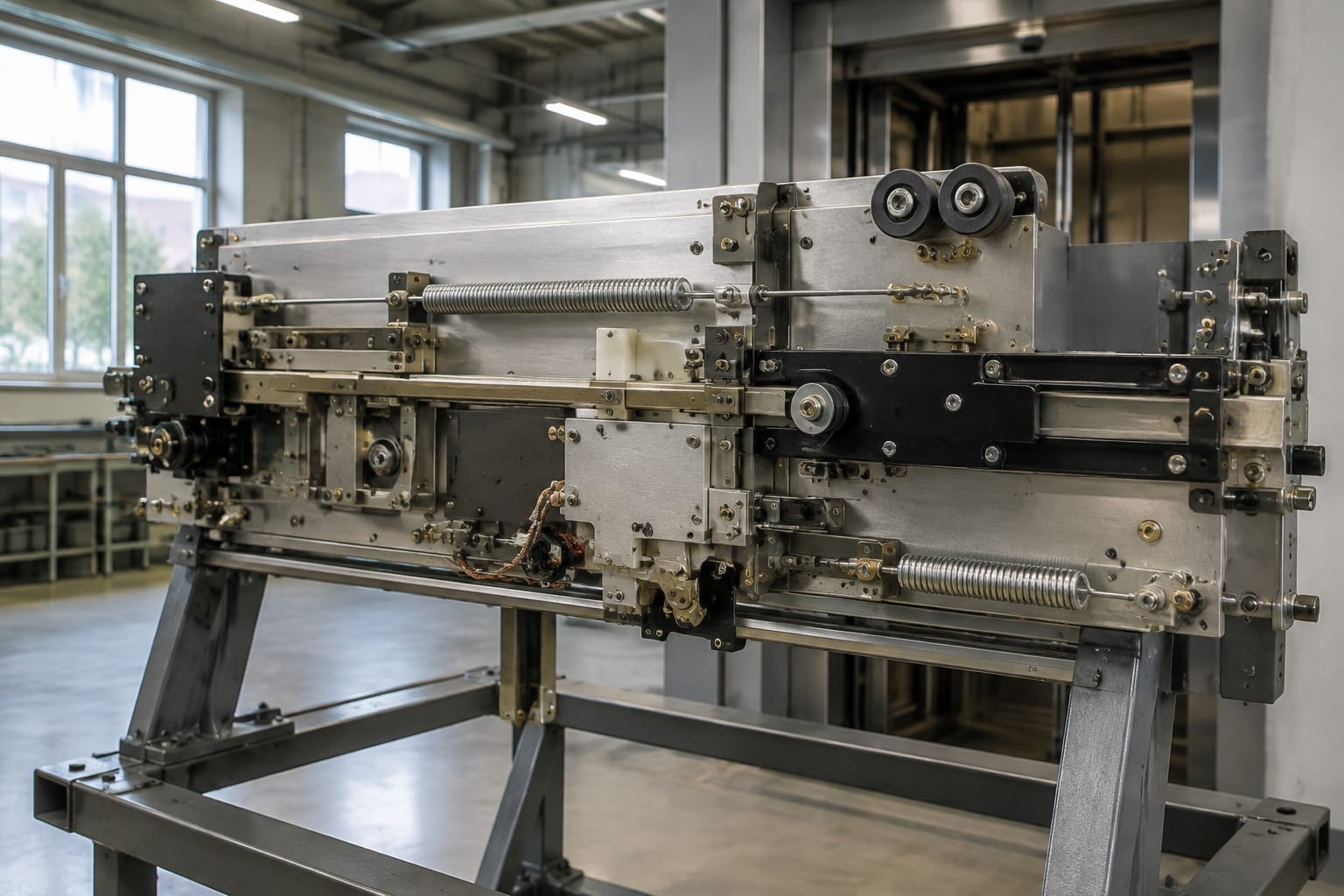
An elevator door stopper is not always one separately named part. In lift-door work, buyers may use the term for any component that limits travel, cushions the panel, returns a moving part, or helps the door stop in the correct position. Depending on the door system, this can mean a spring, rubber buffer, roller, stop block, hanger-related component or door-operator limit arrangement.
The correct replacement depends on the exact function of the original item. Do not select a part by its general appearance alone: door type, mounting method, dimensions, handedness, spring force and interaction with the operator all affect compatibility. A stopper that is too hard, too soft, incorrectly positioned or fitted to a worn bracket can create a persistent closing or re-opening fault.
What buyers mean by elevator door stopper
An elevator door stopper generally refers to a mechanical component that prevents excessive movement or controls the final part of the door’s travel. It may be installed on a car door, landing door, header, sill, hanger assembly or operator mechanism.
Common uses of the term include:
- A rubber or polyurethane bumper that absorbs the final impact of a panel.
- A metal stop block that physically limits door travel.
- A coil, compression, extension or leaf spring that returns a lever, knife or locking component.
- A roller or cam-related part that guides a panel into its intended stopping position.
- A travel-limit device associated with the door operator.
- A retaining component that prevents a hanger, vane, clutch or linkage from moving beyond its designed range.
Before sourcing, establish what happens when the component fails. A part that cushions a panel is not interchangeable with a part that establishes the open position. Similarly, a door knife spring may be described informally as a stopper because it controls movement, but its actual purpose is to return or load the knife mechanism.
For multi-brand maintenance portfolios, buyers should obtain photos of the installed component, the door operator or landing-door assembly, and all available part markings. These details are more useful than a generic description such as “lift door rubber” or “door stop spring”.
Springs, buffers, and travel limits
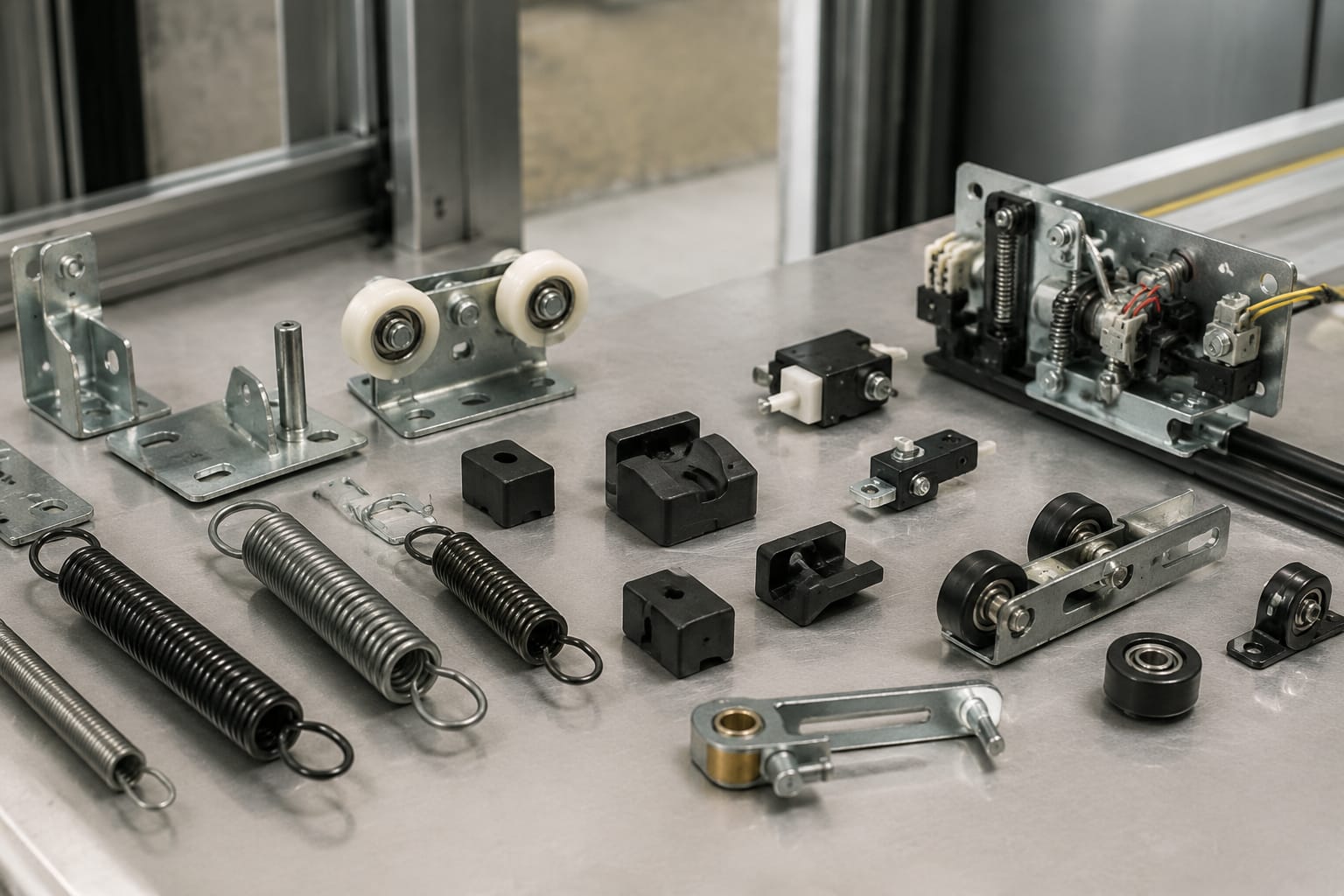
Springs, buffers and hard stops can all influence where and how an elevator door comes to rest. They should be assessed by function rather than grouped as interchangeable “door stopper parts”.
| Component type | Main function | Typical failure signs | Important sourcing checks |
|---|---|---|---|
| Rubber or polyurethane buffer | Cushions contact at the end of travel | Noise, impact marks, flattened or cracked material | Diameter, height, hardness where known, fixing method, contact surface |
| Metal stop block or bracket | Creates a fixed mechanical travel limit | Panel over-travel, loose stop, damaged mounting holes | Profile, mounting-hole centres, thickness, orientation, material condition |
| Compression spring | Provides return force or absorbs limited travel | Weak return, rattling, coil breakage, uneven action | Free length, outside diameter, wire diameter, coil count, end type |
| Extension spring | Pulls a linkage or mechanism back to position | Slow return, overstretching, broken hook ends | Hook arrangement, free length, body dimensions, extension length and force |
| Leaf or knife spring | Loads a contact, knife or latch-related mechanism | Inconsistent engagement, weak contact pressure, distortion | Overall length, width, thickness, hole or slot positions, shape |
| Operator travel-limit arrangement | Signals or controls intended travel limits | Failure to stop, reversal, repeated fault codes | Door operator make and model, switch type, cam position, wiring and settings |
A buffer should only absorb the movement it was designed to receive. It must not be used to hide a panel that is running too far, a failing operator limit, worn rollers or a distorted door track. Replacing the bumper without correcting the cause will often result in rapid repeat damage.
Spring selection also needs care. The dimensions of two springs can appear similar while their working force differs substantially. A spring that is overly strong can increase load on a lever, knife or linkage. One that is too weak may allow delayed return, incomplete engagement or vibration.
Where a door assembly uses a replaceable spring, compare its complete geometry. This includes the direction and shape of hooks, bends, tabs and formed ends, not merely the coil or strip dimensions. For example, a [door knife spring for Mitsubishi elevator parts](/products/elevator-door-knife-spring-119x17mm-mitsubishi-elevator-parts-lift-accessories/) should be matched to the relevant mechanism and measured against the installed part before it is ordered for a particular application.
Mechanical stop versus electrical limit
A mechanical stop physically prevents further movement. An electrical limit switch, sensor or encoder input tells the operator when it has reached a chosen point. Many door systems rely on both.
The mechanical stop provides protection against excessive travel, while the operator should normally decelerate and stop the door before it strikes that stop with force. If the door consistently hits a mechanical stopper, investigate the operator settings, limit arrangement, belt or linkage condition and encoder feedback. Treating a hard stop as the normal operating stop causes impact, noise and accelerated wear.
Related rollers and hanging components
A door that does not stop or close cleanly may have a sound stopper but worn guidance or hanging components. These parts determine whether the panel can travel smoothly and arrive at the intended position without binding.
Check the following related items during diagnosis:
- Hanger rollers: Flat spots, bearing play, damaged running surfaces and poor adjustment can make the panel oscillate or sit unevenly.
- Door tracks: Dirt, scoring, corrosion and deformation change roller travel and can prevent a repeatable final position.
- Gibs and sill guides: Wear or damage may allow the lower edge of the panel to move sideways, causing rubbing or poor engagement.
- Hanger plates and fasteners: Loose mounting hardware can shift the panel position under load.
- Coupling vane, clutch or knife components: Incorrect clearance or weak spring return can affect landing-door unlocking and closure.
- Door belts, chains, arms and linkages: Wear, slack or incorrect tension can alter the opening and closing travel.
- Landing-door locks and interlocks: A door may appear to stop badly when the actual issue is incomplete lock engagement or a sticking lock mechanism.
Do not assume a roller is acceptable because it still turns by hand. Under the weight of a panel, a roller bearing can bind, develop clearance or run unevenly. Look for a consistent panel gap and smooth movement over the full door travel.
Where spring dimensions match one of the common configurations, a [600 mm hall-door spring](/products/600mm-hall-door-spring-lift-accessories-elevator-spare-parts/) may be relevant. The stated length alone is not enough to establish suitability; end fittings, installation position and duty within the door arrangement must also correspond.
Symptoms of poor stopping or closing
The way a door behaves helps narrow down the fault, although it should not be treated as proof of one defective part. Observe several cycles, from the safe inspection position and in accordance with the site’s maintenance procedures, before altering an adjustment.
| Symptom | Likely mechanical contributors | Other checks before replacing parts |
|---|---|---|
| Loud impact at full open or closed | Missing buffer, worn stopper, operator over-travel | Travel-limit setting, encoder feedback, loose bracket |
| Door stops short of closed position | Binding roller, poor sill guidance, weak return spring | Door detector, lock engagement, operator force and timing |
| Door bounces or re-opens | Incorrect stop position, excessive spring force, panel misalignment | Safety edge or light curtain, detector wiring, closing-force settings |
| One panel reaches position before the other | Uneven hanger adjustment, linkage wear, roller drag | Centre-opening synchronisation, belt or chain condition |
| Scraping or rubbing near final travel | Misaligned panel, worn gibs, distorted track | Sill debris, door-panel damage, header alignment |
| Intermittent failure to unlock landing door | Worn knife, return spring fault, coupling misalignment | Lock condition, vane clearance, car-door position |
| Repeated buffer damage | Over-travel, loose mounting, unsuitable material | Operator control, impact source, stop alignment |
A consistent impact at the same point in every cycle often suggests a stop, limit or operator-travel problem. An intermittent symptom is more likely to involve loose hardware, worn rollers, a damaged track, fluctuating electrical feedback or a component that shifts under load.
When a door fault affects landing-door locking, re-opening behaviour or passenger access, it must be handled by appropriately competent lift personnel. Avoid bypassing safety circuits, disabling protective devices or increasing closing force simply to make a door complete its cycle.
Inspect alignment and mechanical wear
Inspect the door system before making an adjustment. An adjustment made on a worn or misaligned assembly can mask the fault briefly while worsening component wear.
Start with the door isolated and secured according to the applicable maintenance procedure. Confirm the condition of the area around the header, sill and landing-door equipment. Remove dirt or foreign material only where it can be done safely and without introducing contamination into the mechanism.
Practical inspection sequence
- Look for contact evidence. Check buffers, stop blocks, brackets and adjacent metalwork for dents, polished impact points, displaced rubber or cracked fasteners.
- Check panel position. Compare the panel gaps, vertical alignment and meeting edges. A panel that hangs low or leans can touch the sill or strike a stop incorrectly.
- Assess roller movement. Turn rollers where accessible, inspect bearings and confirm that the hanger track is not damaged or obstructed.
- Examine springs and formed parts. Look for broken coils, loss of tension, corrosion, distortion, worn holes and hook damage. Compare the failed component with the matching item on an equivalent panel where applicable.
- Check fixed hardware. Inspect stop-bracket fasteners, mounting holes and welds. A stopper may appear worn when its bracket has moved.
- Observe the linkage. Check belts, arms, chains, coupling components and pivots for play or altered geometry.
- Verify the intended limit point. Establish whether the door operator stops before the panel contacts the mechanical stop, as designed for that arrangement.
Never move a stop block or limit cam without first recording its original position. A measured reference, clear photographs and witness marks can help return the system to its starting setting if further diagnosis is needed.
Measure the original component
For an elevator door stopper replacement, measurements should describe the installed part and its mounting position. A single overall length is rarely enough.
Record the following before ordering:
- Equipment make, door operator model and any part number stamped or moulded onto the component.
- Whether the component is fitted to the car door or landing door.
- Clear photographs from front, side and mounting-face views.
- Overall length, width, thickness or diameter.
- Hole diameter, slot dimensions and centre-to-centre spacing.
- Thread size and pitch for screwed components.
- Spring free length, wire diameter, outside diameter, coil count and end form.
- Buffer height, contact shape and mounting style.
- Left-hand or right-hand orientation, where relevant.
- Position relative to the track, header, sill, vane, hanger or linkage.
- Condition of the matching mounting bracket and adjacent components.
Use callipers where the required tolerance is important. A tape measure is useful for general dimensions but is less reliable for wire diameter, hole size and compact formed components. Measure an unworn portion if a contact face has been crushed, flattened or abraded.
For a spring, do not stretch it merely to estimate its force. If the original specification is unavailable, the supplier will usually need the complete dimensional and application information. A similar-looking spring may not provide the same operating load or fit safely in the available space.
A [replacement door spring for lift accessories](/products/door-spring-lift-accessories-elevator-spare-parts/) should therefore be evaluated against the original spring’s dimensions, ends and installed function rather than selected on length alone.
Adjustment versus replacement
Adjustment is appropriate when the part is undamaged, its mounting is secure and inspection shows that the problem is positional rather than caused by wear. Replacement is the better decision when the component can no longer perform its original function reliably.
Adjustment may be appropriate when
- A stop bracket has shifted but is straight and securely mountable.
- A limit cam requires controlled repositioning after confirming the original settings are incorrect.
- Hanger adjustment is required to restore correct panel alignment.
- A linkage has a documented adjustment range and shows no damaging wear.
- A buffer is intact but no longer meets the contact point because another serviceable component has been correctly repositioned.
Adjust only within the equipment manufacturer’s documented procedure and within the mechanical range intended for that system. Randomly extending travel to overcome a closing issue can result in collision, failed lock engagement or excessive strain on the operator.
Replacement is normally appropriate when
- Rubber has hardened, split, detached or permanently deformed.
- A metal stop is bent, cracked, badly worn or has elongated mounting holes.
- A spring is broken, corroded, stretched, distorted or has lost repeatable return action.
- A roller has rough bearings, flats, excessive play or a damaged running surface.
- A bracket cannot hold its position securely.
- A component has been modified previously and its original geometry is no longer clear.
- Repeated adjustment does not produce stable, repeatable operation.
Replacing just the visibly damaged part is not always enough. If a failed buffer was repeatedly struck because of operator over-travel, confirm and correct the travel cause before fitting the new buffer. Likewise, a replacement spring will not resolve a sticky mechanism with seized pivots or a badly misaligned coupling vane.
For B2B sourcing teams, separate the immediate repair item from related wear items. A contractor may need one stopper for the urgent repair, while a distributor may need compatible rollers, springs or mounting hardware for planned maintenance stock. Keeping the application details with the purchase record reduces the risk of later misidentification.
Final door-motion and safety tests
After an adjustment or replacement, test the complete movement and safety function, not only the repaired area. The aim is smooth, repeatable door motion with correct stopping position and confirmed landing-door security.
Carry out final checks according to the relevant equipment documentation, site procedures and applicable safety requirements. At minimum, verify:
- The door opens and closes without scraping, impact or abnormal vibration.
- The panel reaches the intended open and closed positions consistently.
- Mechanical stops and buffers are contacted only as intended, without excessive impact.
- Panel alignment, sill clearance and meeting-edge gaps remain correct through travel.
- Hanger rollers, gibs, stops and fasteners remain secure after repeated operation.
- Landing-door lock engagement is correct where work affects the coupling or locking area.
- Door protective devices and re-opening functions operate correctly.
- The door operator does not report faults or make repeated unsuccessful closing attempts.
- The repair has not introduced interference with wiring, sensors, covers or other moving parts.
Run enough cycles to identify heat-related binding, drifting adjustments or intermittent contact faults. Observe both normal operation and the relevant safety-device responses. Record the component fitted, dimensions or part number, adjustment position and test result in the maintenance documentation.
An elevator door stopper fault is often a symptom of wider door wear rather than an isolated part failure. Identify the stopping function first, inspect the running and hanging components around it, then source a replacement by measured geometry and verified application. Kelevator supplies multi-brand elevator spare parts for B2B importers, distributors, maintenance contractors and OEM buyers; a clear photo set and measured component record will support a more accurate parts enquiry.