
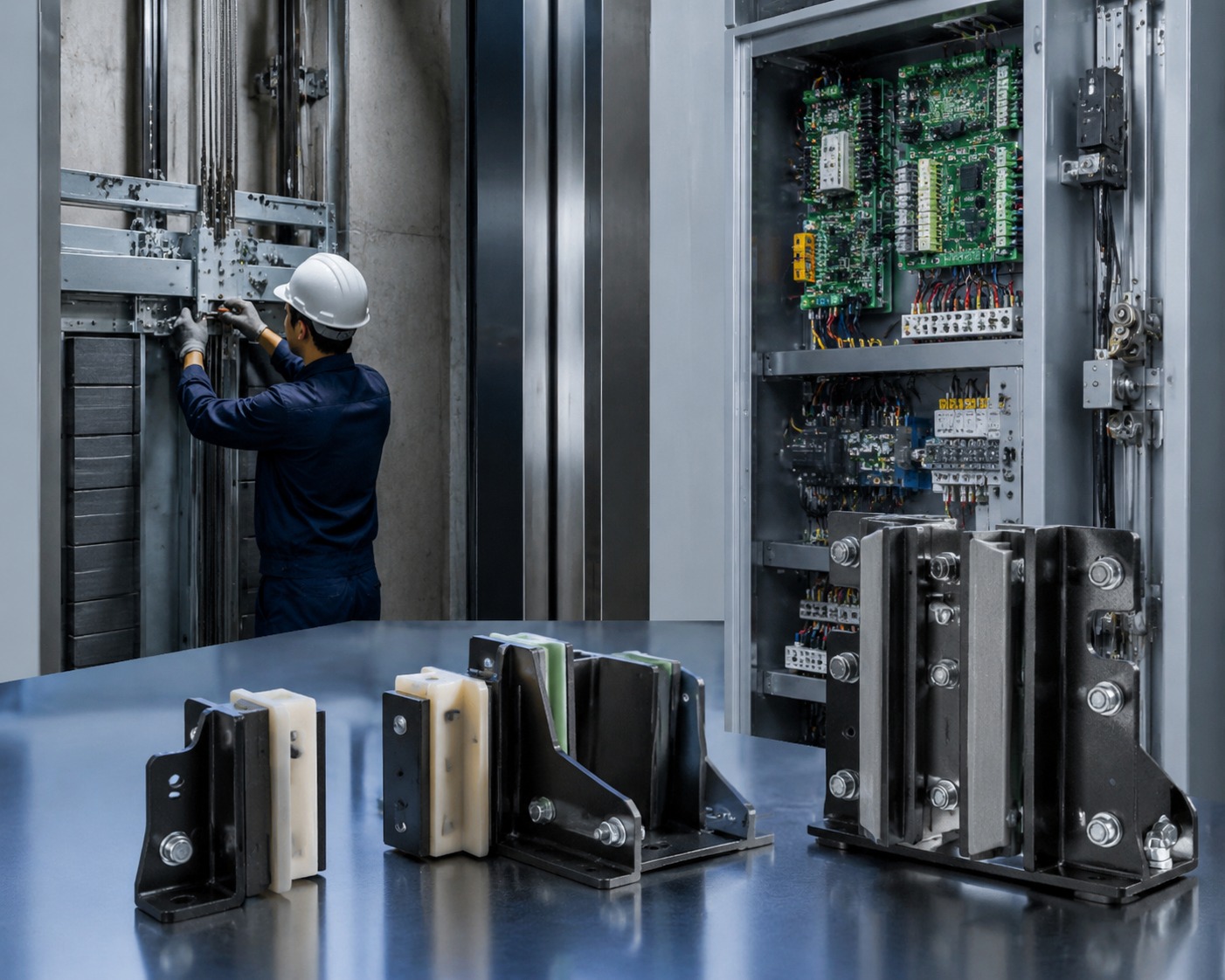
Elevator guide shoes and guide shoe liners are small components with a very big job. They help the car and counterweight travel in a controlled path along the guide rails, reducing side movement, limiting vibration, lowering running noise, and protecting the rail surface from unnecessary wear. In practical maintenance work across South Africa, a correctly matched liner can improve ride comfort, reduce callbacks, and support safer long-term operation in residential towers, commercial buildings, hospitals, hotels, mines, and public facilities.
For building owners and lift maintenance teams in Johannesburg, Cape Town, Durban, Pretoria, Gqeberha, and growing logistics zones near Richards Bay, guide shoe selection is not only about finding a part that physically fits. The correct choice depends on rail size, car load, travel speed, operating environment, alignment condition, and brand-specific requirements. A liner that is too hard, too soft, too loose, or dimensionally incorrect can lead to noise complaints, uneven wear, rail marking, and recurring shutdowns.
In the South African market, many service companies are dealing with aging elevator assets, mixed-brand modernization projects, and tighter maintenance budgets. That makes reliable model matching and replacement planning more important than ever. Whether you need a complete sliding guide shoe for elevator systems, a dedicated counterweight guide shoe lining, a main rail sliding guide shoe lining, or a size-specific 88x20mm guide shoe lining for compatible lift models, the buying process should start with function, fit, and operating condition rather than price alone.
This guide explains what elevator guide shoes do, the differences between main rail and counterweight applications, how to choose lining size and material, what wear signs to watch for, and what to check during installation. It also covers replacement notes relevant to Hitachi systems, practical maintenance advice for smoother travel, and 2026 market trends related to technology, policy, and sustainability.
The line chart above reflects a realistic demand pattern for elevator spare parts in South Africa, where urban refurbishment, mixed-use construction, and modernization of older stock continue to support replacement demand. Guide shoe liners are a recurring consumable in this cycle because they directly affect ride quality and rail protection.
What elevator guide shoes do
Guide shoes are installed on both the elevator car and the counterweight to keep each moving mass aligned with its guide rails. In most conventional systems, the guide shoe body holds a replaceable liner or insert that contacts the rail. This contact surface is engineered to provide controlled sliding or guided movement, depending on design. In sliding guide shoe arrangements, the liner is the wear part. It absorbs friction, stabilizes travel, and acts as a sacrificial component so the rail itself does not wear prematurely.
When technicians in South Africa receive complaints such as cabin shaking, rubbing noise, rough starts, or a scraping sound near landing transitions, guide shoe liners are often one of the first parts inspected. That is because the liner directly influences how evenly the shoe contacts the rail. If the liner is worn unevenly or the shoe is poorly aligned, the elevator may transmit vibration into the car frame and cabin interior.
Guide shoes also play a role in long-term energy efficiency. Excessive friction caused by improper liner material or poor fit increases running resistance. Over time, that can place extra load on the drive system and contribute to avoidable wear in other mechanical components. In coastal areas such as Durban and Cape Town, where humidity and airborne contaminants can influence surface conditions, correct liner choice and maintenance are especially important.
| Guide shoe function | Practical effect | Risk if neglected |
|---|---|---|
| Maintain rail tracking | Keeps the car and counterweight moving on a stable path | Sway, rubbing, and unstable travel |
| Reduce vibration | Improves passenger comfort and cabin feel | Noise complaints and poor ride quality |
| Lower running noise | Minimizes friction sounds between liner and rail | Grinding or squeaking during travel |
| Protect guide rails | Wear occurs on the replaceable liner, not the rail | Rail scoring and costly corrective work |
| Support alignment | Helps maintain consistent clearance along travel path | Uneven contact and accelerated liner wear |
| Enable predictable maintenance | Liners can be replaced before major damage occurs | Unexpected downtime and emergency callouts |
The table shows why guide shoes are not minor accessories. They are a core wear-control interface in the vertical transport system. In buildings with heavy daily use, such as office towers in Sandton, hospitals in Pretoria, and hotels along the Cape Town waterfront, proactive liner replacement often costs far less than reactive repair after vibration and rail wear become severe.
Main rail and counterweight guide shoe differences
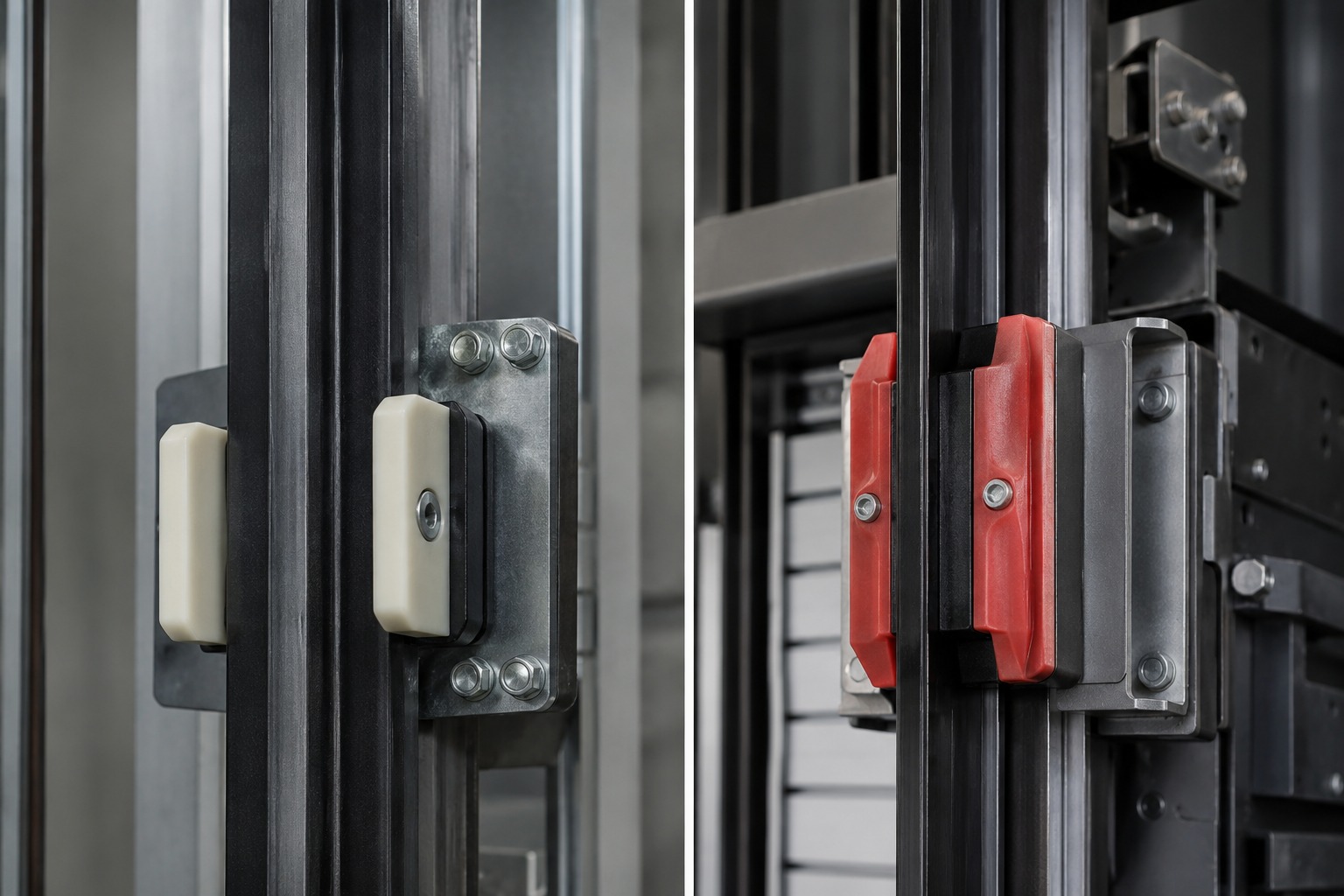
Main rail guide shoes are installed on the elevator car, while counterweight guide shoes are installed on the counterweight frame. Although the operating principle is similar, the wear pattern and selection priorities can differ. The car side is more directly linked to passenger comfort, because any instability or vibration is felt in the cabin. The counterweight side influences balance, smoothness, and overall mechanical stability, but its issues are often less immediately visible until wear becomes significant.
Main rail guide shoe liners may be selected with stronger emphasis on ride comfort, noise control, and compatibility with the car’s load profile and speed range. Counterweight liners, by contrast, may show different pressure behavior due to the counterweight frame geometry, travel dynamics, and rail condition. In modernization projects, replacing the car-side liners but ignoring the counterweight side can result in uneven system behavior and repeated service visits.
Another key difference is inspection visibility. Car-side issues may be identified faster because passengers report symptoms. Counterweight-side wear can continue unnoticed until technicians observe dust, chips, uneven rail marks, or abnormal movement in the shaft. For that reason, experienced maintenance teams in South Africa usually inspect both sides together during scheduled service.
| Item | Main rail guide shoe | Counterweight guide shoe |
|---|---|---|
| Mounted on | Elevator car frame | Counterweight frame |
| Main priority | Ride comfort and cabin stability | System balance and guided movement |
| Typical symptom when worn | Cabin vibration, rubbing noise, rough ride | Shaft noise, imbalance feel, hidden wear |
| Inspection trigger | Passenger complaints and ride quality checks | Routine shaft inspection and rail marking review |
| Replacement importance | High impact on user experience | High impact on long-term mechanical stability |
| Common buying mistake | Choosing by appearance only | Ignoring counterweight compatibility and dimensions |
| Service recommendation | Confirm rail size, shoe body type, liner hardness | Confirm frame fit, wear pattern, and rail contact area |
The explanation above matters when sourcing spare parts for mixed-brand environments. A maintenance contractor handling one Hitachi passenger lift in a hospital and another older commercial lift in Durban CBD should not assume that similar-looking liners are interchangeable. Main rail and counterweight liners may have different profiles, dimensions, contact geometry, or material grades.
The bar chart highlights where demand often concentrates. Commercial offices, hospitals, and retail buildings tend to generate steady guide shoe liner demand because they combine frequent movement with high expectations for smooth travel and low noise.
How to select lining size and material
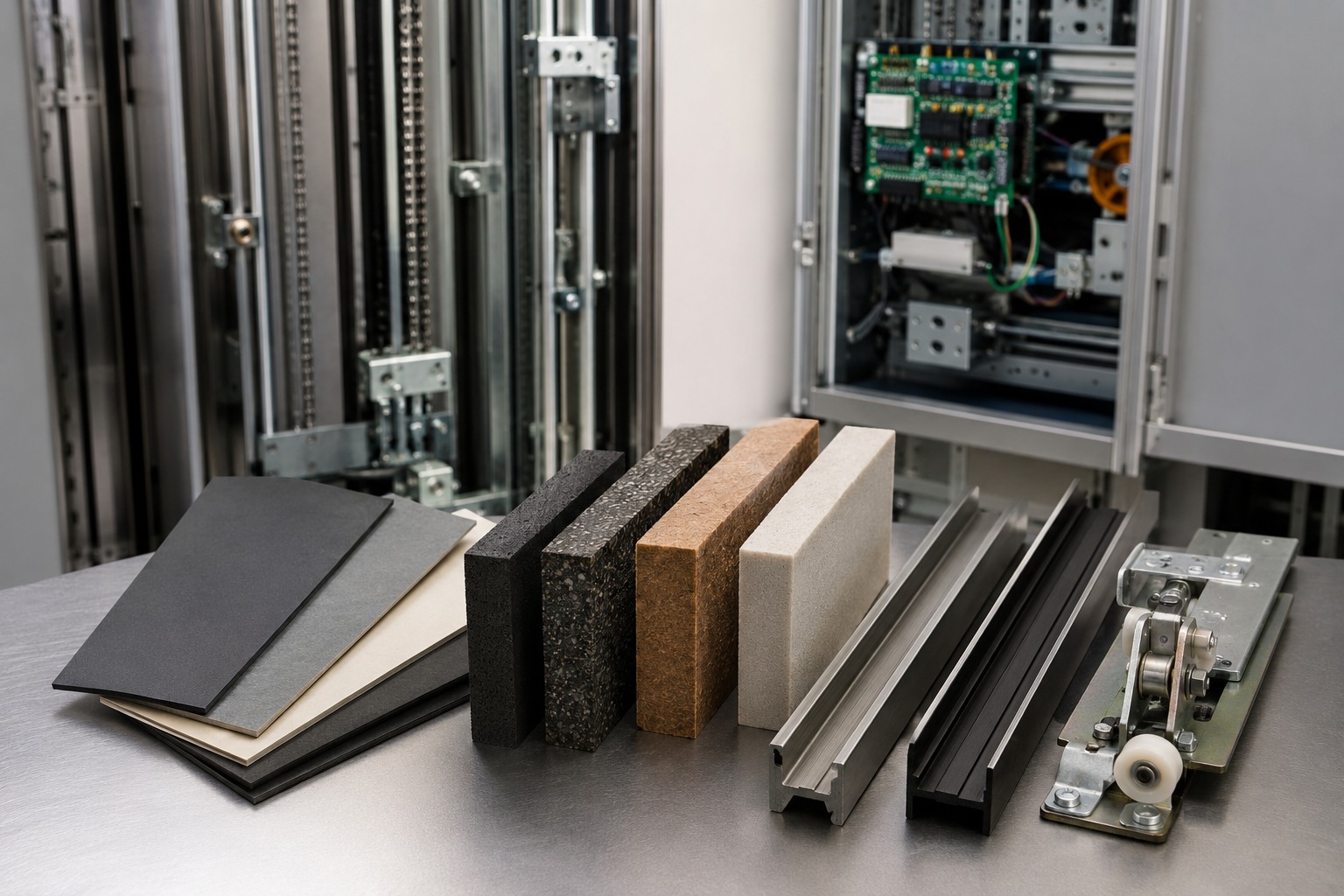
Choosing the correct guide shoe lining starts with accurate dimensional matching. The rail width, liner width, thickness, groove profile, fixing structure, and overall length all matter. A mismatch of even a few millimetres can create excessive clearance or over-tight contact. Both conditions can damage ride quality. Buyers should always verify the old part code, measured dimensions, elevator model, and where possible, photographs of the installed shoe body before ordering replacements.
Material selection is the second major factor. Different polymers and composite materials offer different performance in friction, wear resistance, noise control, temperature tolerance, and rail friendliness. A softer material may reduce noise but wear faster in high-duty applications. A harder material may last longer in some conditions but transfer more vibration if alignment is not ideal. This is why liner material should match the actual site condition, not just the original drawing when the installation has changed over years of service.
For South African conditions, environmental factors can also matter. Inland dust, coastal humidity, shaft temperature variation, and maintenance frequency all influence wear behavior. In a busy Johannesburg residential tower, a liner optimized for stable daily traffic may be the right choice. In a port-adjacent commercial building in Durban, where environmental contamination is higher, maintenance accessibility and contamination resistance may be equally important.
| Selection factor | What to verify | Why it matters |
|---|---|---|
| Rail size | Exact rail type and contact dimensions | Ensures the liner sits and runs correctly |
| Liner width and thickness | Measure the old liner and housing | Prevents looseness or excessive friction |
| Length and profile | Check the groove shape and edge geometry | Avoids partial contact and uneven wear |
| Material grade | Match friction and wear properties to duty level | Balances lifespan, noise, and rail protection |
| Speed and load condition | Know whether the unit is low, medium, or high duty | Heavier use requires more suitable wear performance |
| Brand and model compatibility | Confirm manufacturer reference or equivalent part | Reduces wrong-order risk |
| Site environment | Dust, humidity, temperature, maintenance frequency | Influences material suitability and service interval |
This table should be used as a buying checklist, not a general reference only. When maintenance companies send complete dimensional and application details, sourcing becomes faster and more accurate. That is especially helpful in modernization projects where older equipment may have incomplete records and multiple previous part substitutions.
From a product type perspective, buyers generally compare complete guide shoe assemblies, car-side liners, counterweight liners, and size-specific inserts. If the metal shoe body remains in good condition and only the wear insert is damaged, replacing the liner is often the most cost-effective choice. If the housing is cracked, distorted, or badly corroded, a full guide shoe replacement may be the better solution.
Signs of worn guide shoe liners
Guide shoe liners rarely fail without warning. In most cases, they show progressive symptoms that can be identified during inspection. The challenge is that some signs are subtle at first, especially on the counterweight side. A good maintenance routine looks for both obvious wear and early indicators.
The most common visible signs include thinning of the liner, polished or glazed surfaces, chips at the contact edge, deformation, cracking, and uneven wear on one side. Operational signs include vibration inside the cabin, increased running noise, intermittent scraping, poor floor-to-floor smoothness, and visible rail marking. In extreme cases, misalignment plus worn liners can contribute to abnormal loading on the guide shoe body itself.
Property managers in South Africa often focus first on user complaints, but by that stage wear may already be advanced. Preventive inspections are therefore a smarter and lower-cost approach, especially for buildings with strict uptime expectations such as medical centres, student accommodation, and premium mixed-use developments.
| Wear sign | What it suggests | Recommended action |
|---|---|---|
| Uneven thickness | Misalignment or side-biased rail contact | Replace liner and check shoe alignment |
| Cracks or chips | Material fatigue or impact stress | Replace immediately and inspect rail condition |
| Glazed polished surface | Heat build-up or friction concentration | Review material choice and contact pressure |
| Black or grey dust buildup | Accelerated friction wear | Clean area and inspect wear rate |
| Cabin vibration | Worn liner, loose shoe, or poor rail contact | Inspect both car and counterweight shoes |
| Scraping or squeaking noise | Dry, damaged, or misaligned contact surface | Stop relying on lubrication alone; inspect parts |
| Rail scoring marks | Liner no longer protecting the rail effectively | Replace liner and assess rail damage urgently |
The explanation from the table is straightforward: if wear symptoms are ignored, the cost can move from a simple consumable replacement to rail correction, repeat service visits, and passenger dissatisfaction. A liner is inexpensive compared with the downtime impact of a noisy or unstable lift in a busy property.
The area chart shows a realistic trend shift toward improved low-noise and longer-life liner materials. By 2026 and beyond, modernization projects in South Africa are likely to place greater emphasis on ride comfort, energy efficiency, and fewer maintenance interruptions.
Hitachi guide shoe replacement notes
Hitachi elevator systems are widely recognized in many commercial and residential applications, but replacement success depends on accurate model matching. Guide shoe liners used in Hitachi-compatible applications may vary by rail size, car frame design, installation period, and specific modernization history. Visual similarity is not enough. Even when a liner appears close in length or thickness, a small difference in contact geometry can affect wear rate and ride performance.
When replacing Hitachi guide shoe liners, technicians should record the old part code where visible, take clear photos of the shoe body and liner seating area, measure the full liner dimensions, and confirm whether the application is car main rail or counterweight. It is also useful to note whether abnormal wear was present on one side only, because that may point to an alignment issue rather than a parts issue.
In retrofit work, one common problem is that the old liner has already been replaced in the past with a non-original equivalent. If buyers simply reorder based on the installed part without checking the full configuration, the same mismatch may continue. That is why a careful supply partner does not only ask for a brand name. They ask for dimensions, application side, quantity, photos, and any observed symptoms.
Our work with maintenance companies and distributors is built around three practical capabilities. On the technological side, we support model matching through part identification, cross-checking, and compatibility review for elevator electronics and mechanical spare parts across brands including Hitachi, Toshiba, KONE, Mitsubishi, and others. On the manufacturing side, we focus on stable sourcing, dimensional consistency, and protective packaging that helps liners and other wear parts arrive in service-ready condition. On the service side, we respond quickly to application questions, help reduce wrong orders, and support customers who need reliable replacement parts to minimize lift downtime.
For projects where replacement speed matters, such as hospitals in Gauteng or hospitality sites in Cape Town during high season, this combination of matching accuracy, inspection discipline, and responsive service can make a meaningful difference.
Installation and alignment checks
Even the best guide shoe liner will not perform correctly if it is installed poorly. Installation should include inspection of the guide shoe body, fasteners, seating surfaces, rail condition, and overall alignment. Any burrs, contamination, or damage in the housing can prevent the liner from seating properly. The rail surface should also be checked for scoring, corrosion, or build-up that could quickly damage the new insert.
Alignment is one of the most important and most overlooked factors. If the guide shoe body is not square to the rail path, the liner will wear unevenly and may cause vibration from the first day of service. After replacement, technicians should confirm contact consistency, running clearance where applicable, fastener security, and smooth manual or test movement before returning the lift to normal operation.
| Installation check | What to inspect | Why it matters |
|---|---|---|
| Correct liner identity | Part code, dimensions, application side | Prevents wrong-fit installation |
| Shoe body condition | Cracks, distortion, corrosion, loose hardware | A damaged body will ruin a new liner quickly |
| Housing cleanliness | Dust, metal particles, old debris | Ensures full seating and stable contact |
| Rail surface condition | Scoring, roughness, contamination | Protects the new liner from immediate damage |
| Alignment | Square contact and even pressure | Reduces one-sided wear and vibration |
| Fastener security | Proper tightening and retention | Avoids movement or liner shift during travel |
| Test run review | Noise, smoothness, temperature, wear trace | Confirms correct installation before full use |
The practical lesson from this checklist is clear: replacing only the visible wear part without correcting installation or alignment faults leads to repeated failure. In many field cases, the liner is blamed when the root cause is actually rail condition, shoe body deformation, or shaft alignment drift over time.
For larger portfolios, some property operators in South Africa now ask maintenance contractors to standardize post-installation reporting. A simple report with photos, measured dimensions, wear observations, and test-run notes helps prevent recurring issues across multiple sites.
This comparison chart reflects the criteria many professional buyers use when evaluating suppliers. Price remains important, but accurate matching, stable quality, and response speed often determine the true cost of a replacement order.
Maintenance tips for smoother travel
Smoother elevator travel comes from maintenance discipline, not from replacement parts alone. Guide shoe liners should be inspected on a scheduled basis according to traffic level, environment, and equipment age. High-use passenger lifts in office towers may need more frequent checks than lightly used service lifts. Buildings near the coast may also require closer attention because environmental conditions can affect rail surfaces and contamination levels.
Maintenance teams should monitor not only the liner itself but also the conditions around it. Key points include rail cleanliness, abnormal dust generation, shoe body security, unusual friction marks, and changes in ride feel. If a newly installed liner begins wearing too quickly, technicians should review alignment, load distribution, and rail condition before assuming the material is defective.
A practical maintenance strategy for South African portfolios often includes the following: maintaining records by building and elevator unit, keeping critical liner sizes in stock for fast-moving models, training technicians to capture dimensions and photos correctly, and replacing car-side and counterweight-side liners as a system when wear patterns indicate paired deterioration. This is particularly useful for maintenance companies supporting mixed stock across Johannesburg business districts, Durban residential complexes, and municipal buildings in Pretoria.
| Maintenance practice | Benefit | Recommended frequency or trigger |
|---|---|---|
| Visual liner inspection | Finds early cracks, thinning, and uneven wear | At each routine service visit |
| Rail surface cleaning review | Reduces abrasive contamination | Based on shaft condition and environment |
| Noise and vibration tracking | Identifies wear before severe damage | Monthly or after complaints |
| Dimension verification on replacement | Prevents repeat wrong orders | Every order and every first-fit installation |
| Photo documentation | Improves future sourcing accuracy | Before and after replacement |
| Paired side inspection | Compares car and counterweight wear behavior | During major service or troubleshooting |
| Spare stock planning | Reduces downtime on critical sites | Quarterly review for high-use buildings |
From an industries and applications perspective, guide shoe liners are essential in residential towers, office buildings, hospitals, hotels, educational facilities, shopping centres, logistics buildings, and industrial plants with passenger or goods lifts. In each case, the business value is slightly different. Residential buildings want low noise and fewer tenant complaints. Hospitals need dependable, smooth movement for patients and equipment. Hotels care about guest experience. Industrial sites prioritize uptime and durability.
One real-world pattern seen in the market is that modernization contractors increasingly request compatible replacement parts for phased upgrades rather than full system replacement all at once. In these projects, guide shoe liners become a practical reliability item that can improve ride feel quickly while other modernization stages are still being planned.
FAQ about guide shoe lining
What is the difference between a guide shoe and a guide shoe lining?
The guide shoe is the complete assembly mounted on the car or counterweight frame. The guide shoe lining is the replaceable wear insert inside or attached to the shoe that contacts the rail.
How often should guide shoe liners be replaced?
There is no single interval for every elevator. Replacement depends on traffic, rail condition, alignment, material grade, and environment. High-use lifts in busy South African commercial buildings may need more frequent inspection and replacement than lightly used residential lifts.
Can I replace only the car-side liners and leave the counterweight side unchanged?
You can if the counterweight liners remain in acceptable condition, but it is best practice to inspect both sides together. Uneven wear between the car and counterweight can reduce the benefit of replacement and may hide a system alignment issue.
What information should I send when requesting a quote?
Provide brand, model if known, whether the part is for main rail or counterweight, exact dimensions, clear photos, quantity needed, and any wear symptoms observed. This helps reduce wrong matching.
Are harder liners always better?
No. Harder material is not automatically the best choice. The correct liner must balance wear life, friction, ride comfort, and rail protection for the actual site condition.
Do worn liners cause noise only, or can they affect safety and reliability too?
They can affect both. Worn liners may start as a noise issue, but if ignored they can lead to unstable travel, rail marking, repeated shutdowns, and higher mechanical stress in the system.
What should buyers in South Africa look for in a supplier?
Look for accurate model matching, reliable quality inspection, stable sourcing, careful packaging, and responsive technical support. Those points matter more than price alone when downtime is costly.
What trends should buyers expect in 2026?
Three trends stand out. First, technology: more customers will request better ride-comfort materials and more precise part identification support. Second, policy and asset management: building owners will continue shifting toward preventive maintenance and documented replacement records. Third, sustainability: there will be stronger interest in longer-life components, reduced waste through correct first-time matching, and packaging that protects parts to avoid reorders and unnecessary transport.
As the South African elevator market grows through modernization, urban densification, and refurbishment, guide shoe liners will remain a small but high-impact spare part. Buyers who focus on dimensional accuracy, application-specific material choice, and professional installation will get better ride quality, fewer complaints, and lower total maintenance cost. For maintenance companies, distributors, building owners, and modernization contractors, this is where dependable sourcing creates real value: less downtime, easier replacement planning, and safer, smoother elevator operation across the full service life of the equipment.
| Buyer priority | Best practice | Expected result |
|---|---|---|
| Correct model matching | Share dimensions, photos, and application side | Fewer wrong orders and faster installation |
| Stable product quality | Choose inspected and consistent liners | Predictable wear performance |
| Good packaging | Protect liners from transit damage and deformation | Ready-to-install condition on arrival |
| Responsive service | Work with a supplier that answers compatibility questions quickly | Reduced downtime during urgent repairs |
| Planned maintenance | Replace before severe wear damages the rail | Lower lifecycle cost |
| Long-term partnership | Standardize data capture across sites | Better stock planning and repeat-order accuracy |
| Sustainability focus | Prioritize correct first-time fit and durable materials | Less waste and fewer unnecessary shipments |
The final table summarizes the commercial side of guide shoe liner buying. In short, the most successful projects combine technical verification, suitable material selection, consistent quality control, and practical service support. That approach helps South African customers keep lifts running smoothly in everything from city office towers to residential estates, hospitals, hospitality sites, and industrial facilities.