
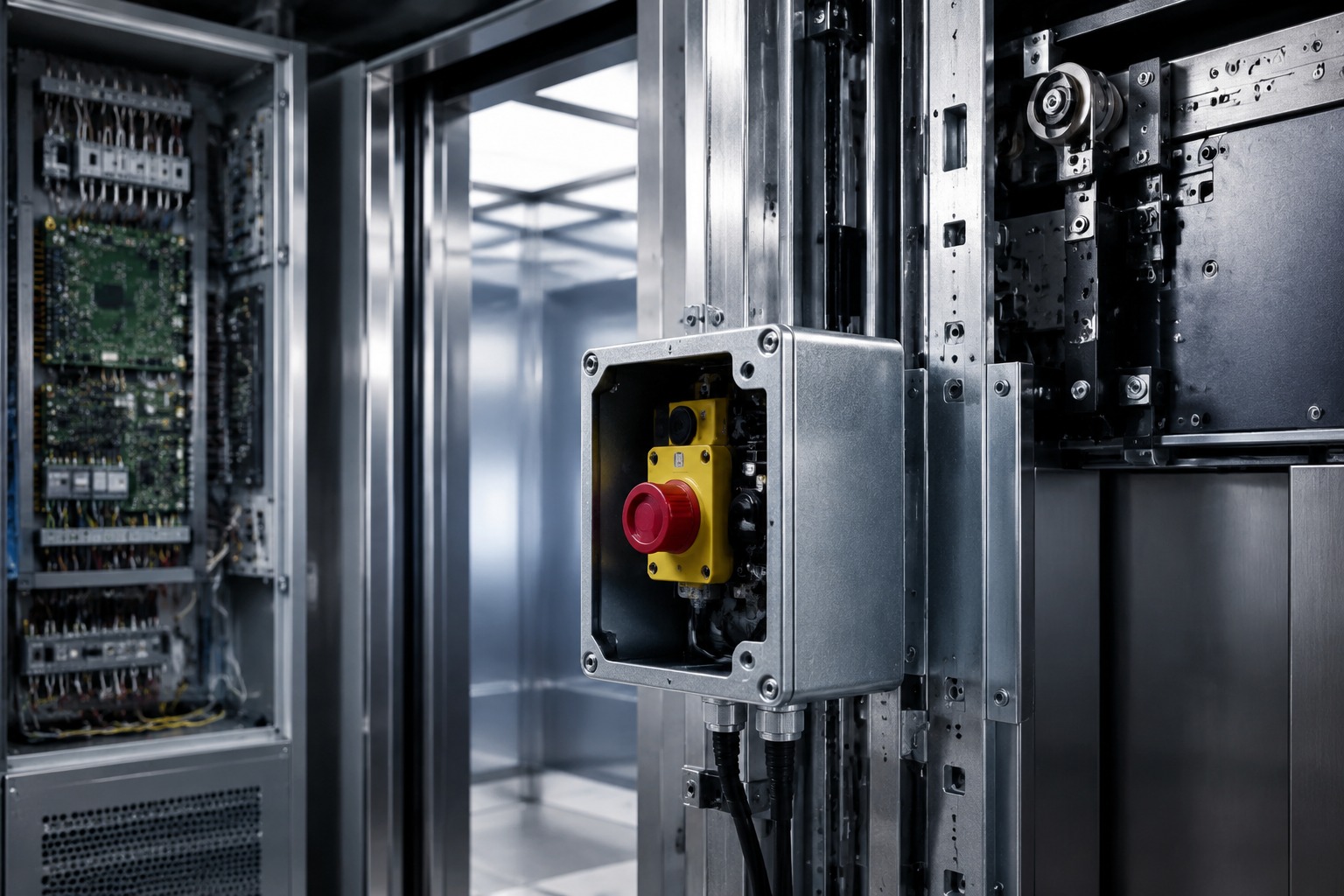
For lift maintenance teams, an elevator inspection box is not a minor accessory. It is a practical safety and control device that helps technicians work on the car top, inside the shaft, and during controlled maintenance operations with better visibility, safer command inputs, and clearer isolation of operating modes. In South Africa, where service providers support elevators in high-rise offices, hospitals, hotels, residential towers, logistics facilities, and public buildings, inspection boxes and mobile switch boxes play an important role in reducing downtime and improving maintenance safety.
In direct terms, an elevator inspection box usually includes inspection control buttons, a stop or emergency stop function, mode selection, cable connection points, housing protection, and in many cases a service light or related power interface. An LCA mobile switch box is commonly used for temporary or portable inspection control during troubleshooting, adjustment, modernization, and replacement work. The correct product must match the lift brand, connector layout, cable length, voltage requirements, and on-site maintenance procedure. Before any unit is returned to service, technicians should confirm installation integrity, cable security, control logic, stop function response, and normal operation in inspection and automatic modes.
Across Johannesburg, Cape Town, Durban, Pretoria, Sandton, Midrand, Bloemfontein, and Gqeberha, maintenance contractors often need replacement parts quickly, especially for older systems where downtime affects tenant experience and building compliance. This is why buyers increasingly look for suppliers that can help with accurate model matching, stable quality checks, protective packing for inland and coastal transport, and responsive support for branded lift systems such as Hitachi, Toshiba, KONE, Mitsubishi, and other major platforms.
If you are sourcing an inspection box for maintenance work, modernization, or a recurring spare parts program, the most important goal is not just to buy a box that looks similar. The goal is to obtain a unit with the right control logic, correct connector structure, dependable stop function, and practical durability for real service conditions in South Africa’s mixed climate and building environments.
South Africa market overview for inspection box demand
The South African lift service market is shaped by a combination of aging installed elevators, phased modernization projects, increased expectations for uptime in premium buildings, and a strong need for cost-controlled replacement parts. In commercial districts such as Sandton and Cape Town CBD, building owners often prioritize fast maintenance recovery because lift downtime affects tenants, visitors, and property image. In industrial and port-linked areas around Durban and Gqeberha, service access and logistics timing matter more, especially when spare parts are moving through major trade hubs.
Inspection boxes are frequently purchased in three situations: first, as direct replacements for damaged or worn service boxes; second, as planned spares for contractors who maintain multiple similar lift models; and third, as part of modernization work where old service controls are no longer reliable. Demand is also influenced by safety culture. Building managers increasingly expect documented testing after maintenance, which places more focus on the quality and reliability of inspection controls.
The market is also changing because many service companies now aim to standardize inventory. Instead of keeping too many mismatched parts, they prefer to stock high-use items with clear model compatibility. Inspection boxes, mobile switch boxes, inspection lights, intercom parts, and related control accessories often sit in the same service inventory group because they are frequently needed together during car-top or shaft work.
The chart above reflects a realistic growth pattern tied to older lift fleets, stricter maintenance expectations, and rising modernization activity. For 2026 and beyond, future demand is likely to be supported by three trends: greater focus on technician safety, more selective replacement of control accessories during upgrades, and broader interest in reliable compatible spare parts rather than waiting for long original supply cycles.
What an elevator inspection box includes
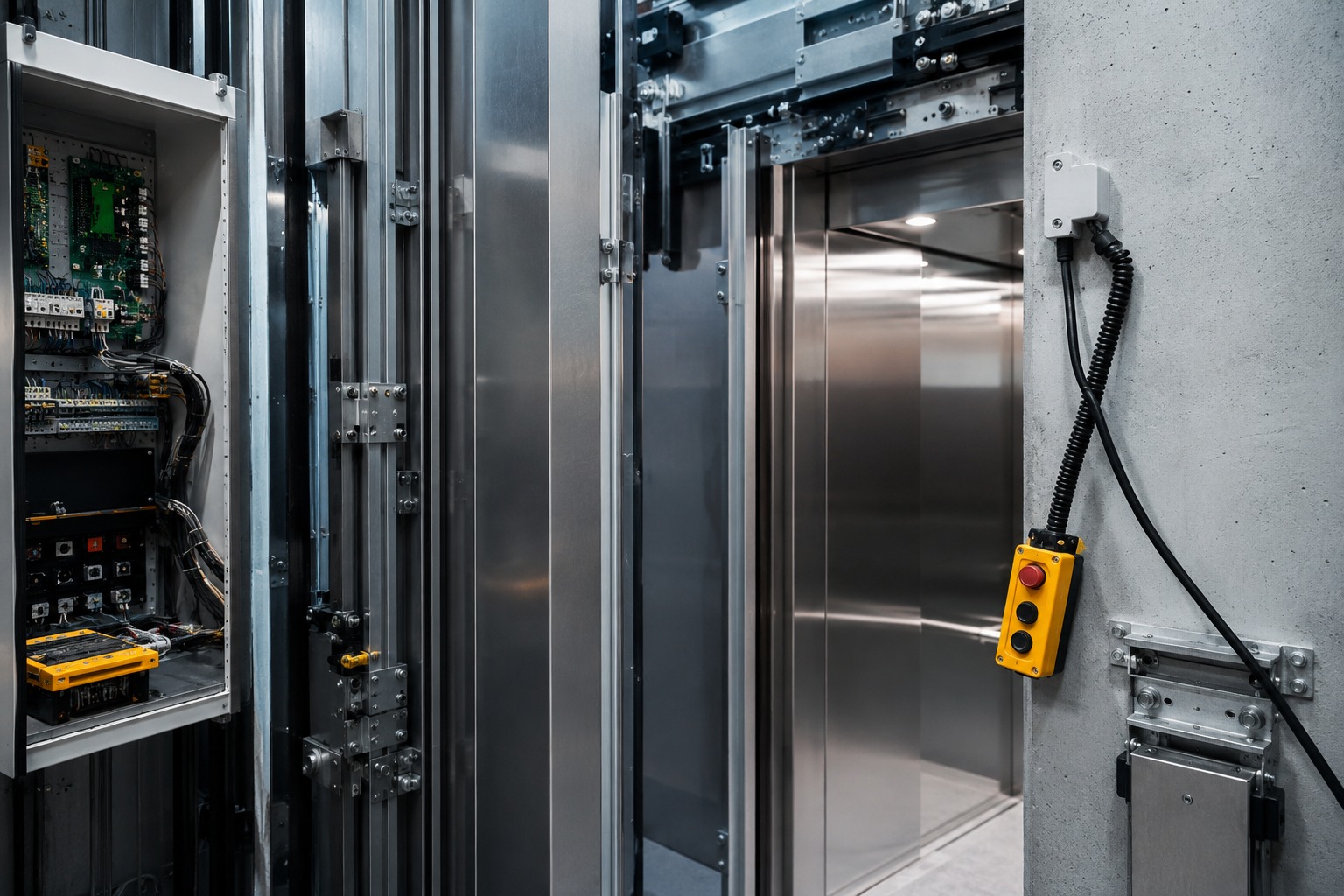
An elevator inspection box is designed to give technicians safe and controlled access to maintenance commands when normal passenger operation is not suitable. While exact configurations vary by manufacturer and model, most units include several core elements. These components must work together correctly because inspection control errors can affect both safety and diagnosis.
Typical contents include push buttons for controlled car movement, a stop device, a mode selector for inspection or normal operation, cable or plug assemblies, internal wiring terminals, and a durable enclosure. Depending on the system, the box may also integrate a key switch, direction buttons, a buzzer, labeling plate, lamp holder, or interface points for additional maintenance functions. Some systems are paired with an inspection light power supply or intercom terminal so technicians can communicate and work more effectively inside low-visibility spaces.
For example, service teams replacing worn control accessories on older lifts may also need a compatible 12V inspection light power supply for elevator maintenance to improve visibility on car tops and shaft access points. On larger sites, especially hospitals and office towers, a matching communication solution such as an elevator intercom terminal for service communication can support safer maintenance coordination.
| Component | Main function | Why it matters | Typical check during servicing |
|---|---|---|---|
| Up button | Commands controlled upward movement in inspection mode | Allows safe low-speed positioning | Confirm tactile response and correct signal output |
| Down button | Commands controlled downward movement | Supports leveling and shaft work | Check button return and motion logic |
| Emergency stop or stop switch | Interrupts movement immediately | Critical life-safety function during maintenance | Test instant response and reset behavior |
| Inspection/normal mode selector | Transfers control authority to maintenance mode | Prevents unintended passenger operation | Verify proper isolation between modes |
| Cable harness | Connects box to control circuit | Ensures stable signal transmission | Inspect insulation, continuity, and strain relief |
| Connector or plug | Provides fast connection to lift system | Must match the original socket design | Check pin arrangement and lock retention |
| Protective enclosure | Shields components from dust and accidental impact | Improves reliability in harsh service areas | Inspect sealing, cracks, and mounting points |
| Labeling and markings | Identifies control functions clearly | Reduces operator error | Confirm readability and correct language marking |
The table shows why an inspection box should be evaluated as a complete service control assembly, not just as a plastic housing with buttons. In many South African maintenance environments, dust, vibration, humidity, and repeated handling can shorten the life of connectors, cable entries, and switch contacts. That is why buyers should request detailed model information and, where possible, photos or diagrams of the connector side before ordering.
LCA mobile switch box use cases
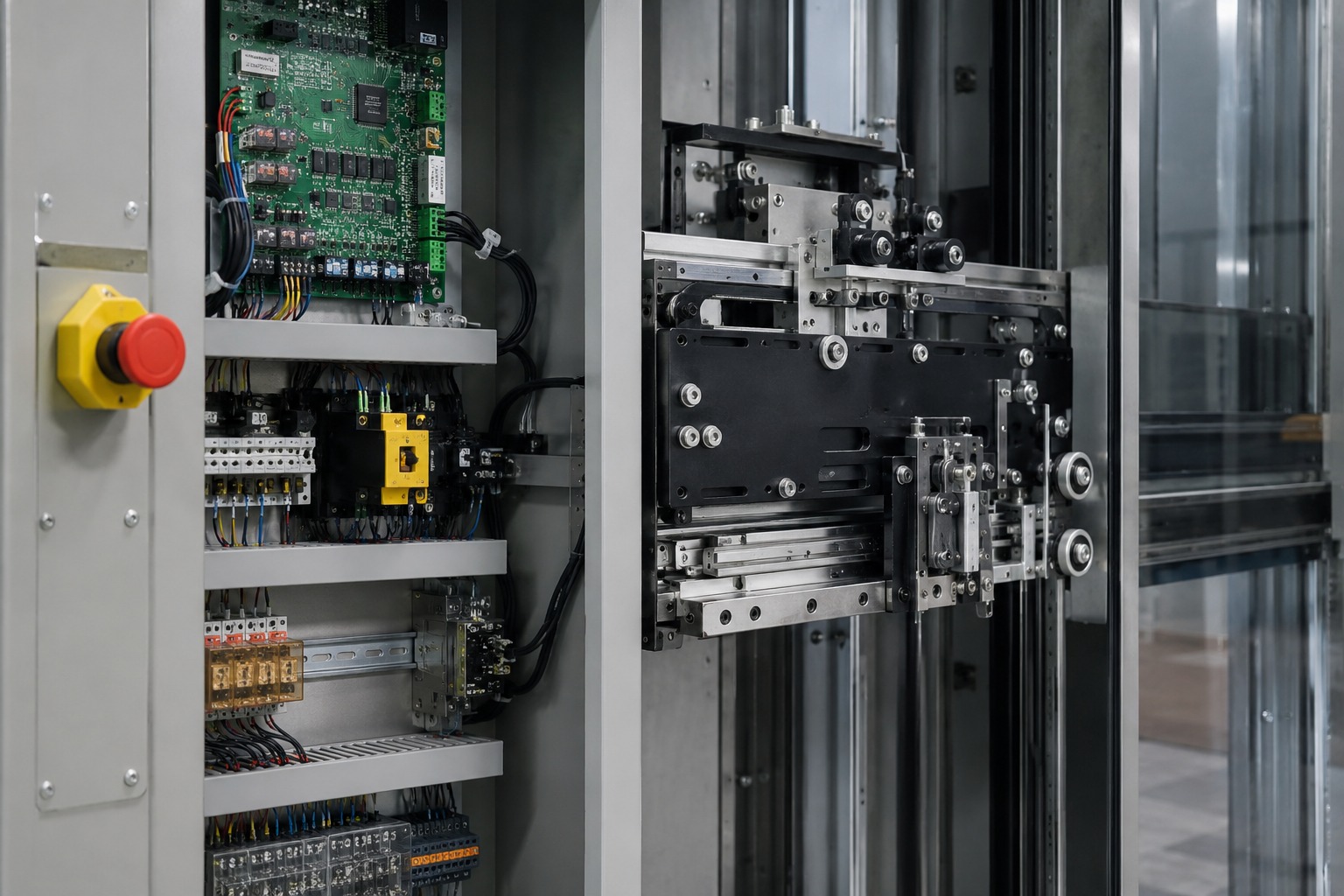
An LCA mobile switch box is commonly used when technicians need temporary, movable, or model-specific inspection control during lift servicing. Compared with fixed assemblies, the mobile format can offer flexibility during troubleshooting, commissioning support, modernization, and component replacement. It is especially practical when the original inspection box is damaged, when service teams need a known-good unit for diagnostics, or when field conditions require a portable control point.
In South Africa, typical use cases include maintenance work in aging commercial buildings, modernization packages in hotels and shopping centres, and urgent troubleshooting in residential towers where a lift must be assessed before full parts replacement is approved. Service companies also use mobile switch boxes as workshop test aids before final installation on site.
If your team needs a replacement or portable unit, it is worth reviewing a dedicated LCA mobile switch box for lift maintenance applications with close attention to wiring layout, cable length, plug structure, and intended brand compatibility.
| Use case | Typical site type | Why a mobile switch box helps | Key buying concern |
|---|---|---|---|
| Temporary replacement during repairs | Office towers in Johannesburg | Restores service control while original unit is assessed | Connector and signal compatibility |
| Troubleshooting intermittent faults | Mixed-use properties in Cape Town | Lets technicians compare suspect and known-good control behavior | Stable button contact quality |
| Modernization project support | Hotels and malls in Durban | Useful during phased replacement of aging components | Integration with revised control logic |
| Workshop bench testing | Service depots in Pretoria | Allows pre-site verification of switch functions | Wire identification and robust cable entry |
| Emergency field response | Residential high-rises in Sandton | Speeds diagnosis when downtime is critical | Fast availability and safe packaging |
| Training and familiarization | Maintenance training centres | Helps technicians understand inspection logic safely | Clear labeling and repeatable performance |
| Backup stock for service fleets | Regional contractors across South Africa | Reduces waiting time for recurring replacements | Model coverage and inventory planning |
This table highlights that the value of an LCA mobile switch box lies in flexibility and uptime support. Buyers should still avoid assuming that “mobile” means “universal.” In practice, exact fit, control logic, and electrical matching remain essential. A visually similar box can still be unsuitable if the connector keying, terminal arrangement, or stop circuit behavior differs from the target lift system.
Control mode and emergency stop functions
Control mode selection and emergency stop functions are the two most important operational aspects of an inspection box. In maintenance mode, control authority is intentionally shifted away from standard passenger commands so technicians can move the car carefully at inspection speed. The mode selector must reliably isolate automatic operation and activate the correct inspection logic. If this transfer is unstable, the risk of unsafe movement or confusing system behavior increases.
The emergency stop or stop switch must also operate immediately and predictably. During car-top work, shaft inspections, or door zone testing, technicians depend on fast interruption of movement. A stop function that is sticky, delayed, electrically inconsistent, or mechanically worn should be treated as unacceptable. Good practice requires verification not only of the stop action itself but also of reset behavior and the correct restoration of control afterward.
Because South African service environments often include both older conventional systems and newer modernized controls, maintenance teams should confirm whether the inspection box expects momentary commands, maintained commands, or a particular sequence for enabling motion. Some systems require strict two-button logic or interlocked command paths. This is another reason why professional model matching matters.
The bar chart reflects the strongest demand concentration in office and residential assets, where lift usage is frequent and downtime quickly becomes visible. Hospitals also maintain significant demand because service reliability and safe maintenance procedures are especially important. For buyers, this means that if you service these sectors, keeping inspection control parts in stock is often more efficient than ordering only after failure.
Cable and connector compatibility
Cable and connector compatibility is where many avoidable ordering mistakes happen. A replacement inspection box may look correct on the outside but still fail to install or operate properly if the plug geometry, pin count, wire mapping, shielding, or cable length does not match the original setup. For South African buyers working across multiple brands and mixed-age building portfolios, this is a common challenge.
Compatibility checks should include the lift brand and model, the original part number if available, photos of both sides of the old unit, cable length, number of conductors, connector type, locking style, key orientation, voltage rating, and whether any field splicing has already been done. If a site has undergone previous modernization, the installed connector may no longer match the original factory documentation. In that case, visual confirmation becomes even more important.
In coastal cities such as Durban and Cape Town, buyers may also consider environmental exposure. Humidity and corrosion can affect contacts, especially in older buildings or poorly protected machine spaces. For inland sites with frequent temperature variation and dust, cable jacket integrity and strain relief become key durability points.
| Item to confirm | Why it matters | Possible risk if ignored | Recommended action |
|---|---|---|---|
| Part number or code | Provides the fastest matching reference | Receiving a similar but unsuitable unit | Share label photos and old documentation |
| Connector pin count | Determines electrical interface capacity | No connection or wrong signal path | Count pins and compare with supplier drawing |
| Connector shape and keying | Prevents misalignment or forced insertion | Mechanical incompatibility and pin damage | Send close-up plug images from multiple angles |
| Cable length | Affects reach and routing safety | Strain on wiring or poor installation path | Measure end-to-end including sheath |
| Wire color or numbering | Supports accurate installation and testing | Wiring confusion during field replacement | Record conductor marks before removal |
| Voltage and signal characteristics | Ensures safe electrical operation | Control malfunction or component damage | Verify against lift controller requirements |
| Shielding and insulation condition | Important in noisy or harsh environments | Intermittent signal issues | Request equivalent or better cable spec |
| Mounting and strain relief points | Secures the box during maintenance use | Premature cable wear | Confirm gland, clamp, or bracket layout |
The table makes clear that connector compatibility is not a single-point check. It is a set of linked mechanical and electrical details. Professional sourcing works best when the supplier reviews not only the product name but also model photos, brand history, and any modernization changes that may have happened at the site.
Installation safety checks
Installation safety checks should always come before the lift is powered back into maintenance control. Even a correct replacement part can become a hazard if installed with loose terminals, damaged insulation, incorrect routing, or unclear mode status. Good field practice includes lockout procedures where required, isolation confirmation, physical inspection of the new assembly, and documentation of any deviations from the original setup.
For contractors working across South Africa, consistency matters. Whether the site is a premium office in Sandton, a hospital in Pretoria, or a coastal hotel in Durban, technicians should follow the same logic: verify the part, inspect the box, secure the cable, confirm the control path, test the stop function, then validate operation under controlled conditions. It is also good practice to inspect adjacent maintenance accessories such as inspection lights, intercom connections, and cable supports while access is available.
| Check point | What to inspect | Why it is important | Typical result expected |
|---|---|---|---|
| Part identity | Model, connector, and application match | Prevents wrong-unit installation | Confirmed against old unit or site data |
| Housing condition | Cracks, deformation, sealing, and mounting tabs | Protects components and user handling | No visible damage or weakness |
| Cable routing | Path, bend radius, and pinch points | Reduces future wear and short-circuit risk | Neat routing with no strain |
| Terminal or connector engagement | Locking, seating depth, and retention | Ensures stable signal transfer | Secure fit with no looseness |
| Stop switch behavior | Mechanical action and electrical interruption | Essential maintenance safety protection | Immediate stop response |
| Mode selector state | Inspection vs normal operating position | Prevents control confusion | Clear mode indication and correct logic |
| Label clarity | Direction and stop markings visible | Supports safe technician use | Readable and correctly placed |
| Nearby accessory condition | Lighting, intercom, and brackets | Improves complete maintenance safety | All related items serviceable |
The explanation behind these checks is simple: maintenance safety depends on both the part and the installation quality. An inspection box with reliable internals can still fail in service if connector locking is weak or cable routing places constant stress on conductors. For this reason, experienced buyers often choose suppliers that support detail verification before shipment rather than relying on generic descriptions alone.
Testing before returning to service
Before a lift returns to normal operation, the installed inspection box should be tested in a structured sequence. The goal is to prove that the replacement does not only power up, but also behaves correctly under the exact maintenance and operating conditions expected by the system. This protects both technicians and building users.
A practical test sequence starts with a visual recheck, then continuity or connection confirmation where appropriate, followed by mode transfer testing, stop switch testing, direction control verification, low-speed movement confirmation, and final restoration to normal mode. Any irregularity should be resolved before the lift is released. On multi-unit sites in Johannesburg or large residential portfolios in Cape Town, documenting this process also helps standardize maintenance quality across teams.
| Test step | Purpose | What to verify | Release decision |
|---|---|---|---|
| Visual recheck | Catch obvious installation issues | No loose cable, open housing, or damage | Proceed only if physically sound |
| Connector and continuity confirmation | Validate stable electrical path | Proper engagement and no intermittent contact | Proceed if connection is stable |
| Inspection mode activation | Confirm control transfer | Automatic mode is disabled as intended | Continue if mode logic is correct |
| Emergency stop test | Verify immediate interruption | Car movement stops without delay | Reject if response is uncertain |
| Up command test | Check directional control | Correct low-speed upward movement | Pass only with correct response |
| Down command test | Check opposite directional control | Correct low-speed downward movement | Pass only with correct response |
| Reset and return to normal mode | Restore system safely | Inspection control releases properly | Proceed if automatic mode recovers normally |
| Final operational observation | Ensure stable post-test behavior | No fault messages or erratic operation | Release only after clean observation |
For larger contractors, a documented test sheet attached to the job file can reduce disputes and improve maintenance traceability. This is especially useful for managed properties, hospitals, and modernization projects where multiple parties may review the maintenance outcome.
The area chart shows a broader trend already visible in the market: buyers are moving away from purely price-led decisions and toward safer, better-matched parts with clearer testing support. This trend is likely to strengthen through 2026 as modernization budgets increasingly focus on reliability, technician safety, and practical lifecycle value.
Maintenance tips for inspection boxes
Inspection boxes are service tools, but they also require service attention. Preventive maintenance can extend useful life, reduce nuisance faults, and prevent unsafe field conditions. This is especially true for units in buildings with heavy usage, repeated maintenance access, or exposure to dust and humidity.
The first rule is regular visual inspection. Look for cracked housings, fading labels, stiff buttons, loose cable glands, damaged connector locks, and worn strain relief points. The second rule is function verification. Buttons should respond consistently, the stop function must remain immediate, and the mode selector should switch positively without ambiguity. The third rule is environmental protection. Where possible, keep the box clean, dry, and properly secured after use.
Contractors that maintain broad brand portfolios often benefit from planned spare rotation. Instead of waiting for total failure, they replace units that show early mechanical wear or intermittent switching. This is especially helpful in premium properties where repeated lift downtime is unacceptable. Service teams can also reduce future errors by labeling stored spares clearly by model, connector type, and intended application.
From a sourcing perspective, long-term maintenance success depends on more than obtaining a single part. It depends on dependable matching, repeatable quality, and packaging that protects sensitive accessories during transport from warehouse to job site. For customers across South Africa, especially those moving parts between inland service depots and coastal locations through Durban or Cape Town logistics channels, packaging quality can make a meaningful difference.
Buying advice for South African contractors and building owners
When choosing an inspection box or LCA mobile switch box, South African buyers should prioritize six factors. First is compatibility: part number, connector type, cable length, and wiring logic must align with the installed lift. Second is safety function reliability, especially the stop circuit and inspection mode changeover. Third is product condition and quality consistency. Fourth is supplier responsiveness when technical photos or application details need review. Fifth is protective packaging for transport. Sixth is after-sales support when clarification is needed during installation.
Buyers in major cities may have faster local courier access, but many maintenance companies support sites over wide geographic areas. This makes pre-shipment checking especially valuable. A supplier that reviews labels, plug photos, and system details before dispatch can help reduce return risk and prevent lost service time. This matters whether the destination is a high-rise in Johannesburg, a university building in Bloemfontein, or a coastal residential site near Gqeberha.
It is also wise to think in terms of total maintenance cost rather than unit price alone. A lower-priced but mismatched part can lead to return delays, repeat technician visits, extended shutdowns, and tenant complaints. In contrast, a correctly matched inspection box with stable performance often saves money through faster installation and fewer service interruptions.
Industries and applications that rely on inspection boxes
Inspection boxes are used wherever lifts require safe access for maintenance, testing, and fault diagnosis. In commercial offices, they support routine servicing and response to heavy daily usage. In hospitals, they help technicians maintain reliable lift performance for patients, staff, and equipment movement. In hotels and residential towers, they are essential for minimizing disruption and restoring uptime quickly. In shopping centres, inspection controls support service in high-traffic systems where doors, leveling, and repeated start-stop cycles create ongoing maintenance demands.
Industrial and logistics sites may use freight-capable lifts or service lifts that require durable maintenance controls. University campuses, government buildings, and transport-linked facilities also rely on dependable inspection access. In all these environments, the inspection box is part of the practical safety framework that allows technicians to work carefully on systems that cannot be serviced through normal passenger controls alone.
The comparison chart shows why many maintenance buyers prefer specialist support over generic sourcing. For technical parts like inspection boxes, the difference often comes down to fewer matching mistakes, more reliable pre-shipment checks, and better service continuity.
Case studies from the South African market
In one Johannesburg office property, a maintenance team faced repeated downtime caused by a worn inspection control assembly during car-top servicing. The original unit had inconsistent button response and unreliable stop action. By replacing it with a carefully matched inspection box and verifying connector layout before dispatch, the team shortened installation time and reduced repeat callouts over the following maintenance cycle.
In Cape Town, a residential tower undergoing phased modernization needed temporary maintenance control support while older accessories were being replaced one by one. A mobile switch box helped the contractor maintain safer service access during the transition period. The key lesson was that temporary control devices still require exact review of connector structure and operating logic; speed should never replace compatibility checks.
In Durban, a coastal building experienced connector corrosion issues on a lift with irregular service history. During replacement, the contractor reviewed not just the box but also nearby cable condition and related accessories. The outcome improved stability and highlighted the value of checking the wider maintenance environment rather than changing a single visible component only.
Local suppliers and sourcing routes in South Africa
Local availability matters, but so does technical accuracy. South African buyers often source elevator spare parts through local distributors, regional maintenance stockists, import channels, and specialist suppliers supporting branded and compatible parts. Proximity can help with delivery speed, yet technical review remains the deciding factor for parts like inspection boxes, intercom accessories, and inspection light power units.
Logistics routes through Durban and Cape Town ports remain important for imported components, while inland distribution through Johannesburg and Pretoria supports service networks across Gauteng and beyond. Contractors managing service fleets in multiple provinces often prefer suppliers that combine inventory planning with clear model verification. This approach reduces downtime and avoids unnecessary emergency procurement.
| Supplier factor | What good service looks like | Why it helps buyers | Warning sign |
|---|---|---|---|
| Technical identification support | Reviews labels, photos, and connector details | Reduces mismatch risk | Only asks for a generic part name |
| Brand and model familiarity | Understands common lift platforms and variations | Improves replacement confidence | Cannot discuss compatibility limits |
| Quality inspection process | Checks appearance, wiring, and basic build integrity | Reduces faulty receipt cases | No mention of inspection before shipment |
| Protective packaging | Secure packing for cable and connector protection | Important for longer transport routes | Loose or minimal packing |
| Communication speed | Fast response to technical questions | Supports urgent downtime cases | Slow replies during model confirmation |
| After-sales follow-up | Available to clarify installation questions | Helps field teams resolve uncertainty | No support after delivery |
| Inventory planning support | Can recommend recurring spares for fleets | Helps reduce emergency orders | Handles every request as one-off only |
This comparison is useful because sourcing quality is often the hidden factor behind maintenance efficiency. The best supplier is not always the closest one, but the one most likely to help you get the right part the first time.
Our company support for elevator maintenance buyers
For South African customers, our role is to help maintenance companies, distributors, building owners, and modernization contractors source compatible lift parts with less uncertainty. We support a broad range of elevator spare parts, including control boards, inverter and frequency converter parts, door operator components, door locks, light curtains, guide shoes, oil cups, sensors, encoders, power supplies, buttons, COP panels, intercom parts, inspection control accessories, and other lift items for brands such as Hitachi, Toshiba, KONE, Mitsubishi, and more.
In terms of technological capabilities, we focus on accurate model matching and practical application review. That means checking available part codes, connector forms, cable details, and product photos to help customers narrow down compatibility before shipment. For buyers dealing with mixed lift fleets in Johannesburg, Pretoria, Durban, or Cape Town, this reduces the risk of ordering visually similar but unsuitable components.
In terms of manufacturing capabilities, we pay attention to stable quality inspection and durable product handling. For inspection boxes and related accessories, that means reviewing build consistency, connector integrity, housing condition, and packing protection before dispatch. This is especially important for parts that may travel long distances or move through multiple logistics points before reaching the job site.
In terms of service capabilities, we aim to provide responsive communication, practical sourcing support, and protective packaging so customers can reduce downtime and plan replacement work more effectively. Many buyers do not just need a supplier; they need a partner that can help confirm models, prepare compatible replacement options, and support recurring spare parts needs across multiple building sites.
Future trends for 2026: technology, policy, and sustainability
Looking ahead to 2026, elevator inspection box demand in South Africa will likely be influenced by three major forces. The first is technology. More buildings are adopting selective modernization strategies, replacing high-failure accessories and safety-related control parts even when the entire lift is not being fully upgraded. This increases demand for dependable inspection controls that fit older and transitional systems.
The second force is policy and compliance culture. While exact project requirements vary, building owners and service providers are under growing pressure to demonstrate safer maintenance practices, better uptime management, and clearer service documentation. This encourages more structured testing and more careful sourcing of maintenance controls, stop devices, and related accessories.
The third force is sustainability. Extending the service life of elevators through targeted replacement of quality-compatible parts can reduce unnecessary waste and help owners avoid early full-system replacement. Buyers are increasingly interested in parts that support reliable maintenance cycles, stable field performance, and better lifecycle value. In practical terms, this means choosing inspection boxes that are properly matched, durable in service, and supplied through a process that minimizes return shipments and repeated site visits.
FAQ about elevator inspection boxes
What does an elevator inspection box do?
It provides controlled maintenance commands for technicians working on the car top or in service mode. It typically includes direction buttons, a stop function, and a mode selection interface.
Is an LCA mobile switch box the same as a universal inspection box?
No. Mobile does not always mean universal. The box still needs to match the lift’s connector layout, signal logic, and application requirements.
What is the most important safety function in an inspection box?
The emergency stop or stop switch is critical, together with reliable inspection mode selection. Both functions must work correctly before the lift is returned to service.
How do I confirm compatibility before ordering?
Provide the part number if available, lift brand and model, clear photos of the old unit, connector images, cable length, and any relevant modernization history.
Can a visually similar box replace the original one?
Not safely by assumption. Similar appearance does not guarantee matching electrical behavior, connector keying, or control logic.
Should the cable be checked as well as the box?
Yes. Cable insulation, conductor condition, strain relief, connector locking, and routing all affect safe and reliable operation.
Why is testing before return to service so important?
Because successful installation alone does not prove safe operation. The stop function, directional control, mode transfer, and normal mode recovery must all be verified.
What other parts are commonly sourced together with inspection boxes?
Inspection light power supplies, intercom terminals, buttons, wiring accessories, and related control components are often purchased together during service and modernization work.
Are inspection boxes relevant only for large commercial buildings?
No. They are equally important in residential towers, hospitals, hotels, educational buildings, retail centres, and industrial sites wherever lifts need safe maintenance control.
What should South African buyers look for in a supplier?
Strong model matching support, reliable quality inspection, protective packaging, responsive communication, and familiarity with multiple lift brands and replacement scenarios.
In summary, the right elevator inspection box supports safe maintenance, clearer service control, and faster return to operation. For the South African market, the best purchasing decision combines accurate compatibility checks, dependable stop and mode functions, disciplined installation testing, and supplier support that understands the realities of lift maintenance in busy urban and regional environments.