
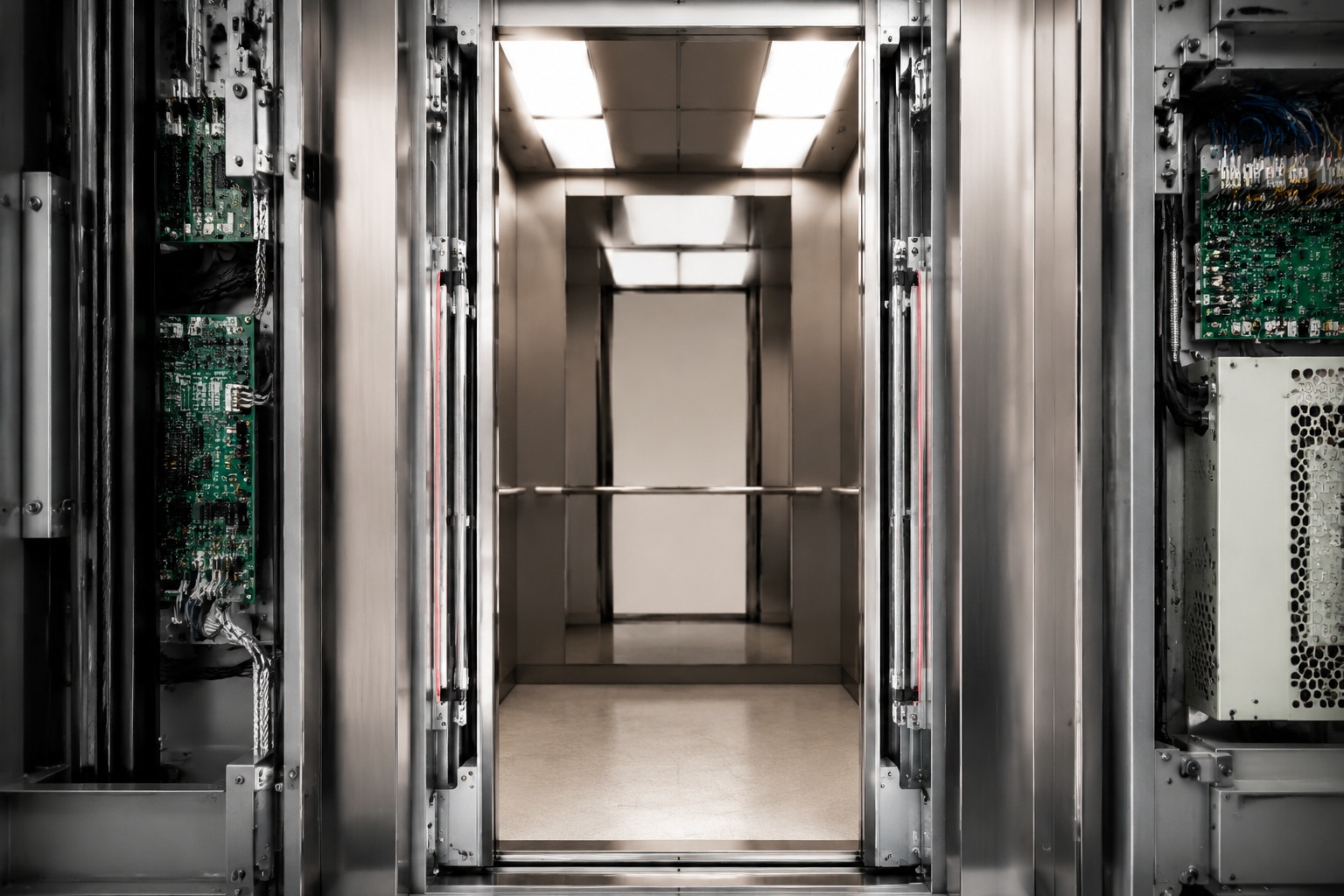
In modern lifts, the door system is one of the most heavily used and most fault-prone assemblies. Every day, office towers in Johannesburg, residential blocks in Cape Town, shopping centres in Durban, hospitals in Pretoria, and hotels around Sandton depend on doors that open and close smoothly while detecting passengers, trolleys, luggage, wheelchairs, and delivery carts. A lift light curtain helps make this possible by creating a dense infrared detection field across the doorway. Instead of relying on a single beam or a simple mechanical door sensor, the light curtain checks a wider area and tells the door operator to reopen or hold the doors when something is present.
For South Africa, this matters even more because many buildings operate mixed-age lift fleets. Some sites still use older door detectors that struggle with reliability, cable wear, dust, humidity, unstable power quality, or heavy traffic patterns. Replacing an outdated sensor with a suitable elevator light curtain can reduce nuisance door strikes, call-backs, passenger complaints, and repeated door reopening faults. It can also support modernization work without changing the entire lift system, provided that beam coverage, voltage, mounting space, and controller compatibility are checked correctly.
This guide explains what a lift light curtain does, how to spot common failure symptoms, how to choose beam coverage and model type, and what to verify when replacing an E GMS unit or another door detector. It also covers testing after installation, upgrade timing, buying advice, industry demand, local market conditions, and practical questions from maintenance teams and building owners. For companies sourcing replacements, it is important to work with a supplier that can match parts carefully, confirm wiring details, inspect product quality, and package components properly for transport into South African cities and regional service routes.
If you are reviewing replacement options now, two commonly requested product pages are E GMS elevator light curtain options and general lift light curtain replacements. These links are useful when you already have a failed detector and need to compare model styles, dimensions, or compatibility notes.
What an elevator light curtain does
An elevator light curtain is a non-contact door protection device installed on one or both sides of the lift entrance. It normally consists of a transmitter and a receiver. The transmitter sends multiple infrared beams across the door opening, while the receiver reads those beams. When a passenger, object, or part of a load interrupts one or more beams, the unit sends a signal to the lift door controller or operator to stop closing, reopen the doors, or keep them open depending on the control logic.
The biggest advantage over old-style door sensors is beam density and coverage. A single photoeye can miss a child’s hand, a walking stick, a narrow parcel, or the edge of a hospital trolley. A light curtain forms a wider protective screen from low to high positions across the entrance. This improves passenger safety and also reduces blunt door impact events that can damage rollers, tracks, hangers, operators, and clutch mechanisms.
In South African commercial and public buildings, light curtains are especially valuable where traffic is irregular and varied. A hotel in Cape Town may deal with luggage and housekeeping carts; a clinic in Bloemfontein may move patients and equipment; a retail centre in Durban may have prams, hand trucks, and delivery stock; and a logistics office near the Port of Durban may need dependable door detection during peak freight movement hours. In all of these cases, the light curtain helps the doors react sooner and more consistently.
| Function | How it works | Benefit to the lift | Benefit to passengers | Where it matters most | Notes |
|---|---|---|---|---|---|
| Obstacle detection | Infrared beams are interrupted by a person or object | Prevents hard door closure on obstructions | Reduces impact risk | Offices and malls | Core function of every light curtain |
| Door reopening signal | Unit sends command to controller or door operator | Lowers door-related faults | Improves convenience | Residential towers | Signal type must match controller input |
| Wide beam coverage | Multiple beams cover more vertical door area | Catches narrow objects better | Safer for children and luggage | Hotels and hospitals | Higher beam counts usually improve coverage |
| Reduced mechanical wear | Fewer repeated impacts and reversals | Helps extend door component life | Smoother ride experience | High-traffic buildings | Not a substitute for door maintenance |
| Lower nuisance call-backs | Consistent detection reduces intermittent strikes | Less downtime for service teams | More reliable service | Mixed-use sites | Depends on correct installation |
| Modernization support | Can retrofit older lifts with improved sensing | Cost-effective safety upgrade | Better entrance protection | Older buildings | Always verify dimensions and wiring |
The table above shows why the light curtain is not just a safety accessory but also a reliability component. Better sensing directly supports smoother door behaviour, which can reduce the chain reaction of faults caused by repeated impacts, poor timing, or unstable reopening commands.
Common light curtain failure symptoms
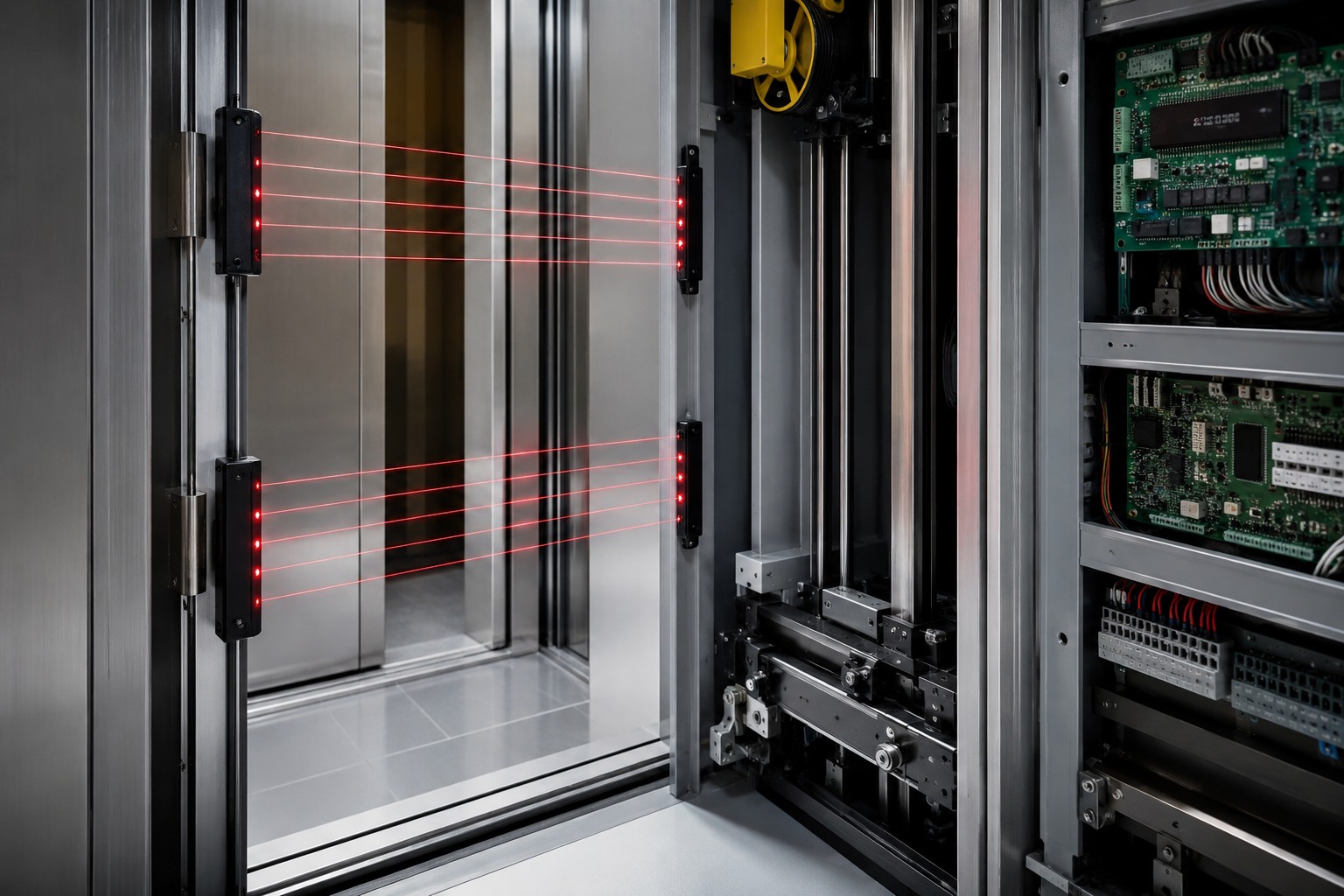
Light curtain faults do not always appear as a complete loss of door protection. In many cases, the symptoms are intermittent. A lift may work for hours and then show random door reopen faults, unexplained nudging, delayed closing, or door strikes against passengers or trolleys. Maintenance teams should look for both electrical and physical symptoms.
Common symptoms include doors closing on passengers before reopening, doors repeatedly opening and closing without obstruction, no reopening when an object is present, fault codes related to door safety circuits, and inconsistent operation at one landing but not another. Sometimes the actual cause is not the light curtain body itself but damaged cabling in the travelling cable area, loose connectors, contaminated lenses, misalignment after door work, or a controller input issue.
South African environmental conditions can intensify these problems. Coastal humidity around Durban and Gqeberha can affect connectors over time. Dust in inland sites, especially near ongoing construction, can coat the sensor face. Voltage irregularities can stress low-voltage accessories if power supply protection is weak. Buildings with frequent power interruptions or older modernization layers may experience control noise or unstable supply conditions that make intermittent diagnosis more difficult.
| Symptom | Likely cause | First check | Risk if ignored | Urgency | Recommended action |
|---|---|---|---|---|---|
| Doors close on passengers | Dead beams, failed receiver, wrong wiring | Beam test and input signal | Safety complaints and strikes | Immediate | Isolate lift and test sensor operation |
| Constant door reopening | Dirty lens, misalignment, electrical noise | Clean sensor and verify mounting | Service disruption | High | Check alignment and cable condition |
| Random intermittent faults | Loose connector or broken cable core | Inspect harness and movement points | Repeat call-backs | High | Wiggle test and continuity test |
| No detection at lower doorway area | Partial beam failure | Block beams at multiple heights | Missed child or trolley detection | Immediate | Replace unit if beam group is dead |
| Fault after door operator replacement | Controller logic mismatch | Review input type and timing | Installation delay | Medium | Confirm compatibility before energizing |
| Works at some landings only | Travel cable or door zone movement issue | Observe while car moves and doors cycle | Hard-to-find intermittent failure | High | Inspect moving cable path and connectors |
This table is useful because it links visible field symptoms to the first practical checks. A fast visual diagnosis can save several return visits, especially for subcontractors covering wide service areas from Johannesburg to Rustenburg or from Cape Town into the Western Cape winelands.
How to choose beam coverage and model type
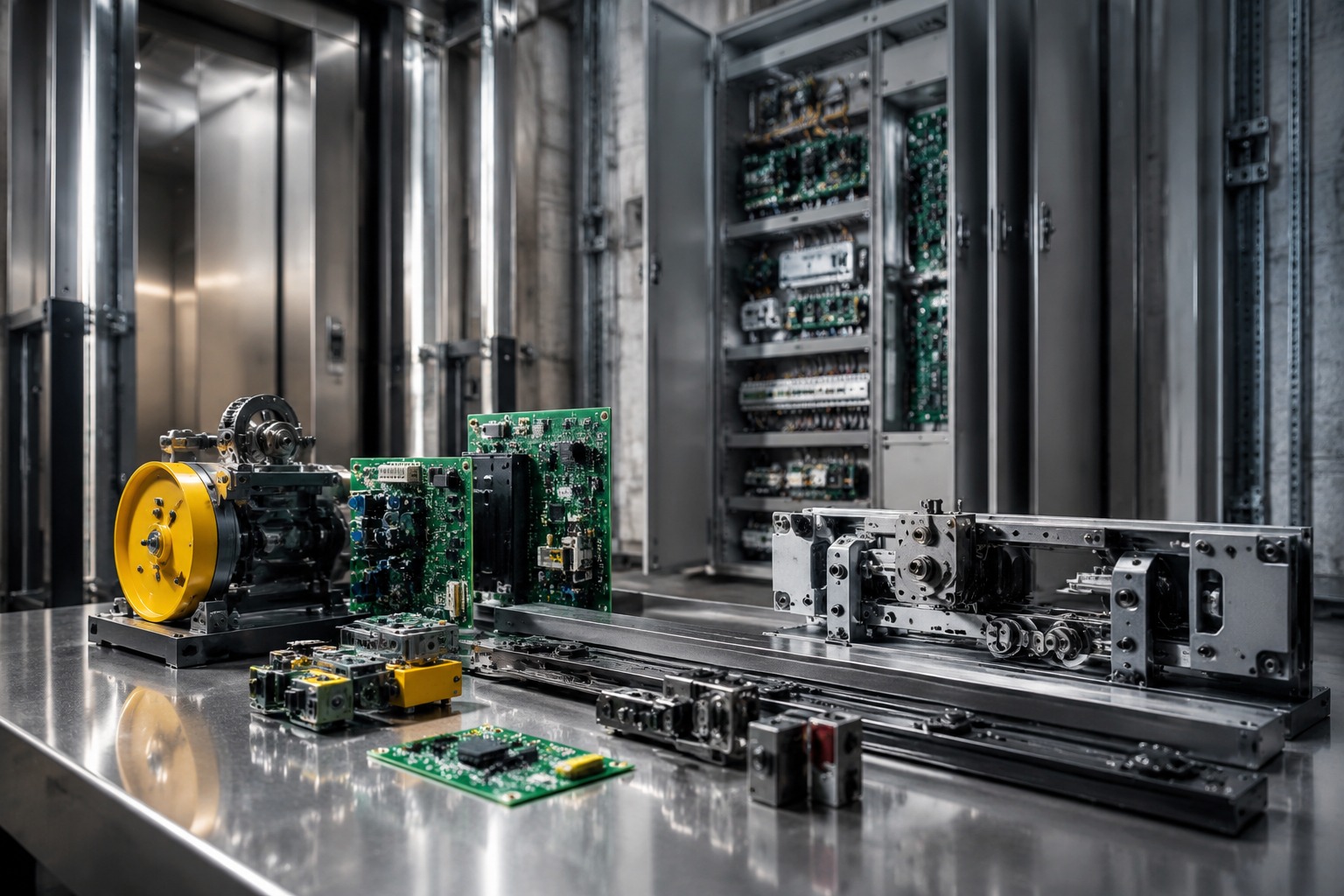
Choosing a replacement light curtain should never start with price alone. The right approach is to confirm the existing lift brand, door operator model, mounting space, input voltage, controller expectations, beam density, cable exit direction, and overall detector length. The more accurate the model match, the lower the risk of installation delays or repeat faults.
Beam coverage is one of the most important specifications. A low beam-count detector may be enough for a lightly used low-rise building, but high traffic sites usually benefit from denser coverage. More beams generally improve obstacle detection at different heights and widths. For passenger lifts in office towers, hotels, and hospitals, a broader protection field is often the safer long-term choice.
Model type also matters. Some units are direct replacements for specific lift brands or door systems, while others are universal or semi-universal retrofit types. Universal models can be useful during modernization, but they still require careful checking of voltage, relay output, NPN or PNP logic, response time, and physical dimensions. A direct replacement typically saves labour if it matches the original brackets, connector type, and input signal.
| Selection factor | What to confirm | Why it matters | Best for | Common mistake | Practical advice |
|---|---|---|---|---|---|
| Beam count | Number and density of infrared beams | Controls detection quality | High-traffic passenger lifts | Choosing lowest-cost low-density model | Use higher coverage where trolley traffic exists |
| Detector length | Overall height of transmitter and receiver | Must fit door opening and brackets | Retrofits and replacements | Ignoring top and bottom clearance | Measure old unit before ordering |
| Voltage | Supply voltage range and tolerance | Ensures stable operation | All installations | Assuming all units are interchangeable | Check nameplate and controller output |
| Output type | Relay, transistor, NO/NC logic | Controller must read signal correctly | Older systems and modernization | Wiring by colour only | Use schematic, not guesswork |
| Mounting style | Bracket, slot, screw position, side profile | Affects fit and alignment | Brand-specific door operators | Ordering without photos | Send front and side photos to supplier |
| Environment | Dust, humidity, usage level | Influences durability and maintenance | Coastal and industrial sites | Ignoring site conditions | Choose robust housing and protect cables |
The explanation from this table is simple: a compatible light curtain is both an electrical match and a mechanical match. Good sourcing depends on complete information. For that reason, building owners and maintenance contractors should provide photos of the old unit, label details, connector images, lift brand, and door operator data whenever possible.
In South Africa’s market, buyers often face a choice between urgent same-day local stock and a more exact imported match. For critical buildings such as hospitals, data centres, premium residential towers, and airport-linked hotels near OR Tambo corridors, a more precise fit is usually worth the effort because it reduces commissioning time and avoids risky adaptations.
The line chart above reflects a realistic market direction: more building owners are shifting budget toward targeted door safety upgrades rather than full lift replacement. This is particularly relevant in Johannesburg, Cape Town, Durban, and Pretoria where mixed-age building stock creates steady demand for compatible spare parts.
E GMS light curtain replacement notes
When replacing an E GMS light curtain, the most important rule is not to assume that every visually similar detector is identical. Replacement success depends on confirming exact series details, cable arrangement, detector dimensions, bracket positions, and output requirements. Even if the housing appears close, a mismatch in input voltage or signal style can lead to false door reopening, no detection, or complete non-operation.
For E GMS replacements, technicians should record the old label, count wire cores, photograph both ends of the connector, and note the mounting points on the door panel or jamb. It is also useful to identify whether the original system uses a dedicated controller board or a direct input into the door operator. Some older systems have modified field wiring from previous repairs, so the current colour sequence may not match the original factory arrangement.
If the original unit has suffered impact damage, lens cracking, or water ingress, check whether brackets also bent during the failure. Installing a new detector onto a distorted mounting surface can create alignment faults from day one. On high-use passenger lifts, replacing damaged cable ties, flexible cable sleeves, or worn connector housings at the same time is often a good preventive step.
For buyers sourcing replacements internationally into South Africa, exact model matching is particularly important because delays at ports and inland logistics routes can lengthen downtime if the first unit ordered is wrong. That is why many maintenance firms prefer to send part photos and lift information before purchase rather than relying on a broad description such as “lift door eye” or “infrared detector.”
Wiring and controller compatibility checks
Wiring checks are where many replacement jobs succeed or fail. Even an excellent quality light curtain will not perform correctly if connected to the wrong supply or signal terminals. Before removing the old unit, technicians should document every connection clearly. Take photos, mark terminal numbers, and compare field wiring against the lift schematic and door operator documents. If no reliable schematic is available, continuity testing and safe circuit tracing may be necessary.
Key compatibility points include supply voltage, output type, relay contact rating if used, signal polarity, common and switched lines, and whether the controller expects a normally open or normally closed response. Some door systems are sensitive to signal timing or require a separate power isolation arrangement. Others combine light curtain input with nudging logic, overload behaviour, or car call control.
In modernization projects, compatibility becomes even more critical because the lift may contain components from several generations. A controller retrofit in Midrand or a door operator change in a Cape Town commercial tower may leave the original sensor wiring in place, but the input logic may have changed. In such cases, the correct replacement decision should be based on the currently active controller interface, not on the oldest hardware still present on the lift.
| Compatibility item | Question to ask | What can go wrong | How to verify | Field tip | Decision impact |
|---|---|---|---|---|---|
| Supply voltage | What voltage feeds the sensor? | Unit may not start or may fail early | Measure with meter under load | Check during door movement too | Determines model eligibility |
| Output logic | Does controller expect NO, NC, NPN, or PNP? | False triggering or no response | Read controller manual or test input | Never guess by wire colour | Critical for operation |
| Connector type | Can existing plug be reused? | Loose connection or rewiring errors | Match pin count and orientation | Photograph plug close-up | Affects installation speed |
| Cable routing | Is cable exposed to repeated flexing? | Intermittent breaks after installation | Inspect travel path and clamp points | Replace damaged sleeves | Affects long-term reliability |
| Door controller interface | Direct input or separate board? | Signal never reaches operator logic | Trace wiring to destination | Label wires before removal | Important in retrofits |
| Power quality | Is low-voltage supply stable? | Random resets and ghost faults | Check fluctuation and grounding | Review recent power issues onsite | May require broader repair |
The table above highlights why wiring confirmation is not a minor step. It is often the difference between a successful first-time fix and a repeated callback. In South Africa, where many service teams cover large routes between city centres and satellite sites, getting this right on the first visit saves time, travel cost, and tenant frustration.
The bar chart shows where replacement demand is strongest. Commercial offices, retail centres, and residential towers account for much of the market, but hospitals often justify higher-spec protection because passenger safety and trolley movement are more demanding.
Testing after installation
After fitting a new light curtain, testing should be systematic rather than limited to a quick hand wave in front of the door. A proper test sequence checks physical alignment, beam detection across the full height of the entrance, door reopening response, controller recognition, cable stability during movement, and repeatability over multiple cycles.
Start with a visual inspection. Confirm that the transmitter and receiver are mounted straight, secure, and free from twisting. Verify that cabling is protected and not rubbing against moving parts. Then energize the lift and check any indicator lights specified by the product documentation. Test the beams at low, middle, and high positions across the doorway using a suitable object. Observe whether the doors stop or reopen consistently each time.
Next, cycle the doors repeatedly under no-load and normal traffic conditions. Watch for delayed response, random resets, or false triggering caused by vibration. If possible, test at several landings because slight differences in sill condition, door alignment, or cable movement can reveal hidden issues. On busy sites in Johannesburg CBD, Durban commercial zones, or public buildings in Pretoria, a short monitored run during live traffic can provide useful confirmation that the system performs under real use conditions.
| Test step | What to do | Pass result | Failure sign | Reason for test | Follow-up if failed |
|---|---|---|---|---|---|
| Visual alignment | Inspect straightness and bracket security | Units are parallel and secure | Twisted or loose mounting | Prevents false readings | Realign and tighten hardware |
| Low beam test | Block beams near sill level | Doors reopen immediately | No response at lower level | Protects children and small objects | Check dead beams or positioning |
| Mid-height test | Block center beam field | Consistent reopening signal | Intermittent operation | Verifies normal passenger detection | Check wiring and receiver stability |
| High beam test | Block upper field zone | Response matches lower zones | Top area not detected | Confirms full-height coverage | Inspect beam array and alignment |
| Multi-cycle test | Run repeated open-close cycles | No nuisance faults | Random reopen or reset | Checks vibration and cable issues | Review harness movement path |
| Live traffic observation | Monitor during actual use | Safe, smooth operation | Complaints or delayed closing | Confirms real-world performance | Fine tune or recheck compatibility |
This testing table shows that installation is only complete when the detector proves itself in full-height, repeat-cycle, and live-use conditions. Skipping that process often leads to a second visit that could have been avoided.
When to upgrade old door sensors
Not every old sensor needs immediate replacement, but certain conditions make upgrading the smart choice. If the lift still uses a single-beam detector, a mechanical contact edge, or an unreliable early infrared unit, the safety and reliability gains from a modern light curtain can be significant. Upgrade timing becomes even more compelling when door strikes, nuisance faults, passenger complaints, or repeat call-backs are already occurring.
Another good time to upgrade is during related door work. If the building is already replacing door rollers, hangers, operator boards, door locks, or control components, fitting a modern light curtain at the same time can be more cost-effective than returning later. This is particularly relevant for older residential and commercial buildings in central business districts where access windows and tenant coordination are difficult.
Buildings planning partial modernization should also consider the sensor question early. A new controller or door operator can expose the limitations of an old detector. Rather than forcing an outdated sensor into a new logic environment, many contractors prefer to upgrade the doorway protection during the same project. This approach is often more reliable and easier to document for future maintenance.
The area chart illustrates the broader trend toward replacing simple or aging door detectors with denser infrared protection. Looking ahead to 2026, this shift is likely to continue due to modernization budgets, higher service expectations, and growing attention to passenger safety and equipment uptime.
Future trends will shape buying decisions as well. By 2026, we expect stronger interest in detectors with better noise resistance, easier retrofit mounting, improved diagnostics, and more consistent compatibility across modernization packages. Policy and compliance attention will continue to push owners toward dependable door protection, while sustainability goals will encourage targeted upgrades that extend the life of existing lift systems rather than forcing unnecessary full replacements. Lower repeat call-backs and fewer damaged door parts also support maintenance efficiency and material savings.
FAQ about elevator light curtains
How is a light curtain different from a photoelectric door eye?
A light curtain uses many beams across the doorway, while a simple photoeye usually uses a single beam or limited detection point. The wider coverage improves protection for passengers, luggage, wheelchairs, and trolleys.
Can I replace only one side of the detector?
In some cases yes, but it depends on the exact model and whether the transmitter and receiver are sold and calibrated as a set. For reliability, many contractors replace both sides together if the unit is old or if matching is uncertain.
Why do doors still strike people even though a detector is installed?
The detector may have dead beams, poor alignment, cable faults, contamination, controller mismatch, or delayed operator response. The fault may also be in the door operator rather than the detector alone.
What information should I send when asking for a quotation?
Provide the lift brand, old part label, photos of the front and side of the sensor, connector details, door operator model if known, overall length, wire count, and the problem observed onsite.
Is a universal light curtain always a safe replacement?
Not automatically. A universal model can be useful, but only if voltage, signal logic, dimensions, brackets, and controller input requirements are confirmed first.
How long does replacement usually take?
A straightforward like-for-like exchange can be quick, but troubleshooting, rewiring, connector modification, or bracket correction can add time. Proper pre-checks reduce delays significantly.
Should old door sensors be upgraded even if they still work?
If the building has repeated door complaints, vulnerable passenger traffic, aging parts availability issues, or a modernization project planned, upgrading can be a practical preventive step.
Which South African sectors most often request these parts?
Commercial offices, residential high-rises, retail centres, hospitals, hotels, and public buildings are the most frequent buyers, especially in major urban service corridors.
South Africa market, buying advice, applications, and supplier comparison
The South African lift parts market is shaped by a large installed base of mixed-generation equipment. Many sites are not ready for full modernization but still need dependable replacement parts to reduce downtime. This creates strong demand for practical door safety upgrades, especially where passenger complaints, tenant pressure, and service-level commitments are high. Buildings in Johannesburg, Cape Town, Durban, Pretoria, and growing regional hubs often prioritize components that balance compatibility, lead time, and stable quality.
Applications vary by industry. Offices need smooth traffic flow during morning and afternoon peaks. Residential towers need quiet, reliable door operation with fewer nuisance reopen events. Hospitals require better trolley and patient protection. Hotels and retail centres value convenience and reduced passenger complaints. Industrial and logistics buildings may need robust replacement parts that tolerate dust and frequent use.
Buyers comparing suppliers should look beyond list price. The best result usually comes from a supplier that can review photos, check model details, confirm compatibility before shipment, protect the product in transit, and respond quickly when clarification is needed. For import-supported supply into South Africa, packaging quality and document accuracy also matter, particularly for deliveries routed through major trade and distribution channels.
| Supplier evaluation point | Why it matters | Good sign | Warning sign | Best buyer action | Outcome |
|---|---|---|---|---|---|
| Model matching support | Prevents wrong-part orders | Supplier asks for labels and photos | Supplier quotes blindly | Send complete technical details | Higher first-time fit rate |
| Product range | Useful for mixed lift fleets | Supports several brands and door systems | Only generic description available | Ask for alternatives by model | Better sourcing flexibility |
| Quality inspection | Reduces early failures | Functional and visual checks performed | No inspection process explained | Request pre-shipment confirmation | Lower defect risk |
| Packaging quality | Protects fragile sensor bodies | Protective packaging used | Loose or thin packing | Confirm export-safe packing | Less transit damage |
| Technical response speed | Important during downtime | Clear wiring and match support | Slow, vague answers | Test service before ordering | Faster commissioning |
| After-sales coordination | Supports field troubleshooting | Responsive follow-up on fit issues | No post-sale help | Choose service-oriented partner | Reduced repeat call-backs |
The comparison table makes one point very clear: buying the cheapest detector can become more expensive if the part is mismatched or unsupported. In lift maintenance, correct fit and clear technical communication often save more money than a small initial price difference.
The supplier comparison chart reflects how maintenance buyers usually think in practice. Technical fit, responsiveness, and inspection quality rank above marketing claims because door protection parts must work reliably the first time.
Our company capabilities for South Africa customers
Technological capabilities: We support customers by checking model information carefully across a broad range of lift spare parts, including light curtains, door operator components, control boards, sensors, encoders, power supplies, buttons, intercom parts, and other accessories used on brands such as Hitachi, Toshiba, KONE, Mitsubishi, and more. For light curtain inquiries, we focus on practical matching details such as dimensions, connectors, beam arrangement, and controller interface needs so that maintenance companies and modernization contractors can reduce ordering risk.
Manufacturing capabilities: Our sourcing and product control approach is designed around stable quality inspection and consistent product handling. For sensitive items like elevator light curtains, careful inspection and protective packaging are essential because the housings, lenses, and connectors must arrive in good condition for reliable installation. This is especially important for shipments serving South African distributors, building owners, and maintenance teams that need dependable parts for urgent downtime situations.
Service capabilities: We work with maintenance companies, distributors, building owners, and modernization contractors who need responsive communication and practical replacement support. Our aim is to help customers reduce downtime, source compatible replacement parts, and keep lift systems operating safely. Whether the request involves an E GMS detector, a general retrofit light curtain, or a broader door system spare parts package, we focus on clear model matching and timely follow-up rather than one-size-fits-all quoting.
For teams reviewing current replacement needs, the most effective process is to send complete part information early, compare mounting and wiring details carefully, and test thoroughly after installation. That approach delivers better results in high-rise residential projects, office towers, hotels, hospitals, retail centres, and public infrastructure throughout South Africa.