
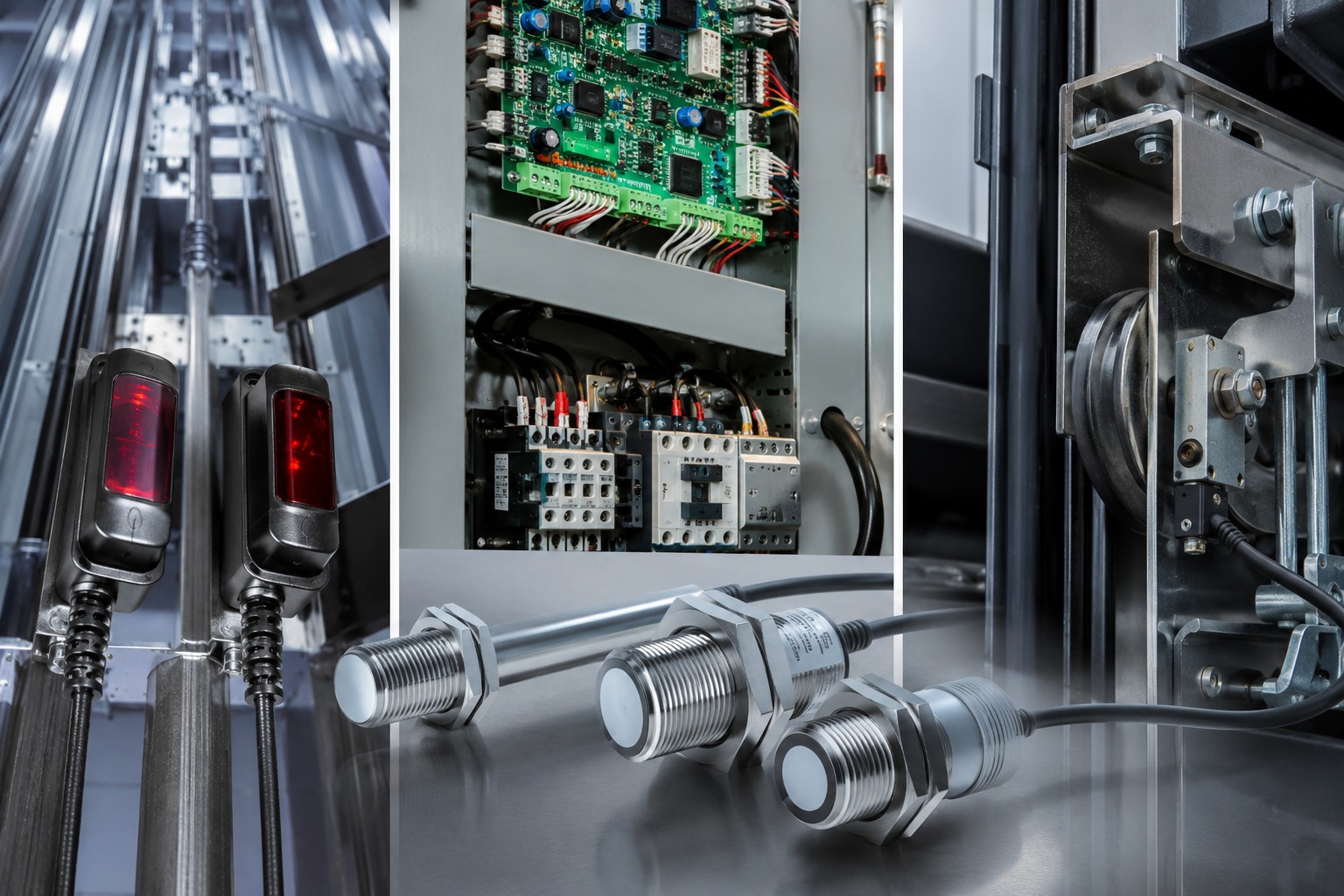
Elevator photoelectric switches and position detection sensors are small components with a large effect on safety, ride quality, and downtime. In practical terms, they help an elevator know where the car is, whether a door area is clear, whether leveling is correct, and whether control signals match the actual movement of the lift. For maintenance teams in South Africa, these devices are especially important because many sites combine older installations, modernization projects, imported systems, and mixed-brand spare parts. In Johannesburg office towers, Cape Town hotels, Durban hospitals, Pretoria campuses, and logistics properties near the Port of Durban or the Port of Cape Town, a failed sensor can quickly lead to nuisance faults, poor landing accuracy, or a lift taken out of service.
Direct answer: elevator photoelectric switches detect interruption or reflection of a light beam to confirm presence, position, movement, or alignment. Position detection sensors are used to provide precise landing references, leveling feedback, zone detection, and door-related confirmation signals. Choosing the right replacement means matching sensor type, voltage, output logic, mounting distance, housing size, connector format, environmental resistance, and brand-specific compatibility. For Hitachi elevators and similar systems, replacement success depends on careful model matching rather than visual similarity alone.
South Africa’s vertical transport market includes new developments, public infrastructure, hospital upgrades, hospitality renovations, mine-related commercial buildings, student accommodation, retail centers, and modernization of older buildings. Across these applications, maintenance contractors and building owners need stable parts sourcing, reliable packaging, and quick technical confirmation. That is why many buyers look beyond a simple “same shape” replacement and instead confirm sensing mode, switching distance, response time, cable length, and control board compatibility before installation. If you are comparing options, it helps to review dedicated elevator photoelectric switch spare parts and verify whether the sensor is intended for leveling, door control, or position reference.
Because elevator systems often run continuously in high-traffic environments, sensor selection should also consider temperature variation, dust, vibration, electromagnetic interference, and moisture exposure. Coastal conditions around Durban and Cape Town can increase corrosion risk, while inland sites in Gauteng may see heavy dust and high daily traffic. A good replacement strategy reduces repeated call-backs, protects door operators and controllers from false inputs, and helps the lift return to stable service faster.
The line chart above reflects a realistic upward trend in replacement part demand, driven by aging equipment, modernization work, and stronger maintenance planning. Photoelectric switches and position sensors are often among the first electrical components to be replaced because they directly affect operation quality and fault frequency.
What photoelectric switches detect
A photoelectric switch works by sending and receiving light, usually infrared or visible light, to detect a change in the presence or position of an object. In elevator systems, the device may operate in through-beam, retro-reflective, or diffuse reflective mode. When the beam is interrupted or reflected in a defined way, the sensor changes output state and sends a signal to the controller, door operator, or related circuit.
In elevator applications, photoelectric switches commonly detect the following: landing zone markers, vanes or flags on the car or shaft, door panel position, obstruction presence, leveling points, and control reference points during travel. Some sensors are dedicated to one function, while others are used in paired logic with magnetic switches, encoders, or mechanical limit devices. For instance, a leveling sensor may detect a metal or reflective target near floor level, while a door-related photoelectric device may confirm that a panel has reached a specific position before the next action starts.
The exact thing being detected depends on the installation design. On some lifts, the sensor detects a vane attached to the car sling or shaft. On others, it detects a reflective marker, a bracket edge, or a dedicated target plate. This is why maintenance personnel should avoid assuming that every photoelectric switch is interchangeable. Even if the body size matches, the sensing distance, light emission method, and output behavior may differ.
| Detected item | Typical elevator location | Why it matters | Common sensor mode | Signal purpose | Risk if incorrect |
|---|---|---|---|---|---|
| Landing vane or flag | Car top or shaft zone | Identifies car approach and floor zone | Through-beam or diffuse | Position reference | Missed landing or floor hunting |
| Leveling target | Near sill or car frame | Confirms accurate stop level | Diffuse reflective | Leveling correction | Uneven floor stop |
| Door panel edge | Door operator assembly | Confirms open or closed status | Retro-reflective | Door control feedback | Door lock sequence errors |
| Obstacle or obstruction | Door entrance area | Protects passengers during closing | Photoelectric curtain or beam | Safety reopen command | Door strike complaints |
| Car position marker | Shaft side brackets | Supports travel logic | Through-beam | Controller input | Incorrect dispatch or slowdown |
| Transfer point marker | Special access or service zones | Used in special operating modes | Diffuse or reflective | Mode confirmation | Service mode malfunction |
The table shows why “what the switch detects” is not a single answer. In one building it may be a vane for leveling, and in another it may be a door panel reference. The most reliable way to identify function is to trace the wiring to the relevant circuit and review where the sensor is aimed during operation.
When sourcing replacements, many buyers first start from application type. A useful route is to compare standard lift photoelectric switch options by mounting style, sensing distance, and output configuration before confirming the exact model.
Position detection sensor applications
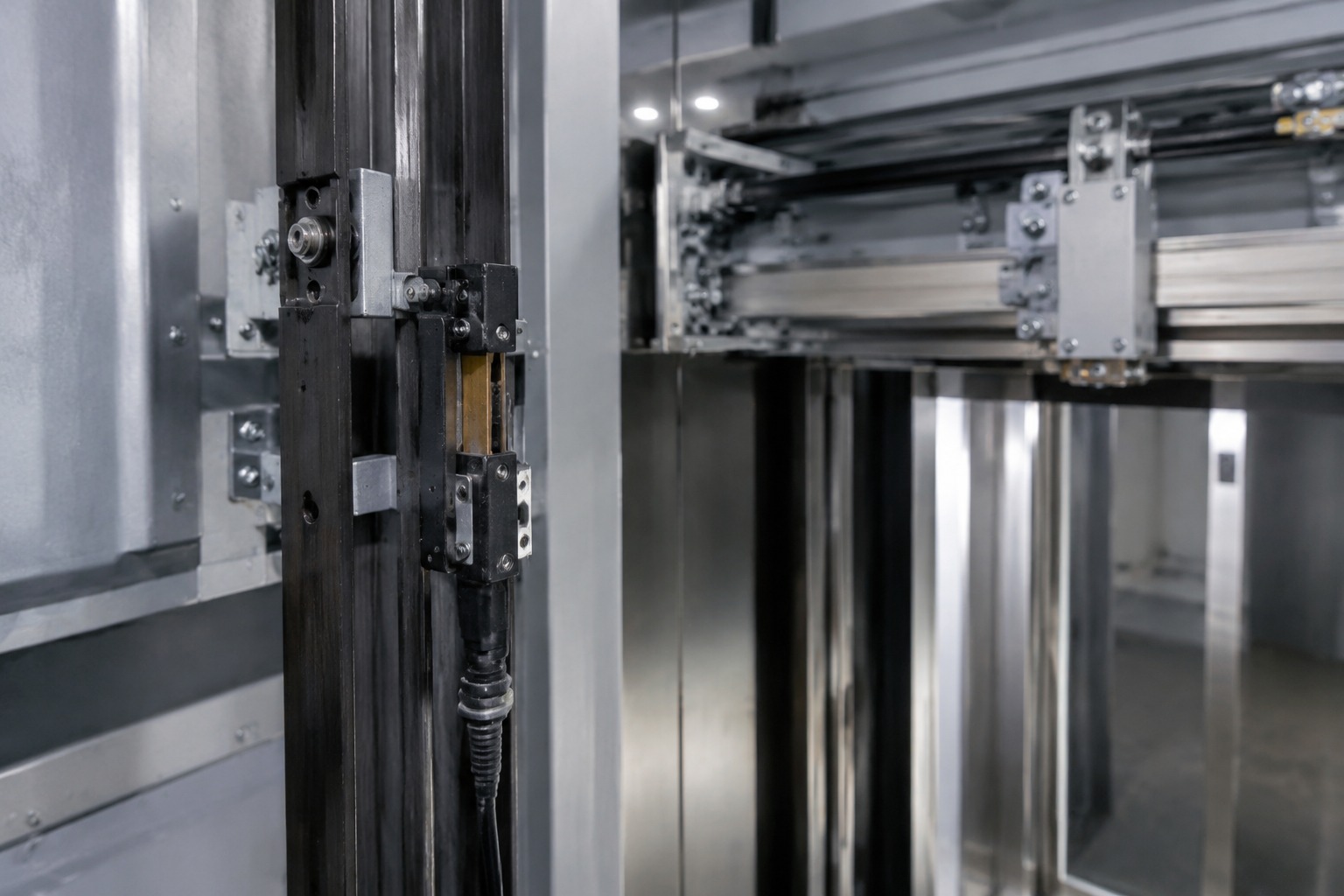
Position detection sensors are used wherever the controller needs precise information about the elevator car or door mechanism. Their role extends beyond a simple on/off presence signal. In many systems, they contribute to smooth leveling, deceleration logic, floor zone recognition, re-leveling, inspection operation, and sequencing between doors and traction control. This makes them critical in both passenger and service elevators.
Common applications include floor zone detection, terminal slowdown confirmation, re-leveling feedback, door zone verification, car top inspection movement, and synchronization with the main controller. Hospitals in Durban and Johannesburg often prioritize accurate leveling because trolleys and beds require minimal sill difference. In shopping centers and transport hubs, stable sensor feedback reduces nuisance door faults and improves passenger flow. In residential towers, correct zone detection helps limit callbacks related to rough stopping or repeated re-opening.
Hitachi and other brand-specific systems often use dedicated position sensors with precise electrical behavior. If you are matching a replacement, a specialized position detection sensor for Hitachi elevators may be preferable to a generic part if the system expects a specific switching pattern or bracket geometry.
| Application | Operating goal | Typical installation point | Control dependency | Common symptom if faulty | Priority level |
|---|---|---|---|---|---|
| Floor zone detection | Recognize correct landing area | Shaft or car top sensor bracket | High | Lift stops above or below floor | Critical |
| Re-leveling | Correct drift after loading | Car frame and leveling target | High | Gradual mislevel after doors open | Critical |
| Door zone verification | Allow safe door operation only in zone | Near landing reference area | High | Doors fail to open at landing | Critical |
| Inspection mode movement | Provide controlled positioning | Car top or shaft reference points | Medium | Unstable slow movement feedback | High |
| Slowdown/approach logic | Improve deceleration timing | Shaft side position markers | Medium | Harsh approach to floor | High |
| Door operator sequencing | Confirm panel status before next step | Door mechanism | Medium | Intermittent door opening cycle | High |
The table illustrates that the same family of sensors supports multiple functions. For modernization contractors in Pretoria, Gqeberha, and Bloemfontein, documenting which sensor is tied to which logic point can save time during commissioning and future maintenance.
The bar chart highlights where replacement demand is strongest. High-traffic commercial towers and retail centers typically consume more door and position-related sensors because operating cycles are much higher than in low-rise residential buildings.
How to choose sensor type and voltage
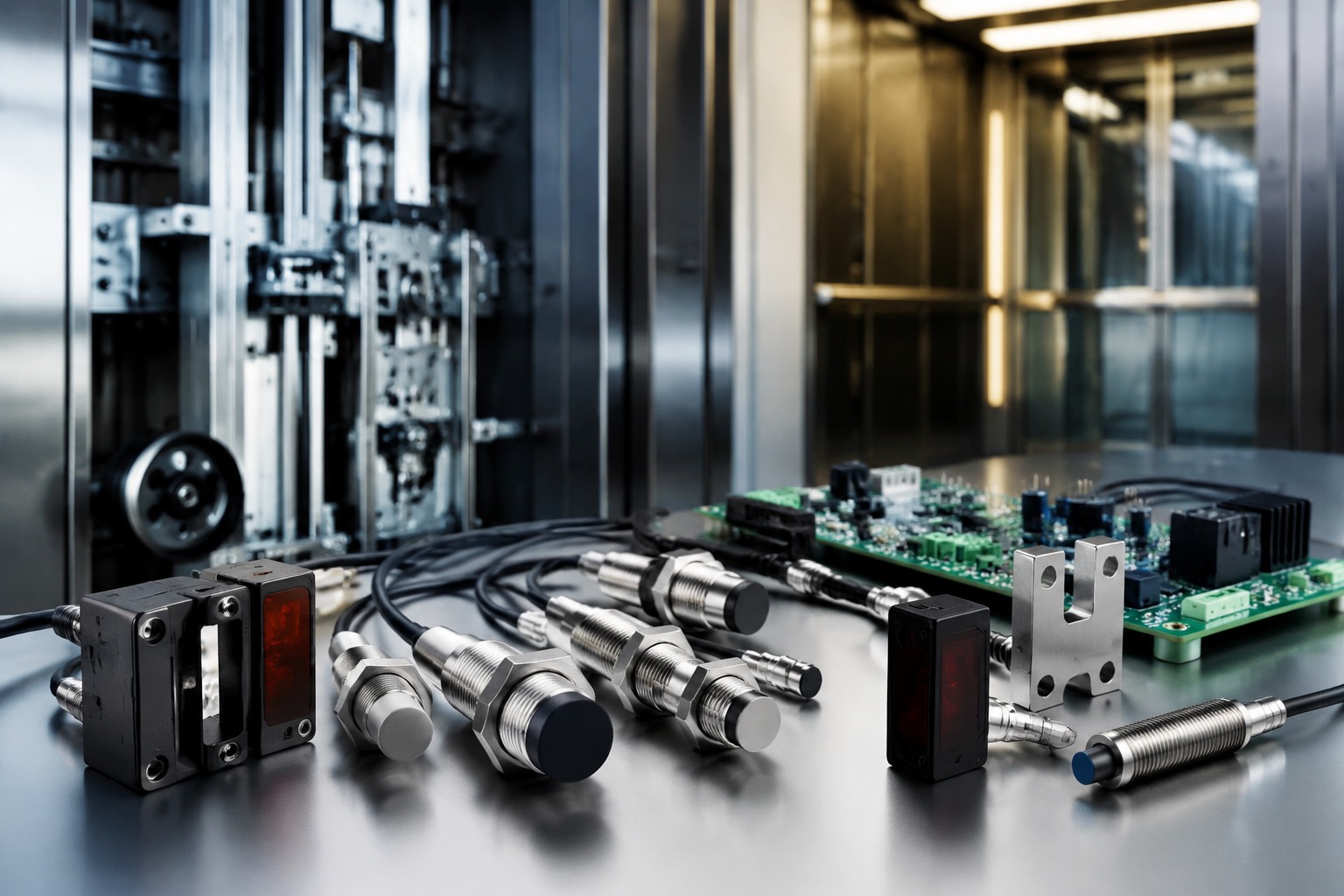
Choosing the right sensor begins with function, then moves to electrical and mechanical matching. Maintenance teams should confirm whether the original device is photoelectric, inductive, magnetic, or a specific brand-defined leveling sensor. For photoelectric replacements, identify the sensing method first: through-beam, reflective, or diffuse. Then confirm rated supply voltage, output type, normally open or normally closed logic, switching distance, current rating, connector type, cable length, response time, housing dimensions, and environmental class.
Voltage matching is critical. Many elevator sensors operate at 12V, 24V DC, or other control voltages. Installing the wrong voltage can cause immediate non-operation, unstable switching, or permanent damage. Output type also matters. NPN and PNP outputs are not interchangeable unless the control input is designed for both. Some controllers expect a dry-contact style interface through relay adaptation, while others require direct transistor output. A wrong output type may lead to persistent fault codes even if the sensor lights up and appears to detect properly.
Mechanical fit is equally important. The bracket spacing, target distance, beam angle, and housing shape must suit the original mounting arrangement. A sensor with a shorter sensing distance may miss the vane during vibration. One with excessive range may detect nearby metal or reflections and create false signals. For this reason, buyers often review the full specification of a dedicated GLS-326 Hit leveling sensor or similar model rather than selecting by appearance alone.
| Selection factor | What to check | Why it matters | Typical mistake | Best practice | Result of correct choice |
|---|---|---|---|---|---|
| Sensor type | Photoelectric, magnetic, inductive, leveling-specific | Defines detection principle | Replacing with visually similar but different type | Confirm original operating method | Stable intended function |
| Supply voltage | 12V, 24V DC, or site-specific value | Protects electronics and signal integrity | Ignoring controller requirement | Measure and verify documentation | Safe energizing |
| Output logic | NPN, PNP, NO, NC | Must match control input | Assuming all outputs are universal | Trace wiring and board input design | Reliable signal reception |
| Sensing distance | Minimum and maximum target range | Affects detection consistency | Choosing too short or too long range | Measure actual mounting gap | Low false-trigger risk |
| Housing and bracket size | Thread, body width, fixing holes | Ensures alignment and secure mounting | Improvised fitting | Match dimensions before dispatch | Fast installation |
| Environment resistance | Dust, moisture, vibration, corrosion | Important for local conditions | Using indoor-only part in harsh site | Choose robust industrial grade | Longer service life |
For South African buyers, voltage and environmental suitability deserve extra attention. Sites near coastal areas may require better sealing and anti-corrosion tolerance. Busy buildings in Sandton, Umhlanga, or central Cape Town may also demand higher reliability because shutdown windows are short and tenant expectations are high.
Buying advice is simple: provide a clear photo of the label, connector, mounting position, and application point; share the elevator brand and controller model; confirm voltage with a meter; and note whether the issue is intermittent or total failure. This short checklist significantly improves model matching and reduces returns.
Hitachi sensor replacement considerations
Hitachi elevator systems often use sensor arrangements that are straightforward in appearance but exact in specification. Replacement considerations include part number cross-reference, bracket geometry, beam position, connector pinout, output behavior, and interaction with the controller or door operator. On older installations, labels may be faded or missing, which makes application tracing even more important.
The first rule is not to replace by shape alone. Two sensors may have the same body size and cable exit, yet one may use different logic or range. The second rule is to inspect the full signal path. A suspected sensor fault may actually come from damaged cabling, oxidized connectors, misaligned brackets, unstable power supply, or contamination on the target. The third rule is to understand the system role. A Hitachi leveling sensor used for precise floor alignment is not equivalent to a general-purpose beam sensor used on a door edge.
For distributors and maintenance teams handling mixed portfolios, compatibility support is essential. A professional supplier should help verify model matching using photos, markings, dimensions, and site function rather than guessing from a generic category name. This is particularly useful on modernization jobs in South Africa where original documentation may be incomplete.
From a technological capability standpoint, our approach is to support careful model matching through specification review, application identification, and compatibility confirmation across control boards, door systems, sensors, and related lift accessories. This helps reduce the risk of installing a part that powers on but does not communicate correctly with the elevator logic.
| Hitachi replacement check | Why it is necessary | How to verify | Common field issue | Recommended action | Expected outcome |
|---|---|---|---|---|---|
| Original part number | Fastest route to accurate match | Read label or old invoice | Label faded or missing | Use photos and dimensions | Higher matching accuracy |
| Voltage rating | Prevents electrical mismatch | Meter reading and board check | Unknown DC control level | Confirm before energizing | Safer commissioning |
| Output format | Controller expects specific signal | Review wiring and datasheet | Signal LED on but no response | Check NPN/PNP and NO/NC | Correct controller input |
| Mounting geometry | Determines sensing accuracy | Measure hole spacing and gap | New part does not align with target | Match bracket dimensions | Reliable physical fit |
| Connector or cable type | Ensures clean installation | Inspect plug, pin count, lead length | Field splicing causes faults | Use proper connector version | Better signal stability |
| Application function | Avoids wrong-substitute errors | Observe operation point on lift | Door sensor confused with leveling sensor | Confirm function before order | Correct replacement role |
For buyers managing larger fleets, manufacturing capability also matters. Consistent sourcing, stable quality inspection, and protective packaging reduce the chance of receiving fragile electronic parts with transit damage. This is especially relevant when parts move through major logistics channels linked to Durban, Johannesburg, and Cape Town distribution routes.
Mounting distance and alignment checks
Even the correct sensor can fail in service if mounting distance and alignment are wrong. Elevator equipment experiences vibration, repeated door cycling, temperature changes, and occasional impact during maintenance. Over time, brackets can shift, screws can loosen, and accumulated dirt can narrow the effective sensing window. Many “bad sensor” complaints are actually alignment issues.
Start with a visual inspection. Check whether the sensor faces the target squarely, whether the mounting bracket is rigid, and whether there are marks showing rubbing, collision, or previous adjustment. Then measure the actual gap between sensor and target against the rated sensing distance. If the sensor is near the limit of its range, normal vibration may cause intermittent loss of detection. Also inspect for reflective interference from polished metal, cable ties, labels, or nearby components.
Door systems require special care because panel movement can introduce side play. If a beam is too narrow or the bracket is slightly twisted, the output may drop only during part of the travel cycle, creating intermittent faults that are hard to reproduce during static inspection. On landing and leveling applications, vertical and horizontal alignment both matter. A few millimeters of shift may be enough to affect signal timing.
During installation, tighten hardware correctly, route cables away from moving edges, and verify the switching indicator throughout the entire travel path. If the system uses a reflector, clean and secure it as carefully as the sensor itself.
| Check point | Inspection method | Acceptable condition | Typical defect | Correction method | Benefit |
|---|---|---|---|---|---|
| Sensing gap | Measure with ruler or caliper | Within rated range with margin | Gap too wide | Reposition bracket or sensor | Consistent detection |
| Facing angle | Visual line-up and indicator test | Sensor points squarely at target | Skewed alignment | Realign and retighten | Lower intermittent faults |
| Bracket rigidity | Manual movement check | No looseness or flexing | Vibration shift | Replace or reinforce bracket | Stable long-term operation |
| Cable routing | Trace cable path | No pinch or rub points | Insulation wear | Re-route and secure cable | Reduced signal loss |
| Target cleanliness | Surface inspection | Clean and unobstructed | Dust, grease, rust, tape | Clean target surface | Reliable beam response |
| Indicator consistency | Observe during movement | Stable switching at correct position | Flickering output | Adjust distance and inspect power | Improved troubleshooting accuracy |
For sites where replacement windows are short, taking photos before removal and recording the original gap can save valuable time. In high-rise buildings around Sandton or the Cape Town CBD, this helps technicians complete work efficiently and reduce repeat visits.
The area chart shows a realistic technology shift toward more precise, application-specific sensor replacement and monitoring. This trend is expected to continue through 2026 as modernization and predictive maintenance practices expand.
Fault symptoms and troubleshooting
Photoelectric switch faults can appear in several ways: the elevator may fail to level accurately, doors may re-open unexpectedly, the car may stop out of zone, or the controller may log intermittent input faults. In many cases, the symptom changes with temperature, traffic load, or time of day, which points to marginal alignment or power quality rather than a complete device failure.
Effective troubleshooting starts by separating electrical problems from mechanical ones. Check the sensor indicator light, verify supply voltage under load, inspect connector condition, and monitor the input at the controller if possible. Then inspect alignment, bracket stability, and target cleanliness. Swap testing can help, but only if the substitute part is confirmed compatible. Installing an unknown sensor just to “see if it works” can create misleading results.
Typical symptoms include inaccurate floor leveling, no door open command at floor, repeated door reopening, sudden car stopping during slow approach, false obstruction indication, and random service faults after vibration. In older lifts, degraded wiring and oxidized terminals are common hidden causes. In coastal zones, moisture and corrosion can affect both the sensor face and the connector.
| Fault symptom | Likely cause | Primary check | Secondary check | Probable fix | Urgency |
|---|---|---|---|---|---|
| Car stops above or below landing | Leveling sensor misread or misaligned | Check gap and target | Verify voltage and output | Realign or replace matched sensor | Critical |
| Doors do not open at floor | Door zone signal missing | Trace position input | Inspect controller input | Restore zone sensor function | Critical |
| Doors reopen repeatedly | Obstruction beam false trigger | Clean beam path | Inspect cable shielding | Clean, realign, or replace | High |
| Intermittent fault after vibration | Loose bracket or connector | Manual movement test | Check terminal tightness | Secure mounting and wiring | High |
| Sensor LED works but controller shows no input | Wrong output type or damaged wiring | Verify NPN/PNP and NO/NC | Continuity test | Use correct model and repair cable | High |
| Random false detection | Reflective interference or contaminated target | Inspect surroundings | Reduce excess range | Reposition or shield sensor | Medium |
A practical troubleshooting sequence is: observe the symptom, identify the related function, inspect the mechanical alignment, verify power, confirm output logic, and only then replace the sensor if needed. This avoids unnecessary part changes and helps maintenance teams explain root cause clearly to building owners.
Service capability is critical here. Fast response, careful packaging, and responsive communication on model matching can shorten downtime when a site in Durban, Midrand, or Cape Town needs a replacement urgently. For maintenance companies, that support helps reduce the cost of repeat visits and improves tenant satisfaction.
Preventive sensor maintenance
Preventive maintenance for elevator sensors is one of the simplest ways to reduce avoidable shutdowns. Because these devices are exposed to dust, vibration, traffic wear, and occasional cleaning chemical residue, periodic inspection should be part of routine lift service rather than an afterthought. Preventive work does not need to be complex; it needs to be consistent.
Good practice includes cleaning sensor faces and reflectors, checking bracket tightness, inspecting cables for wear, confirming indicator behavior, verifying target cleanliness, reviewing connector security, and checking leveling accuracy under normal load. For heavily used commercial buildings, a trend log of recurring sensor-related faults is useful. If one door side or one landing repeatedly shows issues, that may indicate vibration, poor bracket design, or a marginal replacement part rather than random failure.
Buildings in coastal South Africa benefit from additional corrosion checks. Properties exposed to sea air should include connector inspection and anti-corrosion cleaning more frequently than inland sites. Warehouses and industrial buildings may need more frequent dust cleaning. Hospitals should prioritize precise leveling checks because even small floor offsets can affect bed movement and accessibility.
| Maintenance task | Recommended frequency | What to inspect | Warning sign | Action required | Outcome |
|---|---|---|---|---|---|
| Clean sensor face | Monthly | Dust, grease, residue | Cloudy lens or blocked beam | Use approved non-abrasive cleaning | Stable sensing |
| Check alignment | Monthly | Position versus target | LED flicker at correct point | Realign and tighten | Reduced intermittent faults |
| Inspect wiring | Quarterly | Cable sheath and terminations | Cracks, pinch marks, loose terminals | Repair or replace wiring | Reliable signal path |
| Verify leveling accuracy | Quarterly | Landing stop quality | Repeated small mislevel | Check sensor and target position | Better ride safety |
| Check connector corrosion | Quarterly, more often on coast | Plug pins and contacts | Green or white oxidation | Clean or replace connector | Longer component life |
| Review fault history | Every service cycle | Recurring sensor alarms | Repeated same landing or door fault | Perform root-cause analysis | Prevents repeat downtime |
From a manufacturing capability perspective, stable quality inspection before dispatch helps ensure the part delivered is consistent in dimensions, electrical behavior, and protective packing. This matters because sensors are compact but sensitive; transit damage to the housing, cable, or connector can turn a planned repair into a delayed callout.
Looking ahead to 2026, preventive maintenance is likely to become more data-driven. More building owners and service firms in South Africa are expected to adopt digital maintenance records, fault trend analysis, and selective upgrades toward smarter sensing and controller feedback. Sustainability will also influence decisions. Replacing only the failed compatible component, rather than changing a larger assembly unnecessarily, can reduce waste and lower lifecycle cost. Policy and compliance expectations around accessibility, safe leveling, and reliable building services will further encourage better maintenance discipline.
The comparison chart summarizes what buyers often value most when selecting a supplier: accurate model matching, dependable quality checks, packaging that protects electronics in transit, broad brand coverage, and responsive support when a site is down.
FAQ about elevator photoelectric switches
1. What is the difference between a photoelectric switch and a position detection sensor?
A photoelectric switch uses light to detect presence, interruption, or reflection. A position detection sensor may also be photoelectric, but the term usually emphasizes its function in identifying elevator car or door position for control logic.
2. Can I replace a failed sensor with any universal type that fits the bracket?
No. You must confirm voltage, output logic, sensing distance, mounting geometry, and application. A visually similar universal sensor may not communicate correctly with the controller.
3. How do I know if the fault is in the sensor or in the wiring?
Check the sensor indicator, measure the supply voltage at the device, test continuity of the wiring, and observe whether the controller input changes when the sensor switches. If the LED changes but the input does not, the problem may be wiring, output mismatch, or input board failure.
4. Why does the sensor work during testing but fail during normal operation?
This often points to marginal alignment, vibration, a target that moves during travel, or a power issue that appears only under running conditions. Test the sensor dynamically, not only when the lift is stationary.
5. Are Hitachi elevator sensors difficult to replace?
They are not necessarily difficult, but they do require accurate matching. The safest approach is to use the original part number or confirm the application carefully with photos, dimensions, and wiring details.
6. How often should elevator sensors be inspected?
As part of regular maintenance. High-traffic buildings may need monthly cleaning and alignment checks, while quarterly detailed inspections of wiring and leveling performance are a practical minimum for many sites.
7. What spare information should I send when requesting a quotation?
Send the elevator brand, sensor label photo, full unit photo, mounting position, connector details, cable length, voltage reading if available, and a brief description of the fault symptom. This improves matching speed and accuracy.
8. Are coastal locations in South Africa harder on sensors?
Yes. Moisture and salt air can increase corrosion at connectors and brackets, especially near Durban and Cape Town. Preventive inspections should be more frequent in these environments.
9. What industries rely most on stable elevator sensor performance?
Commercial offices, hospitals, hotels, retail centers, residential towers, universities, and public buildings all depend on reliable sensors, especially where high passenger flow or accessibility needs make downtime costly.
10. What should I prioritize when choosing a supplier?
Prioritize accurate model matching, stable quality inspection, secure packaging, support for multiple elevator brands, and responsive communication. These factors reduce downtime more effectively than price alone.
In summary, elevator photoelectric switches detect beam interruption or reflection to support leveling, door detection, and control feedback, while position detection sensors give the controller accurate location-related signals. For South Africa’s mixed fleet of passenger and service lifts, successful replacement depends on correct type selection, voltage matching, alignment checks, and disciplined troubleshooting. Whether you manage a single building in Pretoria or a portfolio across Johannesburg, Durban, Cape Town, and Gqeberha, a careful sensor strategy helps keep lifts safe, reliable, and available for daily use.