
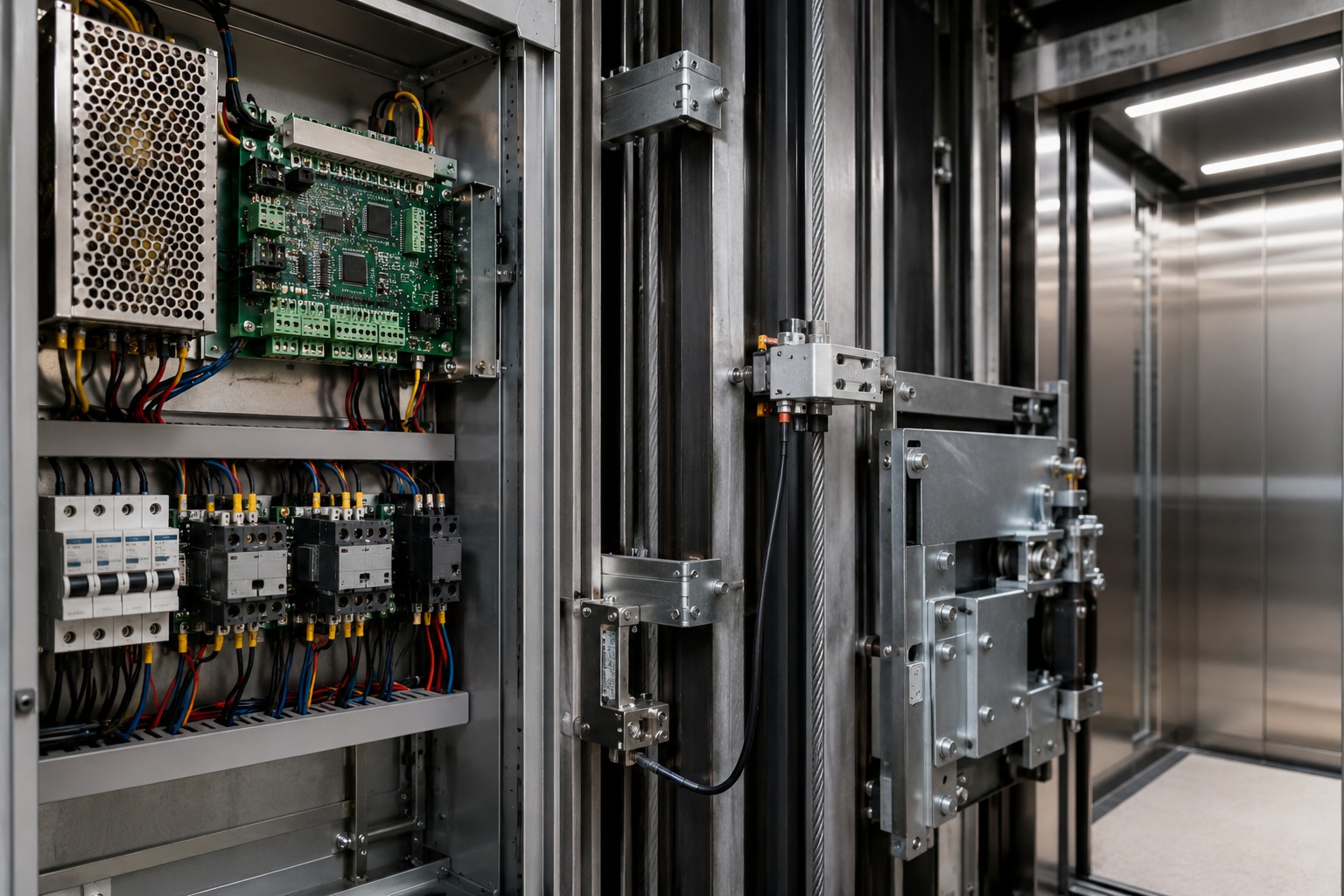
Elevator power supply components do far more than feed electricity into a lift. They stabilise controller logic, support communication circuits, energise brake release devices, protect low-voltage electronics, and keep emergency lighting available when the main supply fails. In South Africa, where building owners and maintenance teams often work across mixed infrastructure in Johannesburg, Cape Town, Durban, Pretoria, Gqeberha, and industrial corridors linked to ports and trade hubs, selecting the correct elevator power supply is directly connected to uptime, passenger safety, and faster service recovery.
The most practical answer is simple: every lift needs a properly matched power supply architecture rather than a generic replacement board. A controller may need one regulated DC output, a door operator another, the communication module a cleaner low-ripple feed, and the brake circuit a separate power arrangement with defined release characteristics. In older modernised lifts, technicians may also face mixed-brand systems where original boards have been replaced over time. In those cases, exact voltage, current reserve, mounting method, heat dissipation, and signal compatibility matter more than the printed part name alone.
For maintenance companies, distributors, building owners, and modernization contractors, the safest buying decision is to confirm supply input range, output voltage, output current, protection functions, duty cycle, connector style, and brand/model cross-reference before ordering. This is especially important in South Africa, where buildings can face variable utility quality, generator changeovers, coastal humidity in Durban, dust exposure in mining regions, and high service expectations in commercial towers, hospitals, residential estates, hotels, and logistics facilities.
In this guide, we cover the main elevator power supply types, switching power supply board selection, brake release power supply requirements, emergency lighting power supply planning, voltage ratings and load checks, common failure symptoms, replacement workflow, and frequently asked questions. The aim is to help buyers and technicians source compatible parts, reduce downtime, and keep lift systems operating safely.
South Africa Elevator Power Supply Market Overview
The South African lift market includes a mix of new installations, service contracts for aging buildings, and modernization projects where only selected components are upgraded. In Sandton office towers, Cape Town mixed-use developments, Durban beachfront hotels, Pretoria government facilities, and industrial sites near Richards Bay and the Port of Durban, elevator power supply issues often appear during controller retrofits, communication upgrades, and long-delayed parts replacement cycles.
Demand for reliable switching power supplies and associated boards is growing because many buildings prefer targeted repairs instead of full system replacement. A failed low-voltage power module can stop an otherwise serviceable controller. For this reason, spare parts planning has become more technical. Contractors increasingly look for stable quality inspection, careful model matching, and protective packaging for imported electronic parts that must travel safely to regional service teams.
Another market factor is standby power strategy. South African buildings frequently consider generator-backed operation, load shedding resilience, and emergency response readiness. That makes brake release supply behaviour, emergency lighting battery support, and communication continuity more important than in markets with more stable grid conditions.
Main Power Supply Types in Elevators
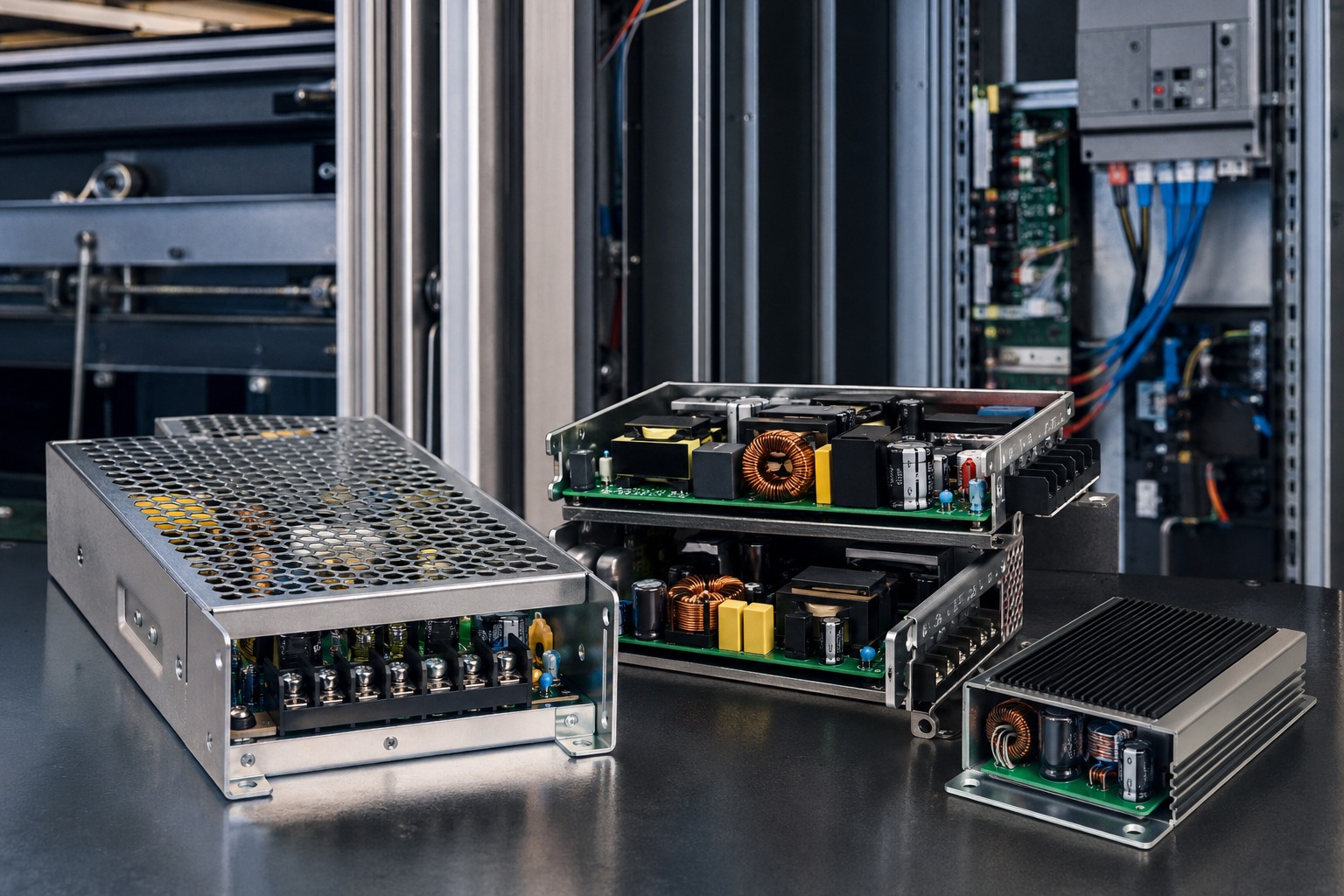
Elevators usually do not rely on a single universal power unit. Instead, they use several power supply forms depending on the subsystem. The main categories include AC input power modules, switching power supply boards for regulated DC outputs, constant voltage boxes, auxiliary supply units for communication or signaling, and special-purpose supplies for brake release or emergency circuits.
In many passenger lifts, the incoming mains feed is converted and distributed through the controller cabinet. From there, regulated outputs are used for the logic board, relay circuits, door operator boards, indicators, intercom modules, and sensors. More advanced systems may also include separate outputs for encoder interfaces, monitoring devices, network communication gateways, and safety chain supervision.
Switch-mode supplies are widely used because they are compact, efficient, and suitable for multi-voltage control cabinets. However, not all switch supplies are equal. Some are intended for stable electronic control, while others are built for broader cabinet-level load support. In modernization projects, technicians may also encounter older linear-style or transformer-based auxiliary supply arrangements that have different heat and voltage characteristics.
Buildings in South Africa should pay special attention to environmental conditions. Coastal installations in Cape Town or Durban may require stronger protection against humidity and corrosion. Inland installations in Gauteng may demand better dust management in machine rooms or control cabinets. For heavy-traffic commercial sites, power supply boards with stronger thermal design and wider tolerance margins are usually a better long-term choice.
| Power supply type | Typical output | Main application | Advantages | Common risks if mismatched | Suitable project type |
|---|---|---|---|---|---|
| Switching power supply board | 12V, 24V, 48V DC | Controller logic, relays, sensors | Efficient, compact, stable | Controller resets, ripple noise, overload trips | Routine replacement and modernization |
| Constant voltage power supply box | Fixed regulated DC | Cabinet-level stable output | Good consistency for sensitive circuits | Incorrect voltage to communication boards | Brand-specific cabinet repair |
| AVR power board | Model-dependent DC outputs | Voltage regulation in selected systems | Improved control stability | Board damage from wrong model selection | Exact replacement jobs |
| Brake release supply unit | Often higher peak DC output | Brake coil actuation | Reliable brake opening behaviour | Incomplete release, overheating, chatter | Traction lift maintenance |
| Emergency lighting supply | Battery-backed low voltage | Car lighting during outages | Passenger reassurance and compliance support | No illumination during emergency | Safety upgrades |
| Auxiliary communication supply | Low-noise DC | Intercom, auto-dialer, monitoring | Cleaner signal reliability | Intermittent comms failure | Remote monitoring installations |
The table shows why a lift power supply should never be treated as a generic spare. Even if two boards share similar output labels, their protection logic, startup profile, insulation, and connector layout may differ enough to affect system safety and communication performance.
Switching Power Supply Board Selection
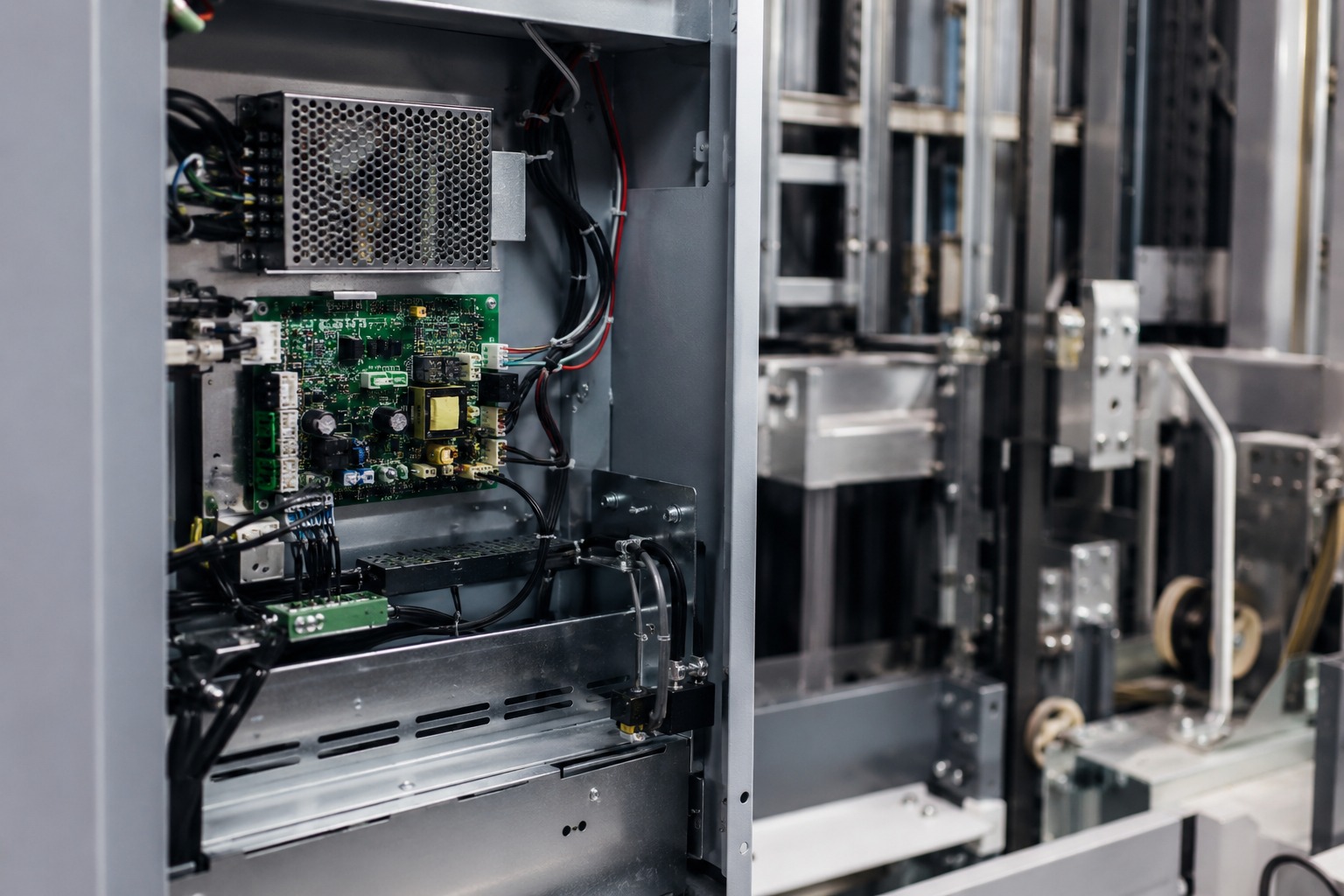
Choosing the right switching power supply board starts with exact model identification, but it should not end there. A professional selection process also checks input voltage range, output voltage accuracy, current capacity, load surge reserve, mounting dimensions, cooling method, and interface compatibility with the controller or cabinet harness.
For example, a board marked 24V may operate perfectly in one elevator controller yet fail in another due to differences in inrush current, relay bank demand, or grounding layout. Technicians should review the original board label, cabinet drawings where available, wire terminal positions, and actual measured load during operation. If the board feeds door operators, hall call boards, or signal lamps, starting current may be higher than the steady-state reading suggests.
It is also wise to source from suppliers that support careful model matching and provide part photos, connector confirmation, and practical replacement guidance. Buyers looking for a switch power supply for lift accessories or a switching power supply board for elevator spare parts should compare the physical board structure as well as the electrical data.
In South Africa, a well-selected replacement board can reduce repeat callouts for buildings in remote service areas outside major centres. This matters for contractors working across long travel distances between Johannesburg, Bloemfontein, Polokwane, Nelspruit, and mining or agricultural regions where emergency revisits are costly.
| Selection item | Why it matters | Recommended check method | Common mistake | Possible field symptom | Buying advice |
|---|---|---|---|---|---|
| Input voltage range | Must match cabinet supply conditions | Read label and cabinet schematic | Ignoring AC tolerance | No startup or unstable output | Choose wide-range input where suitable |
| Output voltage | Protects boards and relays | Measure original live output | Replacing 24V with similar-looking 12V board | Controller fault or dead indicators | Confirm nominal and adjustable range |
| Output current | Supports total connected load | Calculate load plus safety margin | Choosing only by size | Voltage drop under load | Allow reserve for peaks |
| Ripple and noise | Affects communication and logic stability | Check datasheet and field history | Using low-grade industrial substitute | Random resets or intercom noise | Prefer stable control-grade units |
| Connector and terminal layout | Prevents wiring errors | Compare photos and dimensions | Assuming “close enough” fit | Installation delay or miswiring risk | Request exact board image |
| Protection features | Improves safety and service life | Review overload, short, thermal protection | Ignoring protection profile | Repeated blown parts | Select proven protection design |
This checklist reduces the chance of matching by appearance alone. That is especially useful when imported elevator spare parts have different production batches, revised labels, or cabinet modifications performed during previous service work.
Brake Release Power Supply Requirements
The brake release power supply has a direct role in traction elevator operation. It must provide the correct electrical energy to open the brake coil quickly and consistently, without overheating the coil or creating delayed release that affects ride quality and leveling. Unlike some low-voltage control outputs, brake circuits often involve momentary peak demand and can be sensitive to wrong voltage selection.
If the brake release supply is too weak, the brake may chatter, partially release, or open slowly. This can cause motor strain, noise during startup, or a fault condition that appears intermittent. If the supply is too strong or incorrectly regulated, brake coils can run hotter than intended, shortening component life. Some systems use a high initial pull voltage followed by a reduced holding voltage to manage thermal load. Others depend on a dedicated module integrated into the machine or controller circuit.
For buildings with frequent usage, such as hospitals in Pretoria, retail centres in Johannesburg, hotels in Cape Town, and apartment towers in Umhlanga or Durban North, brake release reliability is critical because repeated starts amplify the effects of an incorrectly matched supply. Modernization contractors should also verify the interaction between inverter logic, safety chain commands, and brake output timing when replacing boards or power modules.
Where relevant, buyers may need brand-specific solutions such as an AVR power board 24V/51V for Hitachi elevator parts or a constant voltage power supply box for Hitachi lifts, especially in systems where exact voltage regulation affects brake and controller coordination.
| Evaluation point | What to verify | Why it matters | Failure sign | Test approach | Service note |
|---|---|---|---|---|---|
| Release voltage | Correct opening voltage at coil | Ensures full brake release | Drag, noise, rough start | Measure at command instant | Check under real load conditions |
| Holding voltage | Maintained safe open state | Prevents overheating and dropout | Warm coil or random trip | Measure after stabilization | Compare with machine design |
| Timing coordination | Brake release vs drive command | Affects ride comfort and safety logic | Jerky launch or faults | Observe start sequence | Coordinate with inverter settings |
| Current capacity | Supply peak demand margin | Supports repeated duty cycles | Voltage sag on heavy traffic | Clamp meter or datasheet review | Add reserve for hot conditions |
| Heat dissipation | Cabinet thermal performance | Protects electronics and coil control | Heat shutdown or early aging | Inspect ventilation and temperature | Important in small machine rooms |
| Compatibility with control board | Command signal and feedback logic | Prevents false faults | Brake not releasing despite correct voltage | Check wiring and board interface | Use model-matched replacement |
These checks help separate brake supply problems from mechanical brake wear, contactor faults, or inverter command errors. In the field, symptoms often overlap, so systematic testing is essential.
Emergency Lighting Power Supply Planning
Emergency lighting is one of the most visible passenger protection features during a power interruption. Even when the car cannot continue normal operation, emergency illumination reduces panic and supports safe communication while rescue procedures begin. Planning this power supply involves more than adding a small battery. The installer must consider lamp type, run time requirement, charging method, replacement cycle, and the relationship between emergency lighting, alarm systems, and auto-dial or intercom circuits.
In South Africa, emergency planning often intersects with generator use and building load management. A lift may not be intended to continue full service during an outage, but the car still needs enough local backup for lighting and passenger awareness. In residential complexes, offices, healthcare buildings, and public institutions, building owners increasingly ask for clearer backup strategies because power interruptions can happen with little warning.
Emergency lighting supplies should be checked for battery aging, charger output, indicator status, and actual discharge time. During modernization, LED retrofits may reduce the required load, but the charging circuit still needs to be compatible. If the backup unit also supports communication boards, the total run-time calculation should include all connected devices.
| Planning factor | Typical consideration | Operational impact | Inspection point | Replacement trigger | Local project relevance |
|---|---|---|---|---|---|
| Battery capacity | Must support required run time | Determines emergency light duration | Discharge test | Run time below target | Critical during outages |
| Charging circuit | Correct battery chemistry and voltage | Prevents undercharge or overcharge | Charge voltage measurement | Battery swelling or weak backup | Important in high-use sites |
| Lamp efficiency | LED vs older lamp loads | Changes backup duration | Current draw check | Dim output or excessive draw | Useful in modernization |
| Isolation and protection | Short-circuit and reverse protection | Improves system safety | Visual board review | Repeated fuse failure | Needed for cabinet reliability |
| Integration with alarm/intercom | Shared or separate backup path | Affects emergency communication | Outage simulation | Intercom dies with main power | Important in hospitals and offices |
| Maintenance interval | Scheduled battery and charger checks | Prevents surprise failure | Service log review | Missed test cycles | Essential for managed properties |
This table shows that emergency lighting planning is closely tied to communication continuity. A bright car lamp is helpful, but it is even more effective when paired with a working intercom or emergency call function.
Voltage Ratings and Load Checks
Voltage ratings and load checks are the foundation of safe replacement. Before installing any elevator power supply, technicians should confirm the rated input and actual measured input, the specified output and real output under load, and the total current draw of all connected devices. A bench test is useful, but it is not enough on its own; some faults only appear in real operating conditions with relay switching, door movement, or brake action.
Load checks should include both continuous and peak demand. For instance, a board feeding hall lanterns, COP buttons, indicators, and door zone sensors may seem lightly loaded when idle, but current can climb when multiple outputs change state together. A controller that works in testing mode may still reset in normal traffic because peak demand was underestimated.
Voltage tolerance is especially important where incoming building power quality varies. A unit that operates near its lower threshold may behave unpredictably during utility fluctuation or generator switchover. Good practice is to choose a replacement with reasonable operating headroom rather than the absolute minimum acceptable current rating.
| Check step | What to measure | Target result | Common problem found | Corrective action | Why it saves time |
|---|---|---|---|---|---|
| Input verification | AC or DC source to the supply | Within rated range | Low or unstable mains feed | Fix upstream issue first | Avoids blaming a good board |
| No-load output test | Output voltage without connected load | Nominal setpoint | Dead or drifting output | Reject faulty unit | Quick first screen |
| Loaded output test | Voltage under normal operating load | Stable under duty | Sag under traffic demand | Increase current capacity | Prevents repeat service calls |
| Peak current check | Startup or switching surges | Within safe reserve | Trips during door or brake action | Use higher surge-capable model | Protects intermittent faults |
| Heat observation | Board temperature during run | Controlled thermal profile | Cabinet overheating | Improve ventilation or derate load | Improves service life |
| Ground and noise review | Ripple and grounding quality | Stable control signals | Communication noise or resets | Correct grounding and shielding | Stabilises electronics |
When these checks are documented, maintenance companies can create more consistent replacement decisions across multiple sites and technicians.
Common Power Failure Symptoms
Elevator power supply problems rarely announce themselves with a single obvious sign. Instead, they often appear as secondary failures: the car stops responding, indicators go dark, the door operator behaves erratically, the controller resets, communication cuts out, or the brake does not release consistently. Understanding symptom patterns helps reduce unnecessary replacement of unrelated parts.
For example, repeated controller rebooting may point to low output voltage under load, poor capacitor health, or excessive ripple. Intermittent intercom failure may be tied to noisy DC output or a charger problem in a shared emergency supply path. If the car light works normally on mains but not during outage simulation, the issue may be battery capacity rather than the lamp itself. If the brake fails only during hot conditions, the supply may be sagging as cabinet temperature rises.
In the South African context, some symptoms become more visible during voltage instability, after thunderstorms, or when buildings transfer between utility and standby power. Coastal corrosion can also weaken terminals and connectors, creating resistance that looks like board failure. For this reason, diagnosis should always include wiring condition, terminal torque, signs of heat damage, and evidence of previous repairs.
Typical power-related elevator symptoms include:
- Controller screen dead or flickering
- Random system resets during travel or door operation
- Door operator board faults after startup
- Brake chatter, delayed release, or rough launch
- Intercom, alarm, or remote monitoring dropout
- Emergency lighting not holding charge
- Burn marks, swollen capacitors, or overheated terminals
- Fuse blowing after replacement without obvious short circuit
These symptoms should be tested methodically, not treated as proof that a single board is always at fault. A complete diagnosis reduces parts waste and improves first-time repair success.
Replacement and Testing Workflow
A disciplined replacement workflow protects both safety and service efficiency. First, isolate power according to site procedures and verify the fault with measurements rather than assumptions. Next, record the original part number, voltage labels, terminal markings, and connector orientation. Take clear cabinet photos before disconnecting anything. If available, compare with service manuals, prior replacement records, and actual measured output readings.
After selecting the replacement unit, bench-check the basic output if practical. On installation, inspect upstream fuses, wiring condition, terminals, earthing, cabinet cleanliness, and signs of moisture or carbon tracking. Replace one variable at a time where possible. If several boards have failed together, investigate the root cause first, such as overvoltage, shorted peripheral load, failed charger section, or poor ventilation.
Once fitted, test the new supply under no-load and loaded conditions. Then run operational tests covering startup, normal travel, door cycles, brake release, indicators, communication, and emergency lighting transfer if applicable. For high-use sites, a soak test with repeated trips is preferable before releasing the lift back to full service.
Contractors and distributors benefit from working with suppliers that understand exact model matching, packaging protection for electronic transport, and responsive service for photo-based confirmation. This is especially useful when parts are shipped to projects in Cape Town, Durban, Johannesburg, or inland sites that cannot afford repeated delays.
- Confirm the reported fault and safety-isolate the lift.
- Measure incoming supply and output condition.
- Record labels, terminals, connectors, and cabinet photos.
- Check connected load for shorts or abnormal draw.
- Select a compatible replacement by model and electrical rating.
- Install carefully with wiring verification.
- Test outputs under live operating conditions.
- Run brake, door, indicator, and communication checks.
- Simulate emergency lighting transfer where applicable.
- Document results for future service history.
Following this sequence helps maintenance teams reduce repeat visits, protect controller electronics, and return units to operation with greater confidence.
Industries, Applications, and South African Buying Advice
Different industries place different demands on elevator power supply parts. Hospitals require high reliability for communication and emergency visibility. Residential towers focus on uptime and practical replacement cost. Hotels care about passenger confidence and quiet performance, which is why brake release smoothness matters. Retail and office buildings need stable operation under frequent door cycles and heavy traffic. Industrial and warehouse lifts may face harsher environmental conditions, so board protection and thermal design become more important.
For buying decisions in South Africa, it is wise to consider local logistics as well as technical specifications. Projects serving Gauteng can often move quickly through central distribution routes, while coastal and remote deliveries may need stronger packaging and more precise pre-shipment verification. Ports such as Durban and Cape Town remain important trade gateways for imported spare parts, making lead time planning relevant for larger modernization batches and distributor stock strategy.
When choosing between low-cost substitutes and carefully matched replacement units, the true cost should include technician travel, repeat downtime, tenant complaints, emergency callouts, and possible damage to connected boards. A cheaper unmatched power supply often becomes expensive after one failed revisit.
Case-Based Examples from the Field
Case 1: Commercial office tower in Johannesburg. A lift showed random controller resets during peak morning traffic. Initial suspicion fell on the main controller board, but testing revealed the switching power supply output dropped below tolerance during simultaneous relay and indicator demand. Replacing the supply with a correctly rated board solved the issue without changing the controller.
Case 2: Residential complex in Cape Town. Emergency lighting appeared normal during monthly visual checks, but failed after several minutes during an actual outage. The charger board was functioning, yet the battery capacity had degraded. A proper discharge test and battery replacement restored emergency lighting performance.
Case 3: Hotel lift in Durban. Guests reported a harsh takeoff and occasional fault after restart in humid weather. Investigation found a brake release supply section drifting under heat and moisture exposure. After replacing the matched unit and cleaning affected terminals, startup quality improved and faults stopped.
Case 4: Hospital service lift in Pretoria. The intercom and alarm path became unreliable during power transitions. Testing showed the communication circuit shared a backup path with insufficient reserve. Separating and upgrading the emergency supply arrangement improved resilience during generator transfer events.
Technological Capabilities
Our work with elevator power supplies is built around accurate model identification, electrical parameter checking, and compatibility review for control boards, inverter-related parts, door operators, sensors, intercom modules, and lift accessories across multiple brands including Hitachi, Toshiba, KONE, Mitsubishi, and others. For South African customers, this means we focus on practical sourcing support rather than just listing part names. We help confirm voltage classes, board versions, connector layouts, and replacement suitability so maintenance teams can avoid ordering by appearance alone.
Manufacturing Capabilities
On the supply side, we emphasise stable quality inspection and protective packaging for electronic elevator spare parts. This matters for switch power supplies, switching boards, constant voltage units, and other cabinet electronics that may travel long distances before installation. Proper handling, anti-damage packing, and consistent pre-shipment review help lower the risk of transport-related failures and support smoother installations for contractors and distributors serving South African cities and regional service routes.
Service Capabilities
Responsive service is essential when a lift is down. We support maintenance companies, distributors, building owners, and modernization contractors with careful part matching and practical communication to help reduce downtime. Whether the need is a single replacement board or broader sourcing for elevator accessories, our goal is to make replacement decisions faster and safer by providing clear confirmation, compatible options, and reliable spare-parts support for ongoing lift maintenance work.
Local Suppliers and Sourcing Considerations in South Africa
South African buyers often compare local stock availability with imported replacement options. Local suppliers may provide speed for common items, but model-specific elevator power supply boards frequently require specialist sourcing. The best procurement approach depends on how critical the lift is, whether a temporary shutdown is acceptable, and whether the site has multiple units sharing load.
For high-priority buildings, keeping a small stock of known failure items can be a practical strategy. These may include switching power supply boards, emergency light batteries, intercom supply modules, and selected brand-specific regulator boards. Distributors can also benefit from stocking commonly requested voltage classes and cabinet accessories for mixed-brand service portfolios.
| Comparison point | Local stock supplier | Specialist international source | Best use case | Main risk | Buyer recommendation |
|---|---|---|---|---|---|
| Delivery speed | Often faster for common items | Depends on shipping lane and customs | Urgent routine repairs | Stock may not match exact board | Verify model before purchase |
| Brand-specific coverage | Limited on uncommon models | Usually broader options | Legacy or rare systems | Longer lead time | Plan ahead for modernization |
| Technical matching support | Varies by supplier | Often stronger with specialist parts focus | Complex controller replacements | Miscommunication if data is incomplete | Provide photos and labels |
| Packaging protection | Basic to moderate | Important for electronic export parts | Long-distance transport | Transit damage | Choose well-packed electronics |
| Price level | Can be higher for scarce stock | Can be more competitive on planned orders | Batch procurement | False savings from wrong substitute | Compare total downtime cost |
| After-sales response | Depends on network size | Critical for photo confirmation and cross-checking | Technical troubleshooting | Slow response delays repair | Prefer responsive support partner |
The explanation above is clear: the best source is not always the closest one, and the lowest initial price is not always the lowest operating cost.
2026 Trends: Technology, Policy, and Sustainability
Looking toward 2026, elevator power supply planning in South Africa is likely to move in three main directions. First, technology will continue shifting toward more efficient, compact, and regulation-stable switching supplies with better diagnostic visibility. More buildings will want parts that support communication reliability, remote monitoring, and cleaner power for networked lift components.
Second, policy and risk management expectations are likely to push stronger emergency preparedness. This includes clearer maintenance records for emergency lighting, intercom continuity, and dependable backup pathways during power interruptions or generator transfer. Building owners are increasingly aware that passenger confidence during a fault event depends on visible emergency function, not only on the ability to resume travel later.
Third, sustainability will influence component choices. Energy-efficient power supplies, longer-life electronic designs, lower standby loss, and targeted modernization of control-cabinet electronics can reduce waste compared with full system replacement. For many South African properties, the most sustainable path is often to extend the service life of an elevator through precise component replacement rather than wholesale changeout.
FAQ About Elevator Power Supplies
How do I know if an elevator power supply board is faulty?
Look for low or unstable output voltage, repeated controller resets, dead indicators, communication loss, visible heat damage, or failure under load even when no-load voltage seems normal.
Can I replace a switching power supply with any unit that has the same voltage?
No. Voltage alone is not enough. You must verify current capacity, ripple performance, connector layout, dimensions, protection functions, and compatibility with the controller or subsystem.
Why does the brake release circuit need special attention?
Because the brake must open quickly and consistently without overheating. A wrong supply can cause chatter, rough starts, incomplete release, or shortened brake coil life.
How often should emergency lighting backup be tested?
Visual checks should be routine, but actual discharge and run-time testing should also be scheduled. Battery age, charger health, and actual load all affect performance.
What is the most common buying mistake?
Ordering by appearance or basic voltage label without checking model details, load demand, and connected system requirements.
Do imported elevator power supplies work well in South Africa?
Yes, if they are correctly matched, properly inspected, and packaged for transport. The key is exact compatibility and support during selection, not simply the origin of the part.
Should building owners keep spare power supplies on site?
For critical or high-traffic buildings, keeping selected spare parts such as power supply boards or emergency backup items can reduce downtime significantly.
What information should I send when requesting a replacement?
Share part number, clear photos, voltage labels, connector views, elevator brand, model, fault symptoms, and where the board is installed in the cabinet. This speeds up accurate matching.
Final Buying Guidance for South Africa
If you are selecting an elevator power supply for a building in South Africa, focus on exact compatibility, load reserve, emergency function, and operating environment. A reliable replacement supports more than voltage output: it protects control stability, communication continuity, brake release performance, and emergency preparedness. For service companies and building owners, the right part choice can reduce downtime, prevent repeat callouts, and extend the useful life of the lift system.
Whether the project involves a switching power supply board, a constant voltage unit, a brake-related supply, or emergency lighting backup, careful model matching and proper testing remain the safest path. In a market that combines modernization demand, variable infrastructure conditions, and the need for reliable building transport, elevator power supply planning is not a minor electrical detail. It is a core maintenance decision.