
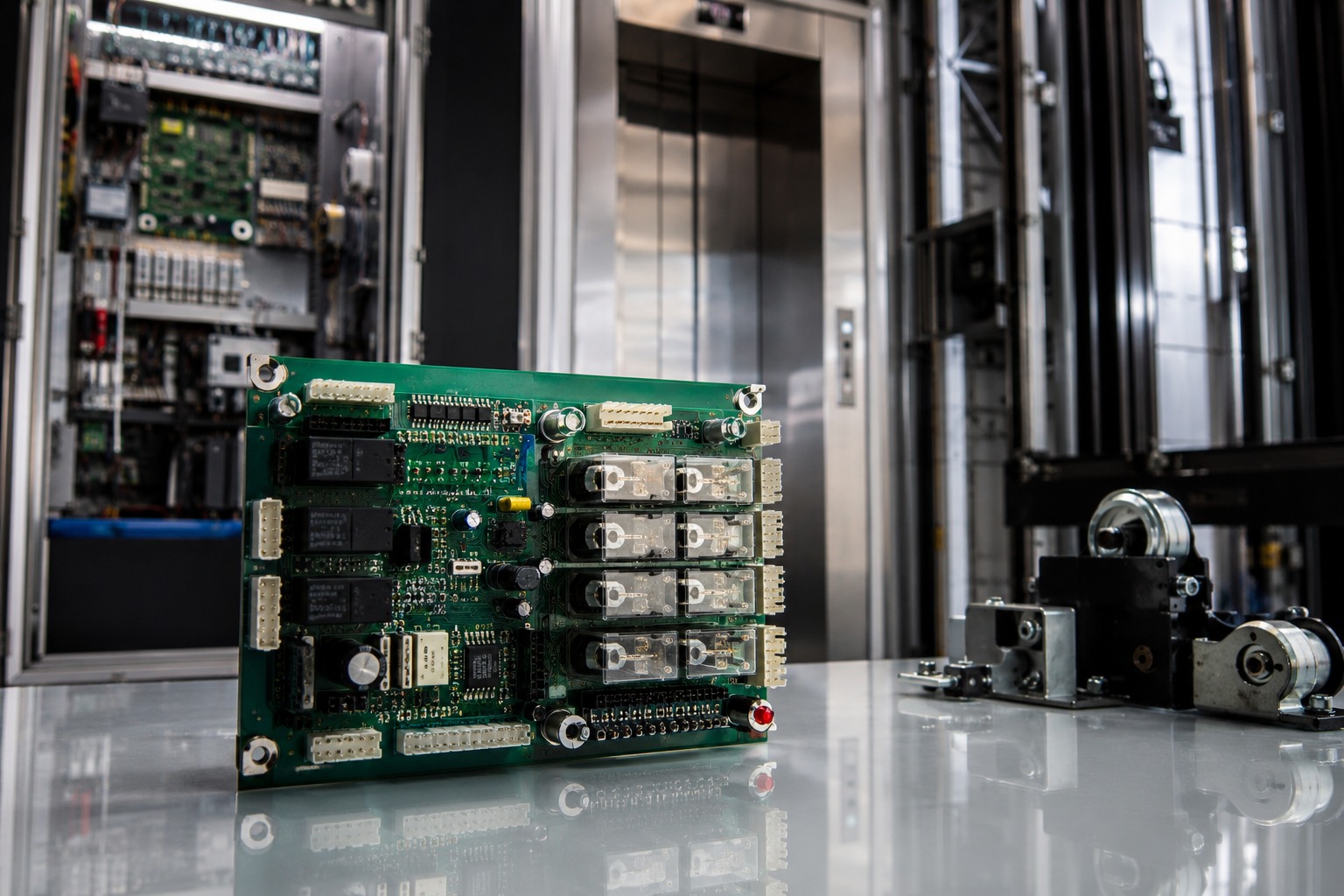
Toshiba elevator safety circuit relay boards are a critical part of the lift protection chain. In simple terms, these boards monitor and relay safety signals between key devices such as door locks, limit switches, emergency stops, governor contacts, brake circuits, and controller logic. If a safety input opens unexpectedly, the board helps stop normal lift motion and prevents unsafe operation until the fault is corrected. For maintenance teams in South Africa, especially those supporting commercial buildings in Johannesburg, Cape Town, Durban, Pretoria, and Gqeberha, understanding the correct relay board function is essential for reducing downtime and protecting passengers.
Because many older and mid-life Toshiba systems remain active in offices, hospitals, hotels, malls, residential towers, mines, and public facilities, the demand for compatible safety circuit boards continues to be steady. Building owners often need reliable replacement parts quickly, but buying the wrong board can create repeat faults, wasted labour, and compliance concerns. A good sourcing process includes exact model matching, board code confirmation, connector and terminal verification, and post-installation safety chain testing by qualified technicians.
For buyers in South Africa, lead time also matters. Imported parts may move through major trade routes linked to Durban Port, Cape Town Port, and OR Tambo cargo channels, which means packaging quality and documentation accuracy can directly affect project timelines. This is why experienced suppliers focus not only on stock access, but also on model identification support, quality checks, anti-static handling, and clear communication before dispatch.
In this guide, you will find a practical explanation of what safety circuit relay boards do, common fault symptoms, Toshiba sourcing considerations, compatibility checks, testing procedures after replacement, supplier documentation requirements, maintenance advice, and a frequently asked questions section. The article is written for elevator maintenance companies, distributors, modernization contractors, and building owners who need clear, field-relevant information for the South African market.
What safety circuit relay boards do
A safety circuit relay board acts as an organized interface for the elevator’s protective devices. Instead of sending raw field signals directly through multiple unrelated paths, the board helps route, condition, and monitor safety signals in a structured way. In many Toshiba lift systems, it sits within the broader controller architecture and works alongside control boards, expansion boards, communication boards, and power modules.
The board typically receives signals from door interlocks, landing door contacts, pit stop switches, top-of-car stop switches, overspeed-related contacts, final limit switches, brake feedback devices, thermal contacts, and emergency rescue interfaces. When all safety conditions are healthy, the board allows the safety chain to remain complete, enabling the controller to permit normal operation. If one device opens or reports an abnormal state, the board interrupts the chain or reports the condition so the controller can stop the car, inhibit movement, or trigger a fault code.
In practice, this function supports several goals:
- Preventing car movement when a door is not safely locked
- Stopping operation if a stop switch is activated
- Protecting the system when travel limits are reached
- Helping isolate abnormal input states for troubleshooting
- Providing an interface between legacy wiring and controller logic
- Reducing risk of unsafe restart after a fault
On many sites, the relay board is not a standalone decision maker but an integral part of the larger safety chain. That means technicians should never evaluate it in isolation. Inputs, outputs, relays, terminal integrity, wiring continuity, and interaction with the main controller must all be reviewed together. Where related boards are involved, some customers also review the matching of the Toshiba elevator expansion board and the Toshiba elevator car top communication board to confirm that signal exchange is consistent across the system.
| Safety input or function | Typical source device | What the relay board does | Impact if open or failed | Field importance | Technician note |
|---|---|---|---|---|---|
| Door lock chain | Car and landing door interlocks | Confirms safe closure path | Lift will not run or may stop | Very high | Check mechanical lock and wiring together |
| Emergency stop circuit | Car top, pit, machine room stop switches | Monitors stop condition | Immediate operation inhibit | Very high | Inspect contact condition and reset status |
| Limit protection | Terminal and final limit switches | Passes protected travel status | Controller blocks motion | High | Verify switch actuation points |
| Brake feedback | Brake auxiliary contacts | Verifies brake state | Run fault or safety stop | High | Look for delayed or sticky contacts |
| Overspeed related chain | Governor or safety contacts | Maintains safety chain integrity | System locked out | Very high | Do not bypass for convenience |
| Thermal or overload contact | Motor or drive protection devices | Communicates unsafe temperature state | Operation disabled | Medium to high | Check root cause before reset |
The table above shows why a relay board matters beyond a simple on-off function. It acts as a practical control point for multiple safety-related conditions, making fault tracing and reliable operation more manageable when the board is correct for the exact Toshiba system.
Common safety circuit fault symptoms
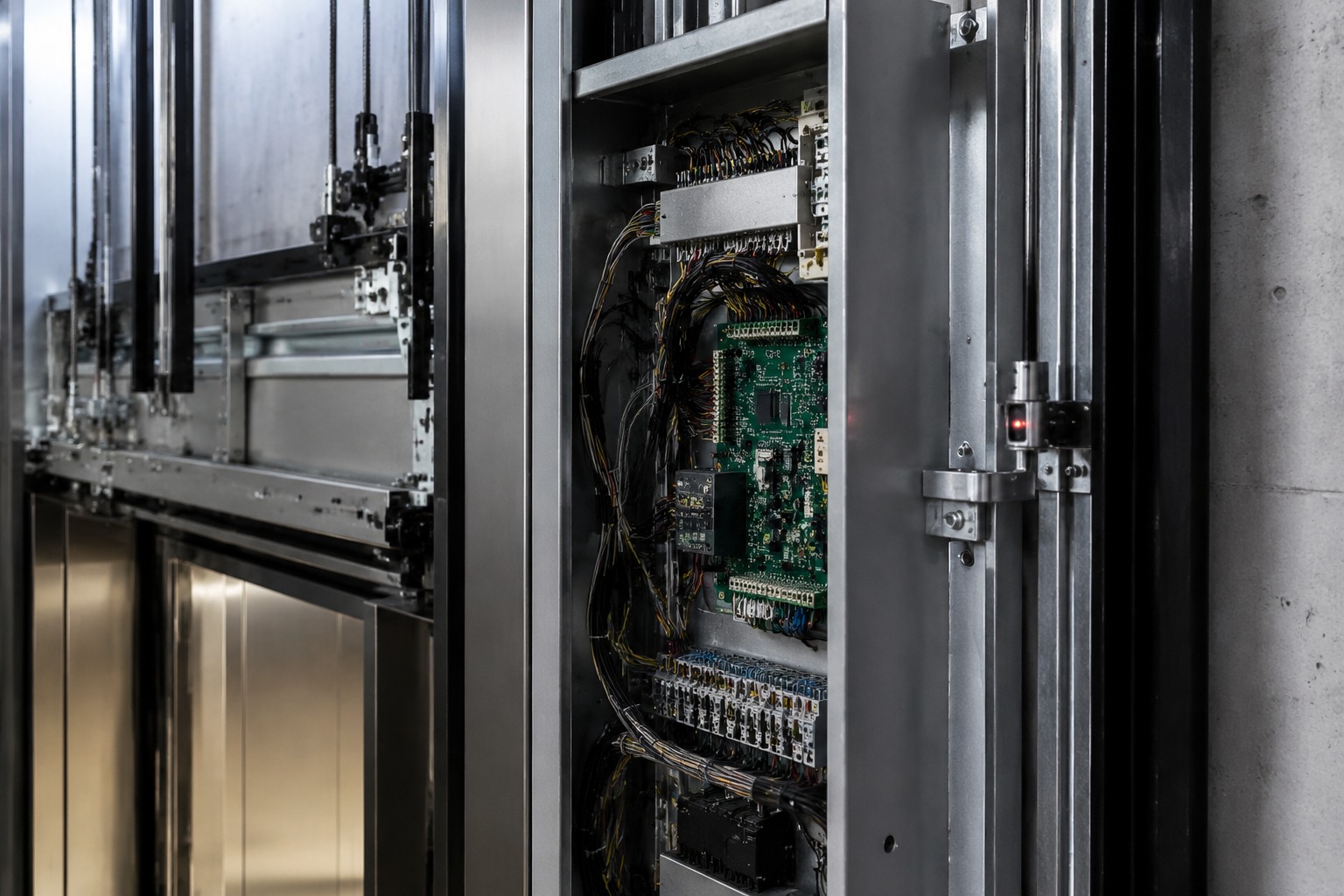
When a safety circuit relay board develops a problem, the symptoms are not always obvious. Some faults originate on the board itself, while others come from external devices and only appear to be a board issue. Good diagnosis starts with symptom recognition.
Common signs include the lift refusing to run even though no visible mechanical issue is present, intermittent safety chain drops, unexplained door lock alarms, relay chatter, inconsistent restart after power cycling, burned relay contacts, terminal discoloration, or fault codes related to safety input mismatch. In certain buildings, faults appear only during humid weather, after cleaning work, or during peak traffic periods when vibration and heat rise inside the controller cabinet.
Technicians in coastal parts of South Africa, including Durban and Cape Town, often pay extra attention to humidity, salt air exposure, and oxidation on terminals. Inland sites such as Johannesburg and Pretoria may instead see dust accumulation, temperature fluctuation, and occasional damage caused by unstable power conditions or cabinet ventilation issues.
| Symptom | Likely board-related cause | Possible non-board cause | How it appears on site | Urgency | Recommended next step |
|---|---|---|---|---|---|
| Lift will not start | Relay not energizing | Open door lock chain | Car remains idle at floor | High | Measure chain continuity and relay state |
| Intermittent shutdown | Cracked solder joint | Loose field wiring | Random stoppages during service | High | Inspect vibration points and terminals |
| Relay chatter | Weak coil or unstable board supply | Voltage fluctuation | Audible clicking, unstable enable | High | Check supply voltage and relay coil values |
| Repeated safety fault code | Input processing error | Defective switch or lock | Same code returns after reset | High | Compare fault log with live inputs |
| Burn marks on board | Overheated relay or track damage | Short circuit downstream | Visible damage, smell, blackened area | Critical | Stop operation and inspect complete circuit |
| False door not locked alarm | Contact interpretation fault | Misaligned interlock | Lift traps at landing or refuses dispatch | High | Check lock mechanics before board replacement |
The explanation behind these symptoms is important. A relay board may fail electrically through worn contacts, aged components, heat stress, contamination, or PCB damage. However, replacing the board without checking connected devices can lead to the same fault returning. For example, a sticky landing door lock can cause repeated relay stress. Similarly, a brake feedback contact with poor timing may create what looks like a board logic problem.
A disciplined fault-finding routine usually includes visual inspection, review of controller logs, continuity testing, terminal tightening, voltage checks under load, relay state confirmation, and cross-checking with system documentation. Where the board is clearly defective, replacement should be based on exact identification rather than broad brand assumptions.
Toshiba relay board sourcing notes
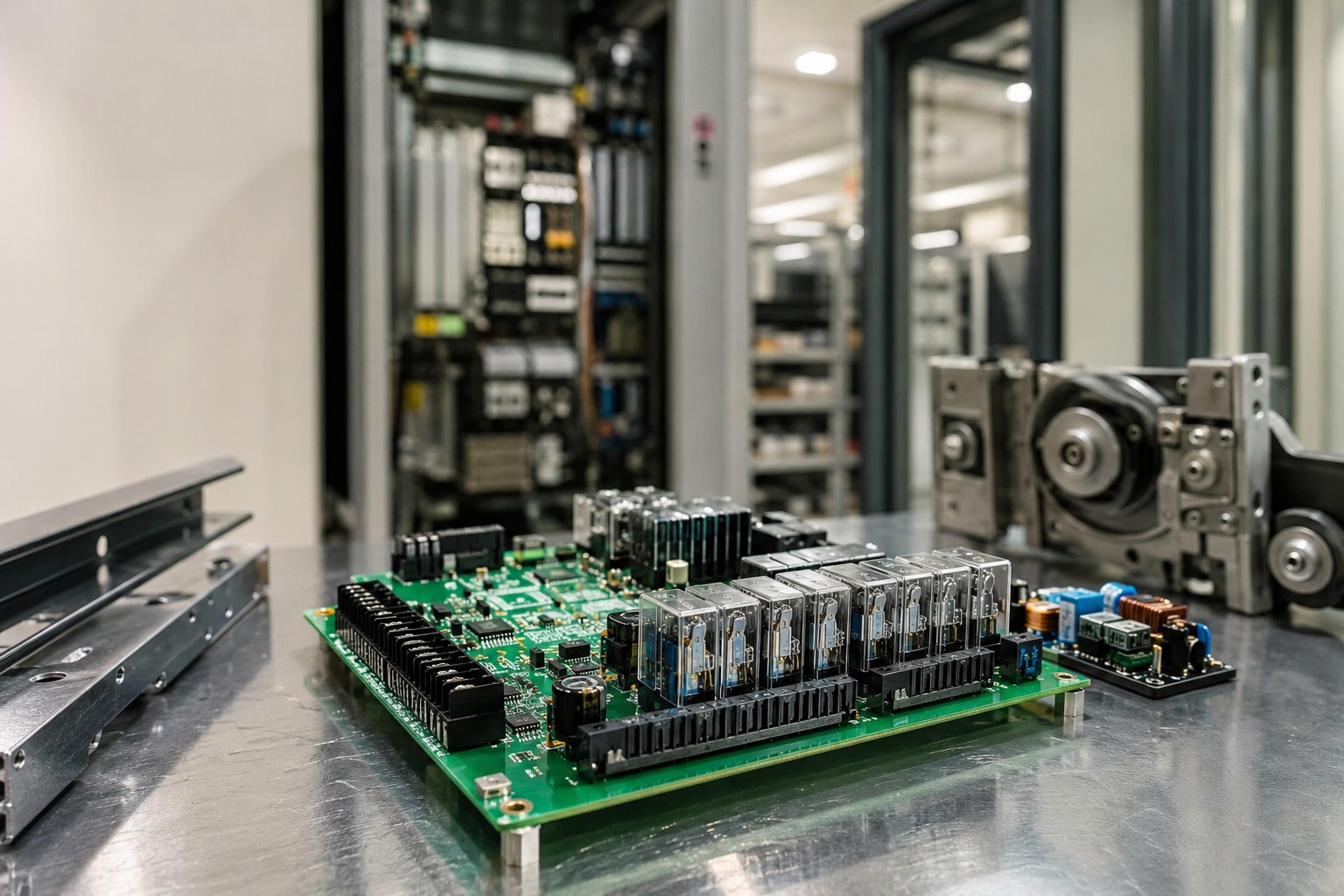
Sourcing a Toshiba elevator safety circuit relay board requires more than matching the brand name. Toshiba systems may have variations by controller generation, lift application, software family, connector layout, relay specification, and board revision. A part that looks similar can still be incompatible in terminal assignment, logic arrangement, input count, or installation orientation.
Buyers in South Africa should normally prepare the following information before requesting a quote:
- Clear photos of the front and back of the existing board
- Board code, serial label, and revision marking
- Controller model and elevator type
- Site fault description and any controller code shown
- Connector count, terminal markings, and relay brand/type if visible
- Whether the need is for repair, direct replacement, or stock backup
Good suppliers can assist with model matching and risk review, especially when the original label is faded or partial. In many cases, a buyer may start with the Toshiba elevator safety circuit relay board page and then share additional identification details for confirmation. This reduces the chance of ordering a board that only partly resembles the required item.
South African customers also often consider logistics. Spare parts for emergency shutdowns may need fast dispatch to Gauteng business districts, coastal hotel properties, hospital maintenance teams, or mining regions where service delays are costly. Reliable anti-static packaging, shock protection, moisture control, and clear outer labelling are therefore part of the sourcing decision, not an afterthought.
| Sourcing factor | Why it matters | Risk if ignored | What to request from supplier | Best practice for SA buyers | Result |
|---|---|---|---|---|---|
| Exact board number | Confirms direct match | Wrong part shipped | Label verification photo | Send close-up images | Higher order accuracy |
| Revision level | Different revisions may vary | Signal mismatch | Revision comparison note | Ask before payment | Reduced rework |
| Connector layout | Ensures physical fit | Installation impossible | Terminal and socket images | Cross-check with cabinet layout | Faster replacement |
| Functional application | Passenger, freight, or other use can differ | Incorrect logic use | Application confirmation | Share controller details | Safer selection |
| Packaging quality | Protects board in transit | Damage during shipping | Anti-static packing statement | Important for long routes | Better arrival condition |
| After-sales support | Helps solve installation issues | Project delay | Response commitment | Choose responsive supplier | Lower downtime |
The table shows that sourcing is part technical and part operational. A strong supply partner supports verification, packing, and communication rather than acting only as a price source. This is particularly useful in South Africa where distances between cities, site access schedules, and shipping lead times can complicate urgent maintenance work.
The line chart above illustrates a realistic growth pattern in replacement demand. The rise is driven by aging installations, modernization planning, stricter uptime expectations, and the tendency of building managers to keep strategic spares for critical assets.
How technicians verify compatibility
Compatibility verification is one of the most important stages before fitting a replacement safety circuit relay board. Skilled technicians do not rely on appearance alone. They compare the old and replacement board across several technical points to avoid hidden mismatch.
The first step is to confirm the board identification code and revision. Next, they inspect terminal names, connector positions, relay count, fuse ratings where applicable, and PCB markings. If drawings or maintenance manuals are available, they compare I/O mapping and board role inside the controller. They also check whether the board is used with supporting modules, because a safety chain board may interact with a controller CPU board, an expansion board, and a car top communication board.
Physical fit is only one aspect. Electrical compatibility is equally important. Relay coil voltage, contact arrangement, signal references, and wiring order must match system requirements. On older installations, previous modifications may have altered terminal usage, so technicians often document the pre-removal wiring with photos and numbering tags.
Technicians also evaluate the source of the replacement. A professionally supplied board should have clear identification, visible condition, protected packaging, and, ideally, test confirmation from the supplier. Our own support approach in this area focuses on technological capabilities: careful model matching using board labels, photos, connector review, and part history comparison. This helps maintenance teams reduce uncertainty before installation.
| Compatibility checkpoint | What is compared | Why it matters | Tool or method used | Common mistake | Correct practice |
|---|---|---|---|---|---|
| Board code | Part number and revision | Primary identification | Label photo and manual | Ignoring suffix codes | Match full code exactly |
| Connector positions | Socket count and location | Ensures fit and signal path | Visual comparison | Assuming same shell means same function | Check every connector |
| Terminal markings | Input and output names | Confirms wiring logic | Wiring diagram review | Reusing wiring without verification | Compare terminal by terminal |
| Relay specification | Coil and contact rating | Supports correct operation | Component label check | Overlooking relay differences | Validate rating and type |
| PCB revision changes | Layout and component updates | Affects behavior or fit | Supplier confirmation | Assuming newer always fits older | Request revision guidance |
| System interaction | Board works with other modules | Prevents communication issues | Full controller review | Checking only one board | Assess whole system path |
This compatibility process becomes even more important when buyers carry stock for planned maintenance contracts. A board that is technically close but not exact can delay restoration and create return complications. That is why many maintenance companies in South Africa prefer a supplier that combines sourcing reliability with practical application support.
The bar chart highlights where replacement demand is often highest. Commercial, residential, and retail installations tend to generate frequent parts needs due to traffic volume and uptime pressure, while hospitals and public buildings place especially high importance on safety and fast restoration.
Testing safety chain after replacement
After installing a replacement board, technicians must verify the entire safety chain before returning the lift to normal service. This testing stage is essential because a correct part can still be installed into a system with external faults, loose terminals, or undocumented modifications. Safety chain testing should always be carried out by qualified elevator personnel following site procedures and applicable regulations.
A typical process includes isolation procedures, visual inspection, connector seating checks, wiring confirmation against pre-removal records, power-on observation, relay status review, and controlled testing of safety inputs one by one. The purpose is not only to confirm that the board powers up, but that the system reacts properly when each safety device changes state.
For example, technicians may verify door lock chain continuity, confirm that opening a protected input produces the expected fault response, and ensure that the controller does not allow movement under unsafe conditions. They may also review event logs, confirm brake response timing, and carry out a monitored test run under safe conditions. On some sites, post-replacement checks are documented for client records or maintenance audits.
From a manufacturing capabilities perspective, we support this stage by emphasizing stable quality inspection before shipment, visual condition review, and protective handling of electronic parts. While field testing remains the responsibility of qualified elevator technicians, careful pre-dispatch inspection helps reduce the risk of arrival damage or obvious mismatch.
| Testing step | Purpose | What technician checks | Expected result | Common issue found | Action if failed |
|---|---|---|---|---|---|
| Visual installation review | Confirm correct fitting | Mounting, connectors, terminals | No loose or stressed points | Half-seated connector | Power down and refit |
| Power and status check | Verify board startup | Indicators, relay energizing, supply voltage | Stable normal state | Missing supply or unstable voltage | Trace power source |
| Safety chain continuity | Confirm closed chain under safe condition | Meter reading and controller state | Chain complete | Open contact in field device | Repair external fault |
| Input response test | Verify each safety input | Open each monitored device safely | Correct fault or inhibit response | Wrong terminal mapping | Recheck compatibility and wiring |
| Controlled run test | Confirm operational behavior | Start, stop, doors, fault free travel | Normal service behavior | Intermittent stop under motion | Check vibration-related faults |
| Record and handover | Document completed work | Board code, tests, findings | Traceable maintenance record | No evidence for future diagnosis | Complete service documentation |
The table shows that testing is a process, not a single power-on moment. A lift should not be returned to duty merely because the fault disappeared temporarily. Confirming each link in the chain is the proper standard for dependable restoration.
This area chart reflects a practical trend in the market: more building owners and maintenance contractors are moving from emergency-only purchasing to planned stock and lifecycle management. That trend is likely to continue into 2026 as uptime requirements and service expectations increase.
Documentation suppliers should provide
Good documentation reduces installation risk, speeds up internal approval, and improves traceability. For elevator parts buyers in South Africa, documentation is especially valuable when parts move through multiple hands such as distributor, maintenance team, site supervisor, and building owner representative.
A supplier should at minimum provide a quotation that clearly identifies the part, photos where available, and shipment details. Beyond that, buyers often benefit from packing lists, invoice accuracy, board identification confirmation, condition photos, and communication records showing how compatibility was assessed. If the part is used or refurbished, the condition should be stated honestly. If it is a compatible replacement rather than the same original revision, that should also be declared clearly.
Service capabilities matter strongly here. Our service approach includes responsive communication, support with model matching, and practical information that helps customers reduce downtime and source compatible replacement parts with less uncertainty. For South African customers managing urgent site work, fast and accurate documentation can save a day or more in internal coordination.
| Document or record | Purpose | Who uses it | Why it matters in SA | Minimum content | Buyer tip |
|---|---|---|---|---|---|
| Formal quotation | Commercial approval | Buyer and finance team | Needed for fast procurement | Part name, code, price, lead time | Ask for exact identification wording |
| Board photos | Visual confirmation | Technician and purchaser | Useful before dispatch across long routes | Front, back, labels, connectors | Compare with site photos |
| Packing list | Goods receipt accuracy | Warehouse and site team | Reduces receiving confusion | Item count and description | Check immediately on arrival |
| Invoice | Trade and accounting record | Accounts and import process | Supports customs and payment flow | Supplier data, item data, value | Ensure codes match quote |
| Condition statement | Clarifies supply status | Technical buyer | Prevents disputes on used or repaired items | New, used, repaired, tested | Request written confirmation |
| Compatibility note | Supports installation confidence | Maintenance team | Helpful for urgent field replacement | Matched model basis or remarks | Keep with maintenance file |
The explanation is straightforward: documentation is not paperwork for its own sake. It is a practical tool that supports safe installation, faster receiving, better accountability, and easier future troubleshooting.
Maintenance and inspection tips
Preventive inspection of safety circuit relay boards can extend service life and reduce emergency failures. Although replacement timing depends on site conditions, load patterns, cabinet environment, and maintenance quality, there are several consistent practices that help.
First, maintain a clean and dry controller environment. Dust, oil mist, moisture, and corrosion can all shorten board life. Second, inspect terminals for loosening, overheating, or discoloration. Third, look for relay wear signs such as chatter, delayed pull-in, or contact burning. Fourth, review ventilation and cabinet temperature, especially in machine rooms or spaces with poor airflow. Fifth, verify that field wiring remains secure and that vibration has not stressed PCB connections.
In high-traffic buildings such as shopping centres in Sandton, office towers in Cape Town CBD, or hospitals in Durban, maintenance teams often schedule more frequent inspection intervals because heavy use accelerates stress on safety-related components. Sites near coastal areas may also need more attention to corrosion prevention and cabinet sealing.
Modernization planning is another useful maintenance strategy. If a Toshiba system has recurring board faults, brittle connectors, repeated relay wear, or multiple unsupported electronics, the issue may not be solved by one replacement board alone. A broader review of associated controller hardware may be more cost-effective over time.
| Inspection item | What to look for | Typical interval | Risk if ignored | Suitable site examples | Benefit |
|---|---|---|---|---|---|
| Terminal condition | Loose screws, heat marks, oxidation | Routine maintenance visit | Intermittent safety faults | All sites, especially humid areas | Improved signal stability |
| Relay behavior | Chatter, delayed action, noise | Quarterly or as needed | Unexpected shutdowns | High-traffic buildings | Early fault detection |
| PCB cleanliness | Dust, residue, insects, moisture | Quarterly | Tracking or corrosion | Industrial and coastal sites | Longer board life |
| Cabinet temperature | Heat buildup and poor ventilation | Seasonally | Component aging | Machine rooms with limited airflow | Reduced thermal stress |
| Wiring support | Vibration, strain, rubbing | Routine maintenance visit | Broken connections | Older installations | More reliable operation |
| Service records | Recurring safety chain alarms | Monthly review | Missed pattern of failure | Contract maintenance portfolios | Better predictive planning |
For 2026 and beyond, several trends are relevant. More building owners are expected to prioritise sustainability through longer asset life, smarter maintenance planning, and reduced unnecessary replacement. Policy and compliance attention may continue to push for better maintenance records and proof of safe restoration after faults. Technically, the market is also moving toward stronger diagnostic support, lifecycle tracking, and more structured spare-parts planning. For suppliers, this means better identification support, cleaner traceability, and reliable quality processes will become even more valuable.
The comparison chart makes clear that buyers place the greatest value on accurate model matching, followed by service responsiveness and condition assurance. Price matters, but for safety chain parts, technical correctness usually matters more.
FAQ about safety circuit relay boards
What is the main job of a safety circuit relay board in a Toshiba lift?
Its job is to help manage and relay critical safety signals so the lift only runs when required protective conditions are satisfied.
Can a lift fault that looks like a bad board actually be caused by something else?
Yes. Door locks, stop switches, brake feedback contacts, loose terminals, unstable power, and damaged field wiring can all create symptoms similar to board failure.
Is visual similarity enough to choose a replacement board?
No. Board code, revision, connector layout, terminal mapping, and system application all need to be verified.
Should a board be replaced before confirming the safety chain condition?
No. Proper diagnosis should come first. Otherwise, the same external fault may damage the replacement or cause repeated downtime.
What should South African buyers send to a supplier for matching help?
Provide clear photos, board labels, controller details, fault description, and visible connector information. This improves matching accuracy.
Why do some faults appear only intermittently?
Heat, vibration, oxidation, weak relay contacts, cracked solder joints, or wiring movement can cause faults that appear only under certain operating conditions.
Is post-installation testing really necessary if the lift starts running again?
Absolutely. The safety chain must be tested properly by qualified technicians to confirm that all inputs and protective responses work correctly.
What related boards might also matter in a Toshiba controller system?
Depending on the configuration, technicians may also review expansion and communication boards because signal interaction across the system can affect diagnosis.
What kind of supplier is best for these parts?
A supplier that combines reliable sourcing, careful model matching, stable quality inspection, protective packaging, and responsive support is usually the best choice.
Should building owners keep a spare safety relay board?
For critical sites such as hospitals, major offices, and high-rise residential towers, keeping a verified spare can reduce downtime significantly.
Practical buying advice for South Africa
If you are purchasing for a lift portfolio in South Africa, focus first on technical accuracy, then on delivery planning. Match the part number exactly where possible, ask for photos and compatibility confirmation, and ensure the supplier understands the urgency of elevator downtime. Consider the transport route to your city, whether that is Johannesburg, Cape Town, Durban, Pretoria, Bloemfontein, or another regional centre. If the site is critical, ask whether a backup unit should be stocked.
It is also wise to consider the full controller ecosystem. When a board fault appears repeatedly, review whether associated electronics, harnesses, or communication modules may be contributing. In some cases, planned modernization is better value than repeated reactive repairs. For buyers serving distributors, contractors, or building owners, this wider view often reduces long-term maintenance cost.
Our role as a parts supply partner
We support elevator maintenance companies, distributors, building owners, and modernization contractors with practical parts sourcing for Toshiba and other major lift brands. Our technological capabilities include careful model matching based on board numbers, photos, and application details so customers can order with more confidence. Our manufacturing and quality approach emphasizes stable inspection standards, protective packaging, and condition checks before dispatch to help parts arrive ready for field use. Our service capabilities focus on responsive communication, reliable sourcing support, and helping customers reduce downtime with compatible replacement parts and efficient coordination.
Whether you need a Toshiba safety circuit relay board for an urgent repair or are building a spare strategy for long-term maintenance in South Africa, a structured identification and testing process will always give better results than buying on appearance alone.