
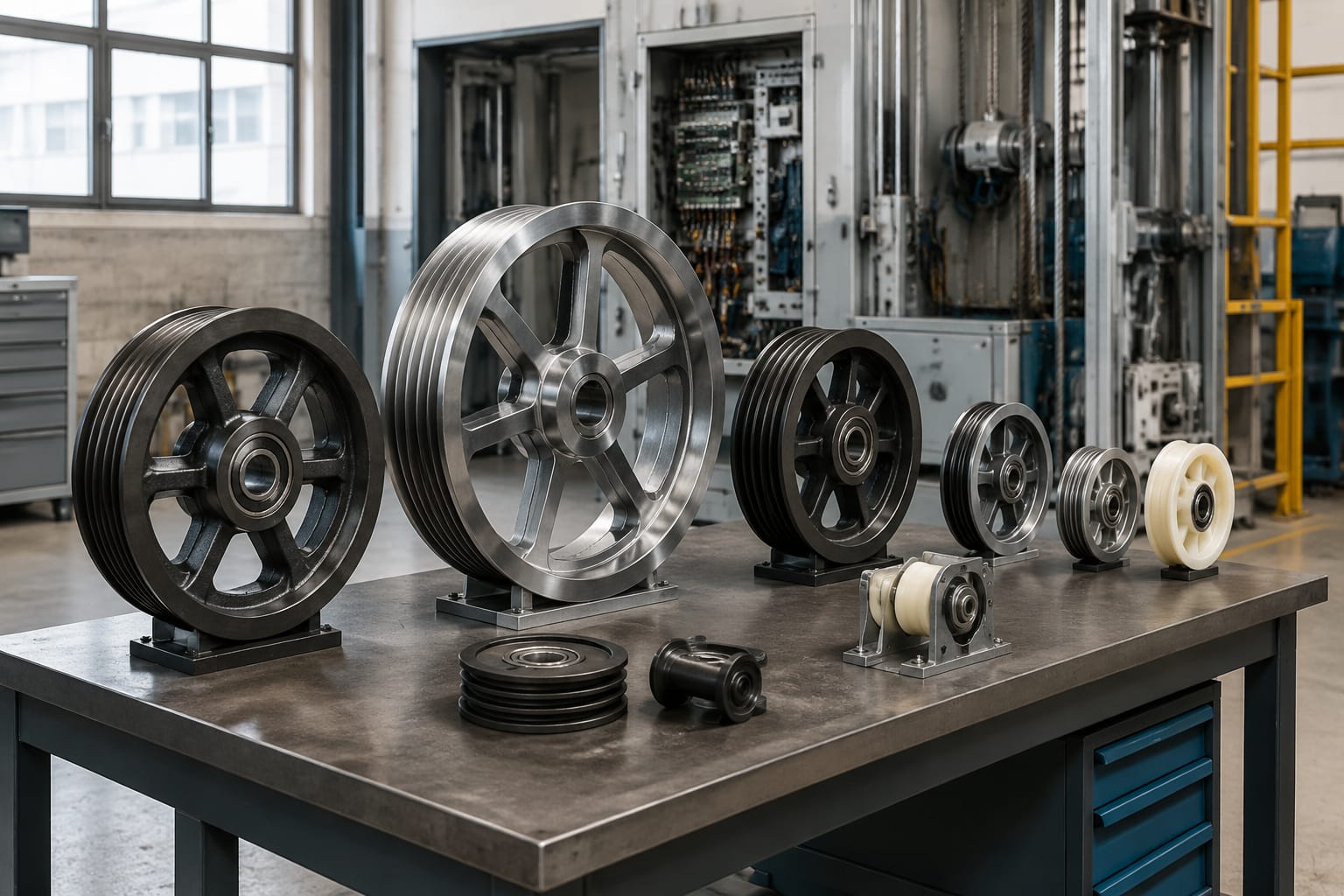
Elevator sheaves guide and support ropes, belts or door suspension elements as they move through a lift system. A correct replacement is not selected by outside diameter alone: the groove profile, rope or belt size, bearing arrangement, bore, shaft fitment and mounting position must all match the original duty.
For maintenance teams and sourcing buyers, the practical priority is to identify the sheave's function, inspect its running surfaces and bearings, then record enough dimensional and application information to prevent an incompatible order. A sheave that appears similar can still cause accelerated rope wear, tracking faults, noise or poor door operation.
Traction and deflector sheaves
Traction and deflector sheaves are both used in the hoisting arrangement, but they perform different jobs.
A traction sheave is the driven wheel in a traction lift machine. The motor turns it, and friction between the rope grooves and suspension ropes moves the car and counterweight. Its groove condition is therefore critical to traction, rope life and load sharing across all ropes.
A deflector sheave redirects the ropes without providing the driving force. It is commonly positioned to create the required rope path between the traction sheave, car and counterweight, or to suit the machine-room or machine-room-less layout. Although it is not driven, it remains a safety-critical rotating component: worn grooves or bearings can alter rope travel and accelerate wear.
| Feature | Traction sheave | Deflector sheave |
|---|---|---|
| Primary role | Drives the suspension ropes | Changes rope direction |
| Power transmission | Yes | No |
| Groove importance | Essential for grip and equal rope loading | Essential for rope guidance and equal rope loading |
| Typical inspection focus | Groove wear, traction, rope seating, run-out | Groove wear, bearing condition, alignment, free rotation |
| Replacement risk | Incorrect profile can affect lift performance | Incorrect geometry can alter rope path and clearances |
Do not assume a deflector sheave can substitute for a traction sheave with a similar diameter. The groove geometry, hub construction, shaft arrangement and working loads may differ substantially.
On geared and gearless installations alike, record the machine or installation details before sourcing a traction-related component. Where the original part number is available, it is useful, but it should support rather than replace a physical measurement check, especially on older or modernised equipment.
Diverting, secondary, and door sheaves
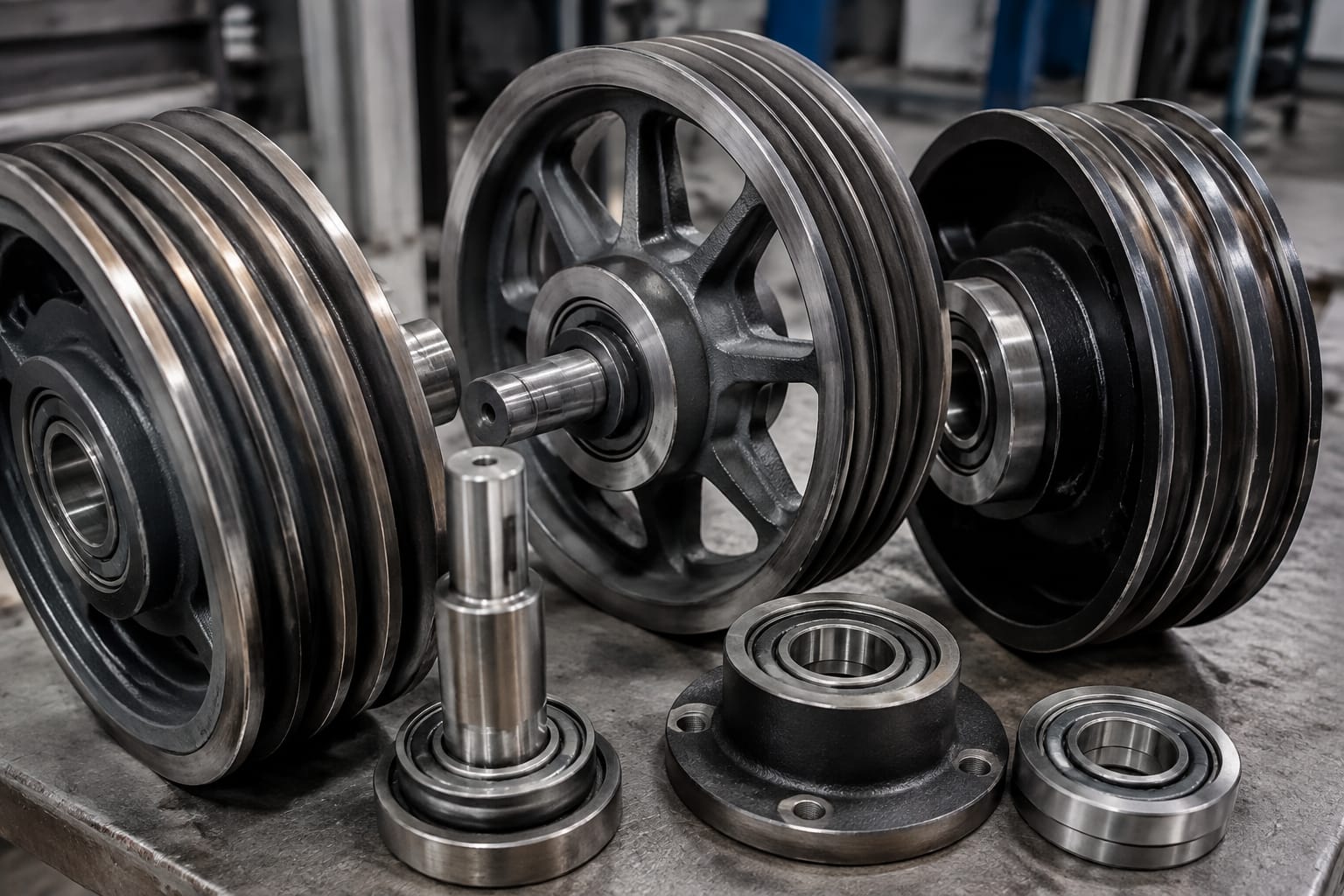
The term diverting sheave is often used interchangeably with deflector sheave. In practice, site terminology can vary, so a buyer should describe where the wheel sits and what it guides rather than relying on a name alone.
A secondary sheave generally refers to an additional sheave in a larger roping arrangement. It may redirect ropes, provide mechanical advantage in a particular suspension ratio, or form part of the car or counterweight sling arrangement. Its suitability depends on the entire rope path, not only its own measurements.
Door sheaves, sometimes called door change wheels, hanging wheels or rollers depending on design, serve a different system. They guide, support or redirect components in the landing or car door mechanism. They are normally smaller than hoisting sheaves and may run on a fixed spindle or contain an integrated bearing.
Door components should be sourced for the exact door mechanism and location. Consider the distinction between a [74 x 19 door change wheel with a 6203 bearing](/products/74x19x6203-lift-door-change-wheel-elevator-parts/) and a [double-groove 140 x 20 door hanging wheel with a 6204 bearing](/products/door-hanging-wheel-double-groove-140x20x6204-lift-parts-elevator-accessories/). Similar wheel diameters do not establish interchangeability, particularly where groove count, bearing series or mounting width differs.
Identify the duty before measuring
Before removing a sheave, establish whether it is:
- A powered traction component;
- A passive hoisting-rope guide;
- A car or counterweight secondary sheave;
- A governor, compensation or auxiliary-system wheel;
- A door-hanging, door-drive or door-redirection wheel.
Photograph the component in position from more than one angle. Include its relationship to ropes, belts, brackets, guards and shafts. This makes it far easier to verify the intended application when comparing parts later.
Sheave materials and groove profiles
Sheaves are commonly made from cast iron, steel or engineered polymer, depending on their duty. Hoisting sheaves must withstand repeated rope contact, imposed loads and the operating environment. Door wheels may use steel, nylon, polyurethane or other engineered materials selected for rolling behaviour, noise control and wear characteristics.
Material alone does not determine suitability. A polymer door wheel may be correct for a particular door operator yet unsuitable for another with higher load, different track contact or a different bearing arrangement. Likewise, a metal sheave is not automatically preferable if the original design specifies a non-metal wheel to manage noise or contact behaviour.
Groove profile matters as much as diameter
The groove must support and guide the rope or belt without creating damaging pressure, uneven contact or unstable travel. Common hoisting-rope groove forms include:
- U-grooves, which provide a rounded seating profile;
- Undercut U-grooves, used where additional traction characteristics are required;
- V-grooves, which create greater wedging action but require careful matching to the system design;
- Round or specialised profiles, used for particular rope, belt or door applications.
The original groove type should be retained unless the lift manufacturer or a competent design authority has specified a system change. Changing groove geometry can alter traction and rope pressure. On multi-rope installations, mixing a new sheave with worn related components may also create uneven rope loading.
For a traction assembly, confirm the number of grooves, groove pitch, groove depth and groove profile. For a door wheel, confirm whether it is single-groove, double-groove, flat-faced or shaped for a specific track or cable.
A [traction wheel for Otis elevator applications](/products/traction-wheel-switch-otis-elevator-parts-lift-accessories/) illustrates why application identification matters. A product description can assist the initial comparison, but the final selection still depends on the relevant machine, groove configuration and installation-specific dimensions.
Bearings, shafts, and mounting
A sheave can have a sound-looking rim but still require replacement because of bearing or hub damage. The rotating assembly must run smoothly and remain accurately located under load.
Common bearing and mounting arrangements include:
- A sheave with sealed ball bearings fitted into its hub;
- A wheel running directly on a spindle or bush;
- A sheave mounted on a fixed shaft with retaining hardware;
- A sheave supplied with a separate shaft, spacer or bearing set;
- A door wheel with a pressed-in bearing identified by a standard bearing number.
Where a bearing number is visible, record it exactly, including prefixes or suffixes. A number such as 6203 identifies a bearing series and basic dimensions, but seal type, clearance, manufacturer specification and wheel fit can still matter. Do not select a complete sheave solely because it contains a bearing with the same basic number.
Check the following interfaces:
- Bore diameter and bore form, such as plain, keyed, splined or stepped;
- Shaft diameter, length and shoulder positions;
- Keyway dimensions where applicable;
- Hub width and overall wheel width;
- Bearing inside diameter, outside diameter and width;
- Retainers, circlips, washers, spacers and locking method;
- Bracket, fork or frame mounting dimensions.
A worn shaft can damage a newly fitted bearing or allow lateral movement. Inspect it for scoring, corrosion, fretting, visible steps and loss of fit. Replace or repair associated parts only in accordance with the equipment design and the responsible maintenance procedure.
Common wear and noise symptoms
Noise is a useful warning sign, but it does not identify the failed component on its own. A squeal, rumble, clicking or scraping sound may originate from the sheave, ropes, bearings, door track, mounting bracket or another moving part.
Symptoms associated with hoisting sheaves
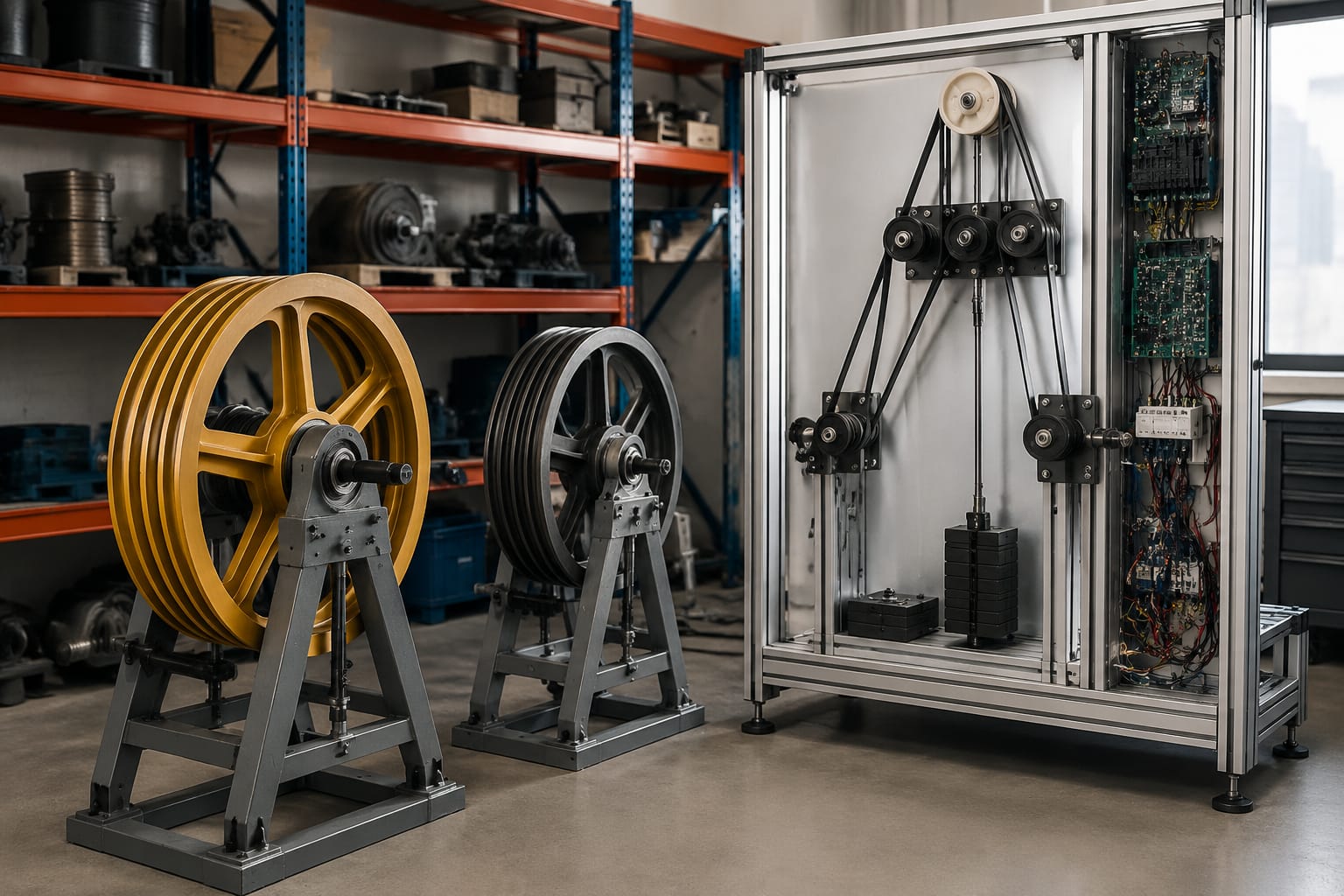
Investigate promptly when there is:
- Uneven groove wear between rope positions;
- Polished, sharp-edged, pitted or visibly deformed grooves;
- Ropes sitting at inconsistent heights in adjacent grooves;
- Excessive black dust or unusual metallic debris near the sheave;
- Rough rotation, rumbling or heat around a bearing housing;
- Noticeable lateral movement or wobble;
- Abnormal rope vibration, tracking or noise;
- Reduced traction symptoms that require broader system assessment.
A sheave groove can wear progressively, making the issue easy to miss during routine visual checks. Use a suitable groove gauge or compare against the original design criteria where available. Visual appearance alone cannot confirm whether the groove remains within acceptable limits.
Symptoms associated with door sheaves
Door wheels and related sheaves commonly show problems through:
- Rattling, clicking or grinding during opening and closing;
- A door panel that drags, binds or travels unevenly;
- Flat spots, chipped tread or worn grooves;
- Side-to-side wheel movement;
- A seized, noisy or loose bearing;
- Uneven wear on the door track or guide surfaces;
- Cable or belt misalignment where the wheel redirects a drive element.
Do not treat noise by lubricating every nearby component. Some sealed bearings are not serviceable, while lubricant in the wrong place can attract dirt or contaminate friction surfaces. Follow the lift or door system manufacturer's maintenance requirements.
Inspection and measurement checklist
Isolate the equipment and follow the applicable site safety procedures before inspection or removal. Hoisting components should only be assessed and replaced by competent personnel with the correct tools, access arrangements and authority.
Use a calibrated vernier calliper or micrometer for critical dimensions. A tape measure is useful for an initial estimate but is rarely accurate enough for a final purchasing specification.
Record the sheave itself
For every replacement enquiry, measure and document:
- Outside diameter: measure across the wheel rim, not only the worn groove area.
- Face width: record the usable grooved width and the overall width if different.
- Number of grooves: count all grooves and note unused or special grooves.
- Groove pitch: measure centre-to-centre spacing between adjacent grooves.
- Groove profile: note U, undercut U, V, flat, double groove or another shape.
- Groove dimensions: record width and depth where practical, preferably with a suitable gauge.
- Bore diameter: measure the central bore and identify any keyway, spline or taper.
- Hub dimensions: record hub diameter, projection and position relative to the wheel.
- Overall assembly dimensions: include offsets, shoulders and flange positions that affect alignment.
- Material and visible markings: photograph cast marks, part numbers, logos and direction indicators.
Record the bearing and mounting details
Also capture:
- Bearing reference and quantity;
- Bearing position, whether internal, external or paired;
- Shaft or spindle diameter;
- Distance between mounting faces;
- Bracket or fork width;
- Retention method;
- Spacer, collar and washer dimensions;
- The direction of rope, belt or door-panel travel.
Take photographs with a scale or calliper visible where possible. One image should show the sheave in its installed position, while close-ups should show the grooves, bearing side, hub and any identification marks.
Check related components
Replacement may not resolve the underlying fault if associated items are worn. Inspect the ropes or belts, shafts, bearings, retaining hardware, guards, brackets and alignment of the full running path. For door systems, inspect the track, hangers, guides, couplings and drive arrangement as well.
Information needed for sourcing
The most effective sourcing request combines part identification, measurements and application context. An original part number is helpful, but physical confirmation is especially important when equipment has been repaired, modified or modernised over its working life.
Provide the following information to a supplier or purchasing team:
| Information | Why it is needed |
|---|---|
| Lift manufacturer, model and machine or door-operator details | Narrows the likely component family |
| Original part number and all visible markings | Supports cross-reference checks |
| Clear photographs in and out of position | Confirms function, mounting and geometry |
| Sheave type and installed location | Prevents confusion between similar wheels |
| Outside diameter, width and bore | Establishes basic fitment |
| Groove count, pitch and profile | Determines rope, belt or cable compatibility |
| Bearing number and mounting arrangement | Confirms rotating assembly fit |
| Rope, belt or cable dimensions | Helps verify groove suitability |
| Quantity required | Identifies whether matching sets may be needed |
| Details of any modification | Flags non-standard or legacy configurations |
Avoid these common purchasing mistakes:
- Ordering from a photograph without dimensions;
- Treating “diameter x width” as a complete specification;
- Assuming a bearing number defines the whole wheel;
- Replacing one item in a matched multi-sheave arrangement without checking the others;
- Changing groove profile to obtain a more readily available part;
- Ignoring shaft wear, spacers or mounting offsets;
- Calling a component a “pulley” without stating whether it is for hoisting ropes, a governor, a door or another subsystem.
Kelevator supplies multi-brand elevator spare parts for B2B importers, distributors, maintenance contractors, modernisation companies and OEM buyers. For a sourcing enquiry, a dimensional drawing or completed measurement record alongside photographs will usually support a more reliable comparison than a name or diameter alone.
Alignment and testing after replacement
A correctly specified sheave still requires careful installation. Alignment errors can shorten rope, bearing and wheel life, and door wheels that are fitted out of position can cause poor panel travel or repeated faults.
After installation, verify that:
- The correct retaining hardware, spacers and guards are installed;
- The shaft and bearing seats are secure and free from unintended play;
- The sheave rotates freely without roughness, binding or abnormal run-out;
- Ropes, belts or cables sit consistently in their intended grooves;
- The running path is aligned with adjacent sheaves and guide surfaces;
- There is no interference with brackets, guards, covers or nearby equipment;
- Door panels travel smoothly through their full movement;
- Fasteners are tightened to the applicable equipment requirements.
For hoisting equipment, complete the required inspection, adjustment and functional testing under the responsible maintenance process before returning the lift to normal service. Do not use a replacement sheave to compensate for unresolved rope tension, alignment, machine or door-system faults.
A sound replacement decision begins with function and measurements, then confirms compatibility with the complete assembly. Keep the inspection record, photographs and part information with the maintenance history; it will make future replacements and multi-brand sourcing more accurate.