
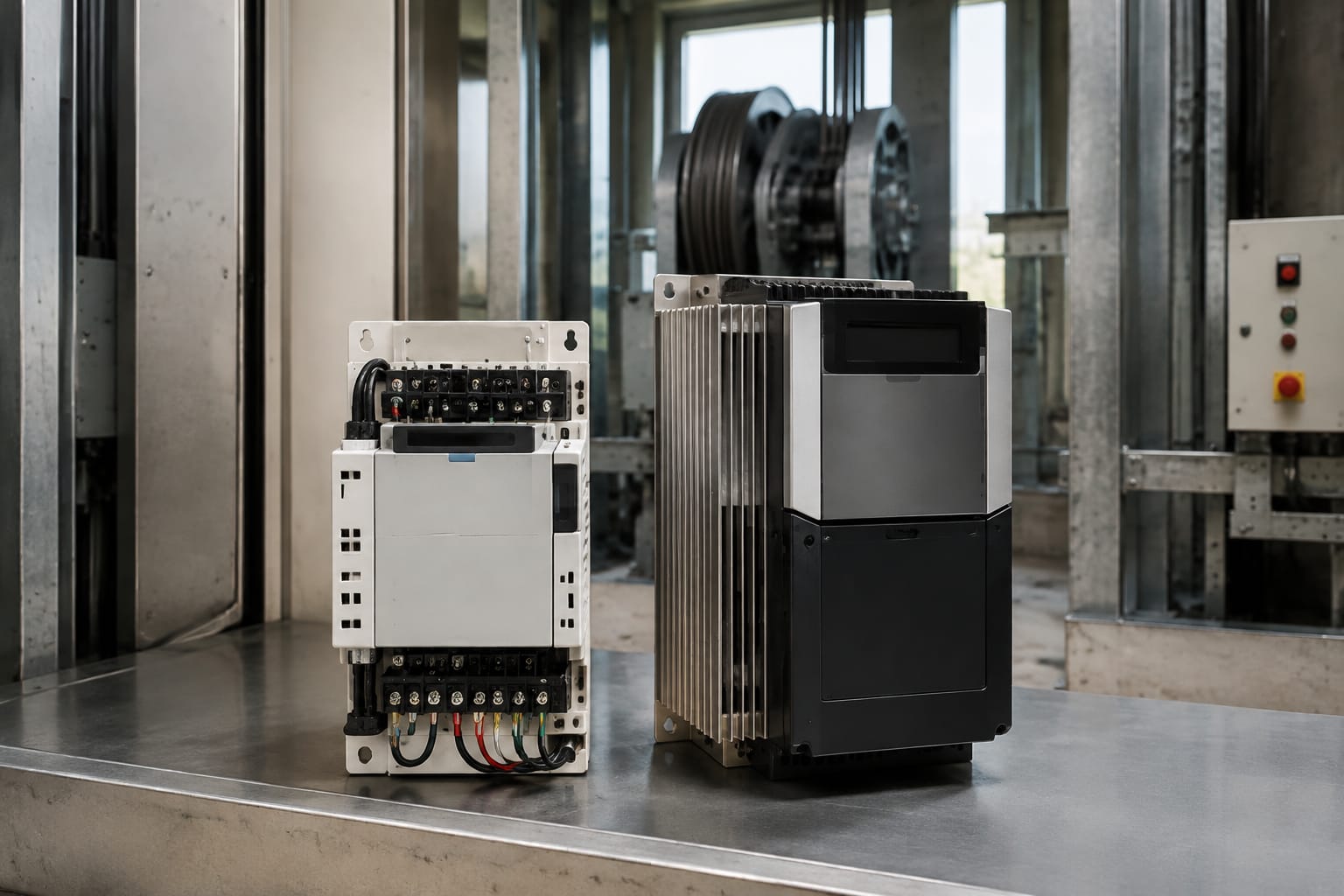
An elevator soft starter is usually the practical choice where a conventional AC motor needs reduced-voltage starting but the lift will operate at one normal running speed. A variable frequency drive (VFD) is the better choice where controlled acceleration, deceleration, levelling and speed flexibility are required.
The decision is not simply about replacing one device with another. The motor type, controller logic, brake arrangement, feedback devices, building use, supply conditions and safety circuit must all be assessed. A soft starter can improve an existing fixed-speed installation economically, while a VFD-based system generally delivers better ride quality and more operating control when the wider lift system is compatible.
How an elevator soft starter works
An elevator soft starter reduces the voltage applied to an AC motor during starting. Rather than connecting the motor directly to the full supply voltage, it uses semiconductor devices, commonly thyristors, to gradually raise the effective motor voltage over a set ramp period.
This limits inrush current and reduces the abrupt torque rise that can occur with direct-on-line starting. Once the motor reaches operating speed, many soft-starter arrangements use a bypass contactor so that the motor runs directly from the supply. The semiconductor section is then removed from the continuous current path, reducing heat losses.
For a lift application, an elevator soft starter is most commonly considered on older fixed-speed traction systems where the objective is to reduce electrical and mechanical stress at start-up without introducing full variable-speed control.
A typical soft-starter sequence is:
- The controller confirms that the safety chain and travel conditions permit a run.
- The brake is managed according to the controller's programmed sequence.
- The soft starter applies reduced voltage to the motor.
- Voltage ramps up until the motor reaches its intended running condition.
- A bypass contactor may close for normal running.
- At stopping, the controller removes the run command and manages braking and motor disconnection.
The exact sequence matters. Lift motors need enough starting torque to lift the car under the expected load. Setting the initial voltage or ramp too low can cause slow pickup, motor heating, poor brake release timing or a failed start. Setting it too aggressively can remove much of the intended benefit.
What a soft starter does not do
A soft starter is not a speed controller. It cannot provide the continuously variable motor frequency needed for controlled low-speed travel, smooth levelling or multiple rated speeds.
It may reduce the harshness of starting, but it will not by itself create the ride profile normally associated with a modern variable-voltage, variable-frequency lift drive. It also cannot correct worn mechanical components, incorrect balancing, brake problems or a motor that is unsuitable for the duty.
How a VFD controls elevator motion
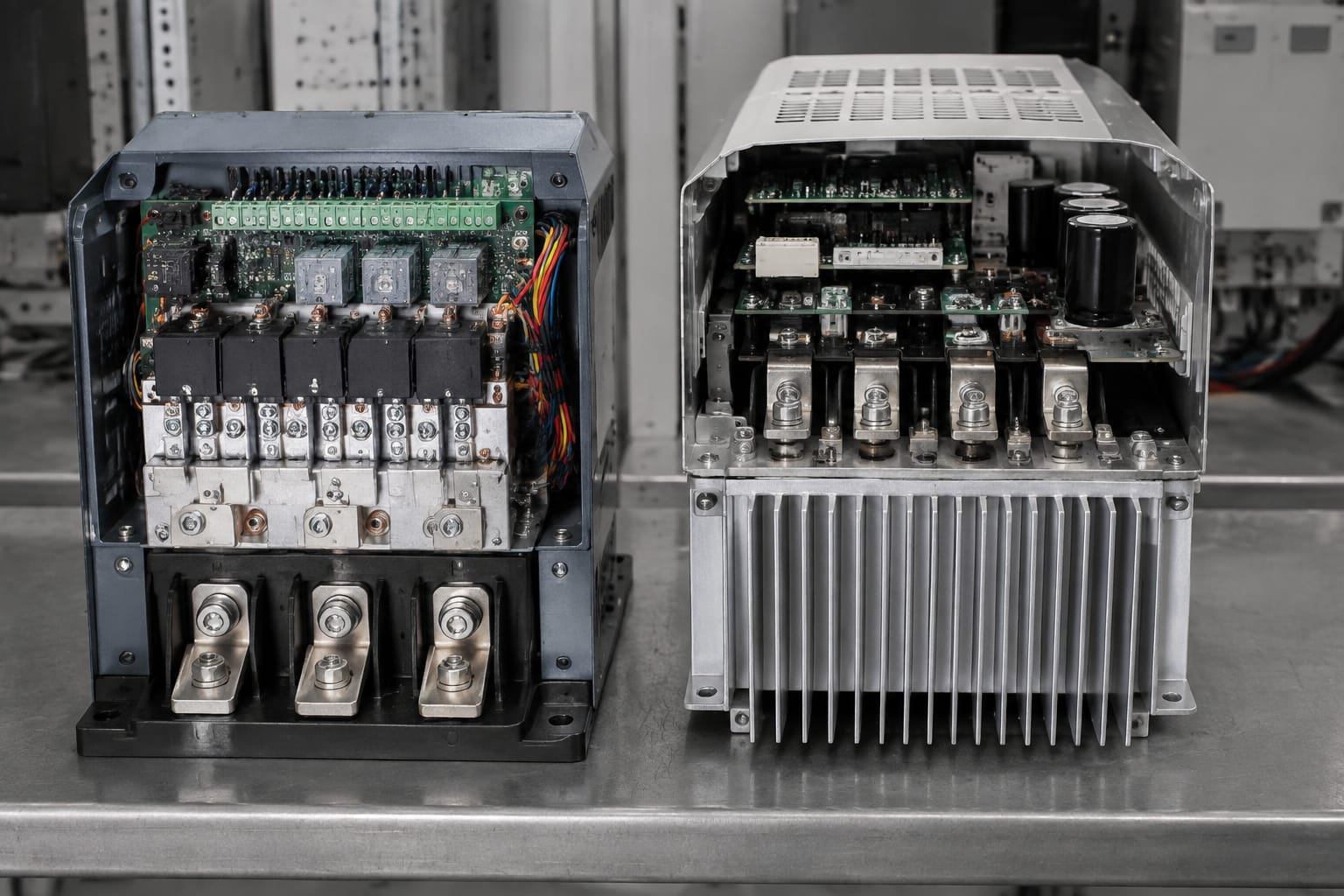
A VFD, also called an inverter or variable-frequency drive, controls the motor by converting the incoming AC supply to DC and then generating an AC output at a controlled frequency and voltage. As motor speed follows output frequency, the drive can accelerate, run and decelerate the motor along programmed profiles.
In a lift system, this allows the controller and drive to manage motion far more precisely than a fixed-frequency supply. Depending on the system design, the VFD can support low-speed inspection operation, acceleration, rated-speed travel, deceleration and approach to floor level.
A VFD normally uses parameter settings for motor data, acceleration and deceleration rates, current limits, braking behaviour, output switching and fault handling. Some lift-specific drives also use encoder feedback to monitor motor speed and support accurate control under changing load conditions.
The practical result is that a VFD can improve ride comfort, reduce abrupt changes in torque and enable more refined stopping. However, these outcomes depend on a correctly matched motor, suitable control interface and proper commissioning.
Why lift VFDs require system-level planning
A general-purpose industrial VFD is not automatically appropriate for an elevator. Lift duty places specific demands on starting torque, brake coordination, rapid reversal, passenger comfort, fault response, levelling and interaction with the controller safety functions.
Before selecting a VFD, establish:
- The motor nameplate voltage, current, frequency, power and speed.
- Whether the motor is induction, permanent magnet, geared or gearless.
- The control method required: open loop, closed loop, vector control or a lift-specific solution.
- Whether an encoder is fitted, needed or compatible.
- How the main controller commands run direction, speed selection, brake release and fault monitoring.
- The braking resistor, regenerative arrangement or other method needed to manage returned energy.
- The electrical supply, earthing, isolation and electromagnetic compatibility requirements.
- The manufacturer's instructions for the lift controller, motor and drive.
A VFD should be configured and commissioned by competent personnel familiar with lift equipment. Incorrect parameters can lead to poor levelling, overcurrent trips, unstable movement, overheating or unsafe brake timing.
Starting current and motor stress
Direct-on-line motor starting can produce a high inrush current. The actual value varies by motor design, load and supply characteristics, but it can place significant demand on the incoming electrical system and introduce a sudden mechanical torque event.
Both an elevator soft starter and a VFD can reduce starting current compared with direct-on-line operation, but they achieve this differently.
| Factor | Elevator soft starter | VFD |
|---|---|---|
| Starting method | Ramps motor voltage | Controls output voltage and frequency |
| Starting current | Reduced relative to direct-on-line, subject to load and settings | Can be closely managed through programmed acceleration and current limits |
| Starting torque | Falls as voltage is reduced; careful setup is essential | Can provide controlled torque across a wider speed range when correctly selected |
| Normal running speed | Usually one fixed supply-frequency speed | Variable and programmable |
| Deceleration | Mainly mechanical or controller-dependent | Controlled electrical deceleration is possible |
| Heat and losses | Often bypassed after starting | Power electronics remain active during operation |
| Retrofit complexity | Often lower for suitable fixed-speed systems | Often higher because motor, feedback, controller and braking must be reviewed |
Soft starters reduce voltage, and motor torque does not reduce in a straight line. In general, available induction-motor torque drops sharply as applied voltage is lowered. This is why a setting that works on an unloaded machine may fail in a lift carrying passengers or freight.
A VFD can start at low frequency while managing voltage and torque. This makes it more capable of controlled movement, but it does not eliminate mechanical or electrical limits. The drive must be sized for the motor and duty cycle, and the lift's braking system must remain correctly adjusted and independently functional.
Motor thermal considerations
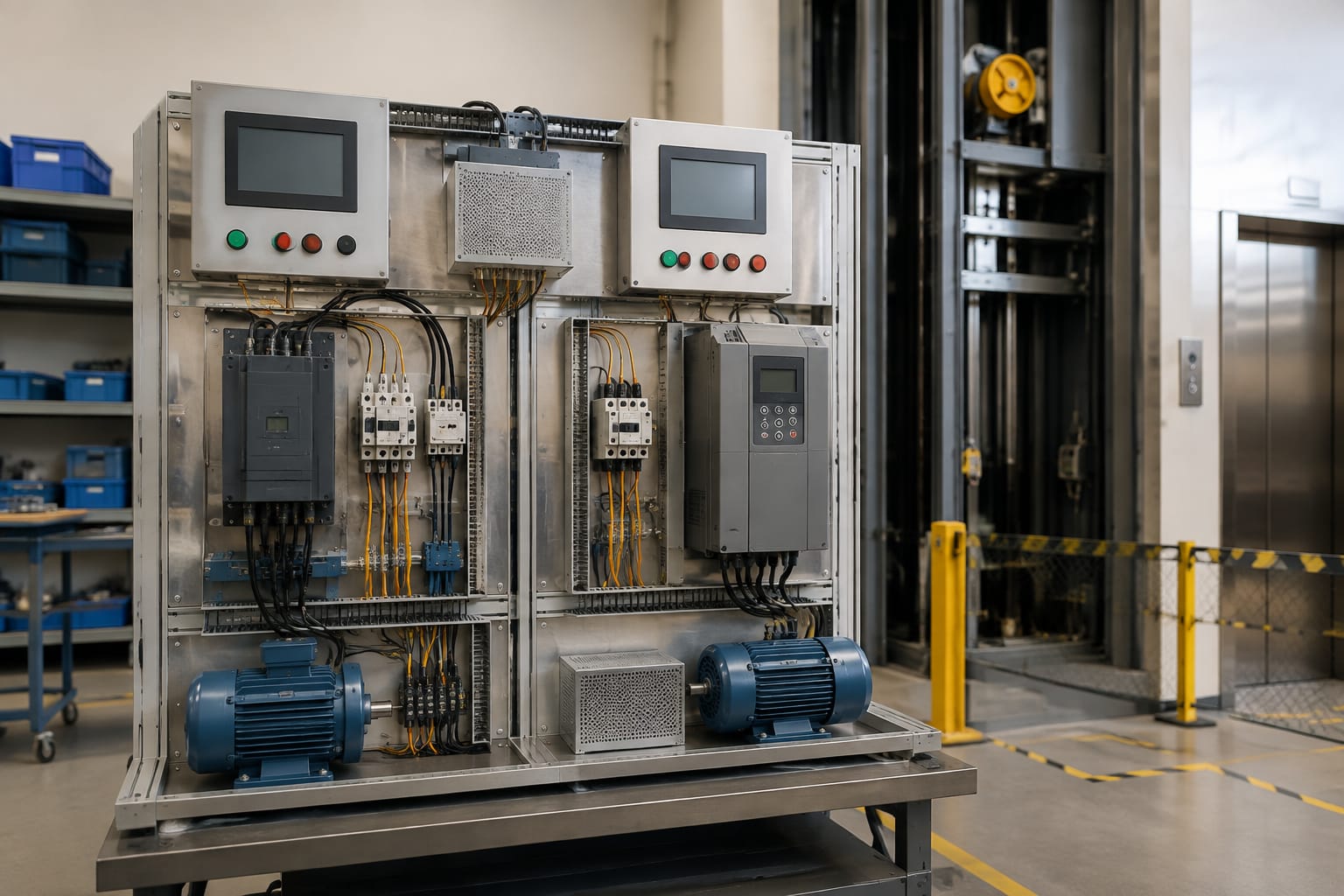
Repeated starts, long acceleration periods and insufficient starting torque can overheat a motor. This is particularly relevant on busy lifts, goods lifts and installations with poor car-to-counterweight balance.
For either control method, confirm:
- Motor rated current and insulation condition.
- Starting frequency and expected trips per hour.
- Motor ventilation at low speed.
- Ambient temperature in the machine room or control space.
- Cable length and any output reactor, filter or insulation requirements for VFD use.
- Overload protection settings and fault reporting.
Do not assume that lowering starting current always means lower motor heating. A prolonged low-voltage start can increase heat because the motor spends longer producing inadequate torque.
Speed control and ride quality
For ride quality, a VFD is generally superior because it can shape the motor's acceleration and deceleration. A well-configured VFD can reduce the sensation of a sudden start, control the transition into rated speed and provide a smoother approach to a landing.
A soft starter can make the initial pickup less abrupt on a fixed-speed lift, but once bypassed, the motor runs at normal supply-frequency speed. Stopping remains dependent on the controller, brake system and mechanical arrangement. It cannot provide a true low-speed landing phase.
Ride quality is influenced by more than the control device. Important mechanical factors include:
- Brake condition and release timing.
- Car and counterweight balance.
- Rope, sheave and gearbox condition where applicable.
- Guide-rail alignment and lubrication requirements.
- Cabin load variation.
- Door-zone and levelling sensor accuracy.
- Motor and machine vibration.
Replacing a starter with a VFD will not resolve mechanical faults. Conversely, a mechanically sound lift can still feel poor if drive parameters, encoder direction or brake timing are incorrect.
Levelling accuracy
Modern lift systems often use a VFD together with position feedback and controller logic to improve stopping accuracy. This is valuable where level differences create trip risks or affect trolley movement.
However, levelling is a combined function. The drive, controller, sensors, motor response and brake must work together. A VFD should not be specified solely on the expectation that it will cure inaccurate floor levelling.
Typical elevator applications
The most appropriate control method depends on the lift's existing configuration and modernization objective.
Where an elevator soft starter may suit
A soft starter may be suitable when:
- The lift uses a conventional induction motor at a fixed running speed.
- The main aim is to reduce start-up current or lessen abrupt starting.
- The existing controller is designed around contactor-based motor control.
- The project scope does not require variable-speed travel or refined levelling.
- The motor has adequate torque at the selected reduced-voltage starting settings.
- The controller, brake and protective devices can be integrated correctly.
This is often a limited-scope improvement rather than a full modernization strategy. It can be useful where equipment reliability and smooth starting are the priorities, but the existing operating concept remains unchanged.
Where a VFD is normally the stronger option
A VFD is generally appropriate when:
- Smooth acceleration and deceleration are required.
- The lift needs controlled low-speed movement and better ride comfort.
- The modernization includes a compatible controller or complete drive package.
- The motor is suitable for inverter duty, or replacement is included in the project.
- Speed feedback, brake control and floor levelling can be properly integrated.
- Energy handling during deceleration has been considered.
For high-use passenger lifts, busy commercial buildings, hospitals, hotels and modern goods-lift applications, the broader control capability of a VFD can justify the additional engineering work. The final choice still depends on the actual lift design and maintenance requirements.
Contactors and protection devices
Contactors and protective devices remain important whether the lift uses a soft starter or a VFD. Their roles may change, but they should never be selected as generic add-ons without checking the full circuit duty.
With a soft starter, contactors may be used for line isolation, direction control in relevant arrangements and bypass operation. The bypass contactor must be rated for the motor's operational duty and coordinated with the starter's control sequence. For component replacement, review the coil voltage, main-contact current rating, auxiliary contacts, mounting format and the original circuit diagram before sourcing a [Fuji AC contactor for elevator applications](/products/fuji-ac-contactor-lift-parts-elevator-accessories-2/).
In older contactor-controlled systems, it is also essential to confirm the control voltage and interlocking arrangement. A replacement such as a [Siemens-compatible AC110V contactor](/products/sw-contactor-ac110v-siemens-contactor-elevator-parts/) must match the installation's electrical and mechanical requirements rather than only looking similar to the removed component.
With a VFD, input contactors are often used for supply isolation and safety-related removal of power where required by the system design. Repeatedly switching the VFD output with contactors while it is running can damage equipment or cause faults, unless the drive manufacturer explicitly permits the arrangement. Direction and speed commands are generally sent through the drive's control inputs or communications interface rather than by switching the motor output directly.
Protection should be designed around the equipment manufacturer's guidance and local installation requirements. Depending on the arrangement, this can include:
- Correctly rated upstream circuit breakers or fuses.
- Motor and drive overload protection settings.
- Phase-loss, earth-fault and short-circuit protection where applicable.
- Surge protection where site conditions justify it.
- An isolator suitable for maintenance procedures.
- A braking resistor protection arrangement where one is fitted.
- Thermal monitoring or motor temperature inputs where specified.
When selecting a [small circuit breaker for elevator equipment](/products/small-circuit-breaker-elevator-equipment-lift-accessories/), confirm pole configuration, voltage rating, breaking capacity, trip curve, coordination with upstream protection and the equipment manufacturer's recommended rating. An incorrectly selected breaker can nuisance-trip during normal operation or fail to provide the intended protection.
Retrofit and compatibility questions
A soft-starter-to-VFD conversion is not a direct one-for-one replacement. A VFD changes how the motor is supplied and commanded, so the controller wiring, brake logic, feedback devices and protective strategy may all need modification.
Before approving a retrofit, gather clear information from the site:
- Lift controller make, model, wiring drawings and available I/O.
- Motor nameplate photograph and insulation condition.
- Existing starter, contactor and overload arrangement.
- Motor connection details, including delta or star configuration.
- Brake voltage, current, rectifier arrangement and release timing.
- Encoder type, voltage, pulses or resolution, and mechanical condition.
- Travel speed, rated load, roping and machine type.
- Existing faults, service history and reported ride-quality issues.
- Incoming supply voltage, phase condition and measured supply quality.
- Machine-room space, ventilation and cable-routing constraints.
Common retrofit mistakes
Treating the motor as automatically inverter-ready. Older motors may have insulation, cooling or winding limitations that need attention before VFD operation.
Using a VFD without a brake-control plan. Brake release and pickup must be coordinated with torque production. A poorly timed brake can cause rollback, jolting or drive faults.
Ignoring encoder compatibility. Where closed-loop operation is needed, incorrect encoder type, wiring, screening or direction can prevent stable control.
Sizing only by kilowatts. Motor current, overload capability, duty cycle, supply voltage and lift application matter as much as nominal power.
Leaving original switching practices unchanged. Contactor logic designed for a fixed-speed motor may not be suitable on the output side of a VFD.
Skipping commissioning under realistic loads. A system should be checked through its intended travel conditions, load range, direction changes and stopping behaviour by qualified lift personnel.
Choosing the appropriate control method
Choose an elevator soft starter when the lift is fundamentally a fixed-speed system and the practical requirement is gentler, lower-current starting. It can be an effective targeted improvement when the motor, load and existing controller are compatible.
Choose a VFD when the project requires controlled speed, improved acceleration and deceleration, better ride quality or integrated modernization of the controller and motor-control system. It offers greater capability, but it also requires more careful design, installation and commissioning.
Use this selection checklist before ordering equipment:
| Question | Soft starter indication | VFD indication |
|---|---|---|
| Is variable speed required? | No | Yes |
| Is improved floor approach and levelling a key objective? | Limited benefit | Usually appropriate with compatible controls |
| Does the existing lift have a fixed-speed contactor controller? | May suit with proper integration | Requires detailed retrofit assessment |
| Is the motor suitable for inverter operation? | Less critical for normal fixed-speed running | Essential to confirm |
| Is the aim only to reduce start-up impact? | Often suitable | May be more capability than required |
| Are controller, brake and feedback changes within project scope? | Usually fewer changes | Often necessary |
| Is a full modernization planned? | May be a temporary or limited upgrade | Often the preferred control approach |
The appropriate choice should follow a documented review of the lift's electrical diagram, motor data and mechanical condition. Avoid selecting by device price alone: an apparently economical component can become costly if it requires unplanned controller changes or does not deliver the required lift performance.
Kelevator supplies multi-brand elevator spare parts for B2B importers, distributors, maintenance contractors and OEM buyers. For a component enquiry, provide the existing part number, photos of the nameplate and terminal markings, the control voltage, and the lift controller and motor details so compatibility can be assessed against the installation.