
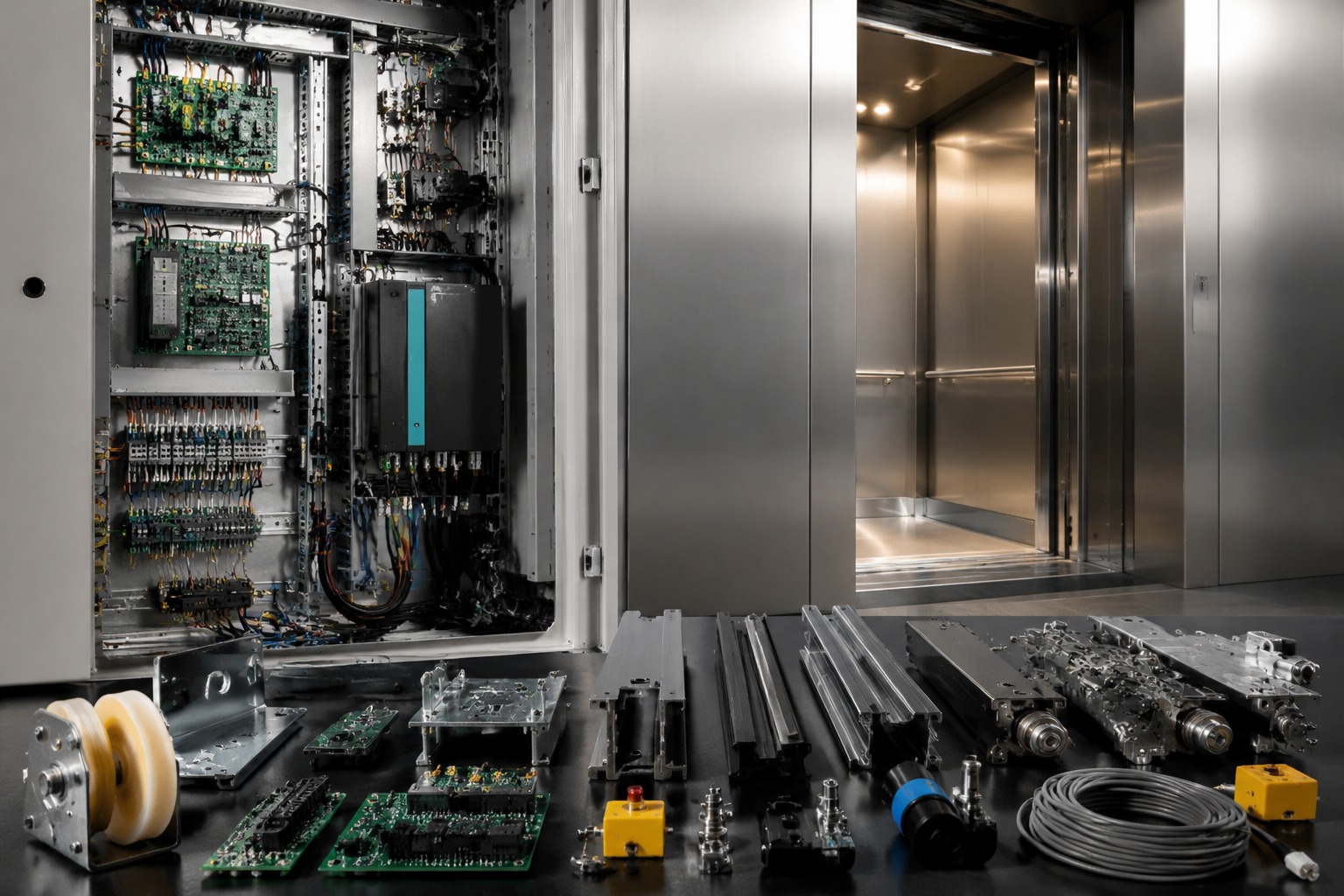
For building owners in South Africa, the safest way to buy lift spare parts is to begin with the exact elevator brand and model, focus first on parts that fail most often, confirm part numbers and dimensions carefully, and choose suppliers that can prove quality, packing, and delivery performance. This approach reduces emergency breakdowns, avoids costly wrong purchases, and helps keep passenger lifts, service lifts, and goods lifts running reliably in offices, hospitals, shopping centres, hotels, residential towers, mines, and industrial facilities.
In practical terms, a good procurement process is not only about finding the lowest quote. It is about matching the right component to the right system, understanding which parts create the biggest downtime risk, and building a replacement plan that suits South African operating conditions. Buildings in Johannesburg and Pretoria often deal with heavy daily traffic and tight maintenance windows. Coastal sites in Durban, Cape Town, Gqeberha, and Richards Bay must also consider humidity, corrosion, and transit time through major ports. If a single door lock, contactor, control board, sensor, encoder, or power supply is unavailable when a lift stops, tenants notice immediately and the building owner pays for lost time, callouts, and unhappy users.
This guide is written for property managers, body corporates, facility teams, lift maintenance companies, distributors, and modernization contractors that need dependable sourcing. It covers the local market, the most common product categories, supplier evaluation, emergency stock planning, and 2026 procurement trends in technology, policy, and sustainability.
South Africa lift spare parts market: what buyers should know
South Africa’s lift spare parts market is influenced by several factors: aging buildings in established city centres, modernization demand in mixed-use developments, ongoing maintenance of public infrastructure, and variable international shipping times. Parts for global brands such as Hitachi, Toshiba, KONE, Mitsubishi, and other well-known elevator systems are often needed quickly, but many building owners discover that lead times can stretch if they wait until a lift is already down.
Trade routes matter. Import planning often revolves around Durban Port, Cape Town Port, and inland transport toward Gauteng. For this reason, buying teams should not assess price alone. They should also look at response speed, packing quality for long-distance transit, and the supplier’s ability to identify compatible replacements for older equipment. In South Africa, downtime is especially expensive in hospitals, high-rise apartments, student accommodation, office blocks, and retail centres where a lift outage can affect accessibility, foot traffic, and tenant retention.
The market is also shifting toward more planned procurement. Instead of reacting to failures one by one, building owners increasingly create part lists by site, by elevator model, and by failure frequency. This is particularly useful where a property portfolio spans several cities and several brands.
The line chart above shows a realistic upward demand trend driven by aging equipment, modernization projects, and stronger preventive maintenance planning. While the exact growth rate differs by city and building segment, the overall direction is clear: buyers who standardize procurement processes now will be better prepared for higher service expectations and tighter operating budgets.
| Region or hub | Main driver of parts demand | Typical building profile | Common urgency level | Procurement challenge | Buying priority |
|---|---|---|---|---|---|
| Johannesburg | High passenger volumes and older commercial towers | Offices, mixed-use towers, hotels | High | Fast restoration after breakdown | Keep critical electrical parts ready |
| Pretoria | Government, education, healthcare traffic | Institutions, hospitals, campuses | High | Service continuity and compliance | Door and control system reliability |
| Durban | Coastal climate and logistics hub activity | Residential, retail, port-linked buildings | Medium to high | Moisture exposure and packing quality | Corrosion-aware sourcing and storage |
| Cape Town | Tourism, premium residential, office assets | Hotels, apartments, offices | Medium to high | Tenant expectations and planned upgrades | Preventive replacement planning |
| Gqeberha | Industrial and logistics support | Warehouses, industrial sites | Medium | Mixed brand compatibility | Verify part matching carefully |
| Richards Bay | Industrial operations and remote response needs | Industrial plants, support facilities | High | Long lead-time risk | Emergency stock for critical lifts |
This market table highlights why a single procurement rule rarely works for every site. Buildings in Gauteng may prioritize response time and technical support, while coastal or industrial locations may care more about protective packaging, anti-moisture handling, and emergency stock because replacement cycles are harder to manage once a failure happens.
Common lift accessories and spare part categories
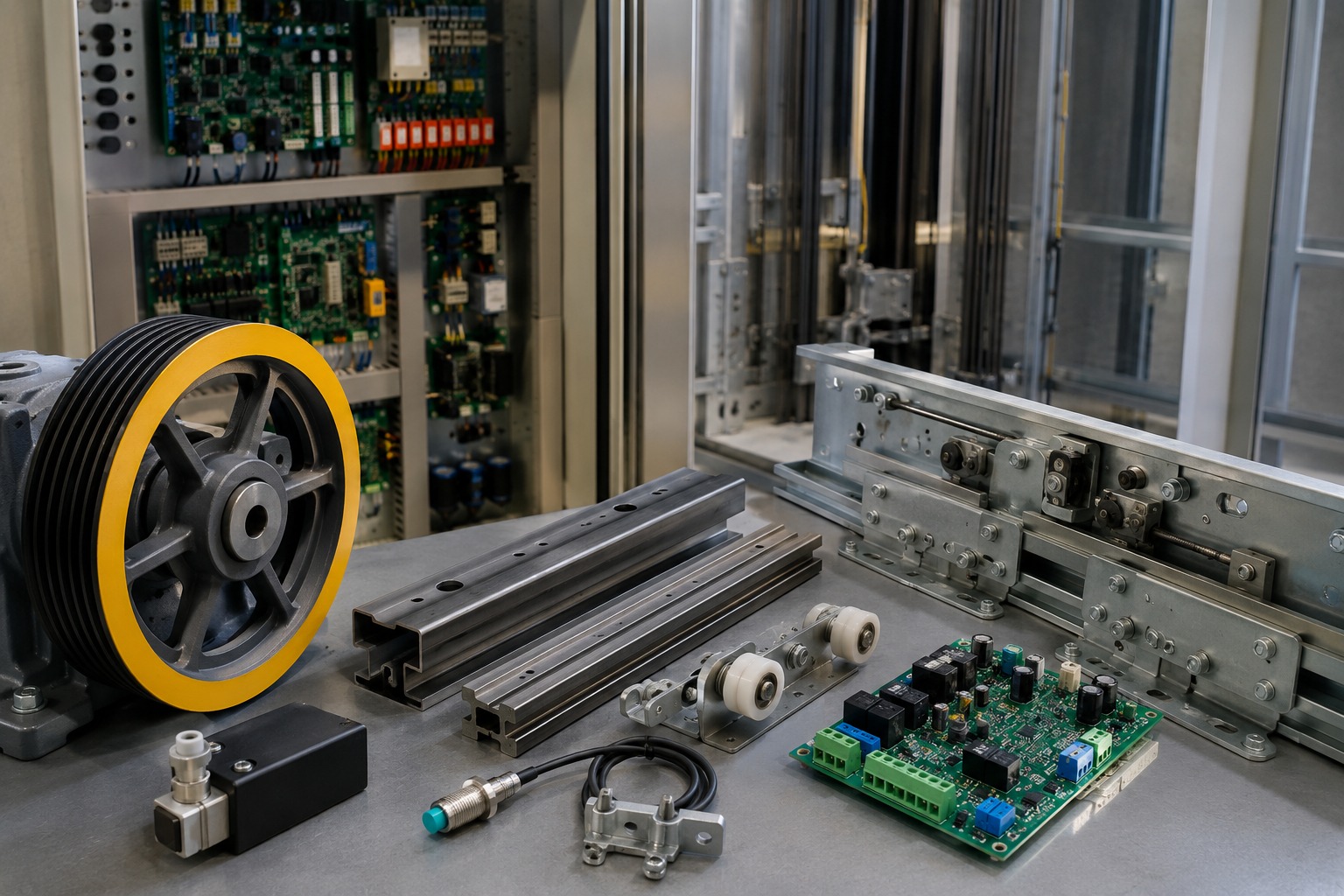
Before ordering, buyers should understand which product types usually create operational risk. Mechanical wear parts, electrical switching parts, door system parts, and electronic control parts all have different failure patterns. A noisy or rough ride may point to guide shoes or lining wear. Intermittent door issues can involve door locks, light curtains, door operator components, or sensors. Sudden shutdowns often lead maintenance teams toward boards, inverters, power supplies, contactors, capacitors, or communication parts.
In many South African buildings, a mixed strategy works best: keep routine wear items and high-failure electrical items on hand, while maintaining fast supplier access for less common major components. For example, a replacement guide boot lining rubber for lift guide shoes may be needed as part of normal wear management, while a Fuji DC48V contactor for elevator circuits could be critical for restoring switching performance during an unexpected outage.
| Part category | Examples | Main failure symptom | Operational impact | Stocking advice | Typical buyer |
|---|---|---|---|---|---|
| Control and electronic boards | Main board, weighing board, communication board | Random faults, shutdown, incorrect signals | Very high | Keep key model-specific items identified in advance | Maintenance firms, modernization contractors |
| Inverter and frequency converter parts | Drive modules, power boards, capacitors | Ride instability, trip faults, no start | Very high | Plan critical spares for older installations | Building owners, service teams |
| Door operator components | Belts, rollers, motors, door controllers | Door not opening or closing smoothly | High | Stock for high-traffic buildings | Residential and retail sites |
| Safety and landing parts | Door locks, light curtains, sensors | Lift unavailable due to safety circuit issues | Very high | Always prioritize verified replacements | All buyer types |
| Travel and guidance parts | Guide shoes, oil cups, rubber linings | Noise, vibration, poor ride comfort | Medium | Use preventive replacement cycles | Property managers |
| Cabin and user interface parts | Buttons, COP panels, intercom parts | Unresponsive controls or communication failure | Medium to high | Hold for prominent public-facing lifts | Hotels, offices, hospitals |
The table shows that not all parts should be treated equally. Electrical and safety-related items usually have the highest downtime impact, while guidance and cabin parts often fit better into scheduled maintenance cycles. Buyers that separate these categories can manage budget more effectively.
The bar chart reflects a realistic pattern for South Africa: commercial towers, hospitals, and retail centres often generate the strongest spare parts demand because of higher traffic and strict uptime expectations. Residential towers also show significant demand, particularly where lifts are essential for daily access and resident satisfaction.
Begin with the elevator brand and exact model
The first rule of reliable lift spare parts buying is simple: never order on a part description alone if the exact elevator brand, model, and system information are available. “Door board,” “encoder,” or “button panel” are not enough. Different versions within the same brand may use different connectors, software logic, mounting points, dimensions, voltage ratings, or communication protocols.
Ask your maintenance team or service provider to collect a minimum equipment profile for every lift in the building. This should include brand, controller model, door operator model, year of installation or modernization, rated load, speed, and photos of labels. If the lift is older and records are incomplete, take cabinet photos, board close-ups, terminal labels, and wiring references. This small effort saves days of delay later.
For example, when sourcing a weighing or load-related board, a buyer should not simply request “an LS board.” It is far better to verify the exact system and compare it against the product images and specifications of an LS weighing device board for lift accessories before confirming the order. The same principle applies to any board, sensor, operator part, or contactor.
| Data to collect first | Why it matters | Where to find it | Common mistake if missing | Urgency level | Who should confirm it |
|---|---|---|---|---|---|
| Elevator brand | Identifies system family and compatibility route | Machine room plate, COP label, controller cabinet | Buying a generic-looking but incompatible part | Critical | Maintenance technician |
| Controller model | Boards and electrical parts depend on it | Controller panel or board sticker | Wrong board revision or terminal type | Critical | Technical buyer |
| Door operator model | Door parts are highly model-specific | Car top or operator assembly label | Incorrect roller, belt, lock, or board | High | Service engineer |
| Voltage and current rating | Protects electrical compatibility | Part nameplate or manual | Unsafe or non-functional installation | Critical | Technician and purchaser |
| Revision or software version | Some boards differ by revision | Board sticker, firmware label | Intermittent faults after replacement | High | Supplier and technician |
| Installation photos | Visual proof of layout, connector side, dimensions | On-site inspection | Ordering by memory or verbal description | High | Site team |
This table can be used as a pre-order checklist. In South Africa, where logistics time matters, every missing detail can add days or weeks to the replacement process. Accurate equipment identification is the fastest way to reduce that risk.
Focus first on parts with the highest failure risk
Once the exact lift models are recorded, the next step is to identify which parts deserve priority. Building owners should not try to stock everything. Instead, they should rank spare parts by failure frequency, safety relevance, lead time, and business impact.
High-failure and high-impact parts usually include door locks, light curtains, sensors, relays, contactors, power supplies, capacitors, some control boards, and selected door operator components. In heavily used office or retail lifts, door-related parts often create the most callouts because every trip depends on reliable opening and closing. In older systems, capacitor aging, switching wear, and intermittent signal faults become more common. For example, buyers planning maintenance for drive-related electronics may review a suitable 400V or 450V capacitor element for lift systems before failures become urgent.
Wear parts should also be reviewed by traffic pattern. A hospital lift carrying beds and equipment faces different stress compared with a residential passenger lift. A shopping centre lift may experience much more frequent door cycling. Industrial and mining support facilities may deal with dust, vibration, or harsher ambient conditions that shorten component life.
| Part group | Failure frequency | Downtime impact | Lead-time risk | Recommended stock level | Reason for priority |
|---|---|---|---|---|---|
| Door locks | High | Very high | Medium | 1 to 2 per critical site | Safety circuit interruption stops service immediately |
| Light curtains and sensors | High | High | Medium | 1 per busy building group | Frequent door reopening or door faults |
| Contactors and relays | Medium to high | High | Low to medium | 2 to 4 by common rating | Electrical switching wear is predictable |
| Power supplies | Medium | Very high | Medium | 1 per key controller family | Single-point failure can stop the lift |
| Capacitors and drive parts | Medium | High | Medium to high | By age and system condition | Aging electronics often fail without much warning |
| Guide shoe linings and oil cups | Medium | Medium | Low | Planned maintenance stock | Wear affects ride quality and long-term health |
The explanation here is straightforward: the best emergency stock list is not the biggest one. It is the most targeted one. In South Africa, where import delays can occur, high-risk and high-impact items deserve the earliest planning attention.
Verify part numbers, photos, and dimensions carefully
One of the most expensive mistakes in elevator spare parts procurement is assuming that a visually similar part is automatically compatible. This happens often with buttons, sensors, guide shoes, contactors, encoders, door rollers, and boards. A correct buying process should compare three things at the same time: part number, physical appearance, and dimensions.
Dimensions are especially important for mechanical and mounting-related items. A few millimetres can mean the difference between a clean fit and an unusable purchase. With electronics, the board layout, connector count, and mounting hole pattern matter as much as the printed part code. If any one of these details is unclear, request additional images from the supplier and compare them with site photos.
As a practical example, guide system parts should never be ordered only by generic size wording. A buyer comparing wear components may need the exact profile, material, and measurement of a 130 mm guide boot lining rubber for elevator spare parts to avoid repeat shipping and wasted labour.
| Verification item | What to compare | Best proof method | Common risk | Buyer action | Supplier action |
|---|---|---|---|---|---|
| Part number | Full code, suffix, revision | Sharp label photo | Wrong version of the same item family | Send original label image | Confirm exact code match |
| Connector layout | Pin count and position | Front and side photos | Board cannot be installed | Measure and photograph | Provide comparison photo |
| Mounting holes | Hole spacing and alignment | Ruler in photo | Incorrect fitment | Record dimensions | State mounting size clearly |
| Overall dimensions | Length, width, height, diameter | Caliper or tape measure | Mechanical mismatch | Share exact measurements | Confirm tolerance range |
| Voltage/current rating | Electrical specifications | Nameplate close-up | Unsafe or unstable operation | Verify site rating | Cross-check against catalog |
| Application photo | Installed position | On-site image in context | Confusing similar parts | Show where part sits in system | Review compatibility by application |
This table is useful because many return problems begin not with product quality but with incomplete identification. Clear photos and measured dimensions create a stronger basis for correct supply, especially when ordering across borders or sourcing for older installations with limited documentation.
Request testing standards and protective packing details
Reliable sourcing is not only about matching the correct part. It is also about how the part is tested and how it is packed before shipment. Buyers in South Africa should ask suppliers direct questions: Was the board function-checked? Was the electrical rating verified? Was the item inspected for connector damage, cosmetic cracks, and terminal integrity? How was it packed for long-distance freight, warehousing, and inland transport?
This matters even more for sensitive electronics, contactors, sensors, and cabin interface parts. Moisture exposure, impact during transit, and electrostatic handling can all affect performance. A supplier that can explain inspection practice and packing standards usually reduces post-delivery surprises.
For electrical switching parts, for instance, a maintenance team may request confirmation of coil rating and contact condition before ordering a Fuji DC48V 18A contactor used in lift accessories. The same principle applies to boards, power supplies, and other sensitive components.
| Question to ask the supplier | Why it matters | Good answer example | Warning sign | Best use case | Buyer decision impact |
|---|---|---|---|---|---|
| Was the part visually inspected? | Finds cracks, broken terminals, missing pieces | Yes, with photo record before packing | No inspection detail provided | All parts | Basic trust and acceptance |
| Was electrical function checked? | Reduces hidden defects | Bench test or rating verification completed | Supplier avoids technical answers | Boards, contactors, power supplies | Higher confidence for urgent orders |
| How is static-sensitive packaging handled? | Protects boards and electronics | Anti-static bag plus foam and carton | Loose packing | Control boards, sensors | Lowers transit risk |
| How is moisture controlled? | Important for coastal routes and storage | Sealed inner bag with desiccant | No mention of moisture protection | Durban, Cape Town deliveries | Important in humid environments |
| Is shock protection included? | Reduces mechanical damage in shipping | Foam support and strong carton | Thin box with free movement inside | Fragile and high-value parts | Prevents arrival damage |
| Can serial or photo confirmation be shared before dispatch? | Confirms correct item was packed | Yes, dispatch photos available | No pre-shipment confirmation | Urgent and model-specific orders | Improves traceability |
The explanation is simple: testing and packing standards are part of product quality, not an extra. For South African buyers working around customs, ports, road freight, and site scheduling, secure packing and clear pre-shipment confirmation can save a full maintenance cycle.
Plan emergency stock for critical lift systems
Not every building needs a large storeroom of spare parts. However, every building owner should know which lifts are mission-critical and which components are worth holding locally. A hospital, senior living facility, premium residential tower, hotel, or major office block may not be able to wait for international lead times when a key part fails.
Emergency stock should be based on risk, not guesswork. Start by ranking lifts by user impact. Then identify the parts that are both likely to fail and likely to stop service completely. If a building has several lifts using the same control family, standardized emergency stock becomes more economical. If a site has mixed brands, keep a smaller but more targeted list supported by strong supplier response.
Buildings in remote industrial corridors or areas with longer service response times should be more conservative. The cost of one additional stocked contactor, sensor, power supply, or door lock may be far lower than the cost of repeated downtime, tenant complaints, or contractual penalties.
| Building type | Critical lift examples | Suggested emergency stock focus | Minimum planning horizon | Main benefit | Review cycle |
|---|---|---|---|---|---|
| Hospital | Bed lift, service lift, patient access lift | Door locks, sensors, boards, power supplies | 3 to 6 months | Service continuity and patient movement | Monthly |
| Commercial tower | Main passenger group | Contactors, buttons, door parts, light curtains | 2 to 4 months | Reduced tenant disruption | Quarterly |
| Residential high-rise | Primary resident lift | Door parts, intercom parts, safety sensors | 2 to 3 months | Resident satisfaction and accessibility | Quarterly |
| Hotel | Guest lift and service lift | Buttons, COP parts, door operator items | 2 to 4 months | Guest experience protection | Quarterly |
| Retail centre | Public passenger lift | Door sensors, locks, contactors, indicators | 2 to 3 months | Foot traffic continuity | Monthly |
| Industrial site | Operational access lift | Switching parts, power modules, safety devices | 4 to 6 months | Reduced downtime in remote operations | Quarterly |
This table shows why emergency stock is a business continuity tool. The right stock list depends on the role of the lift in the building, not just on the part price. South African buyers with multi-site portfolios often achieve the best results by creating one central list and then adding site-specific critical items.
The area chart illustrates a realistic procurement trend: more owners are moving away from purely reactive purchasing toward planned stock management. This shift is likely to continue through 2026 as service expectations rise and procurement teams seek greater control over downtime risk.
Compare supplier response speed and delivery reliability
When evaluating suppliers, buyers should compare more than unit price. A cheaper quote can become the most expensive option if the supplier responds slowly, cannot confirm compatibility, provides weak packaging, or misses dispatch deadlines. In South Africa, where lead times can be shaped by import cycles and inland transport, service quality matters almost as much as product quality.
A strong supplier should be able to support three areas well. First, technological capabilities: understanding control boards, inverter parts, sensors, encoders, and model matching across brands. Second, manufacturing capabilities: stable sourcing, inspection, and careful packaging for transit. Third, service capabilities: fast response, clear communication, practical alternatives, and traceable dispatch support.
For example, a professional supplier may help a buyer compare old site photos, confirm a part family, and then prepare protected packaging for a board or contactor bound for Johannesburg, Durban, or Cape Town. That combination of technical review, quality handling, and responsive service is what reduces downtime in practice.
The comparison chart shows the dimensions buyers should score during supplier selection. A structured scorecard creates better results than informal impressions, especially for distributors, maintenance firms, and property groups managing multiple sites.
| Supplier evaluation factor | What good looks like | Why it matters in South Africa | How to test it | Red flag | Weight in decision |
|---|---|---|---|---|---|
| Technical matching ability | Confirms model, photos, dimensions, revision | Prevents costly wrong imports | Send a sample inquiry with detailed photos | Only quotes by generic description | Very high |
| Response speed | Replies quickly with useful questions | Breakdowns need action fast | Measure first-response time | Slow or vague communication | High |
| Quality inspection | Explains checks before dispatch | Reduces defect risk after lead time | Ask for testing details | No inspection process | Very high |
| Packing standard | Anti-static, moisture control, shock protection | Supports sea and inland transport | Request packaging photos | Basic unprotected packing | High |
| Delivery reliability | Gives realistic dispatch and transit timing | Helps plan maintenance windows | Check previous delivery records | Over-promises without proof | High |
| Service support | Helps with alternatives and repeat orders | Useful for older and mixed-brand sites | Review follow-up quality | Disappears after payment | High |
This table is especially useful for formal procurement teams. By scoring suppliers consistently, building owners can choose partners that support uptime rather than simply offering a low headline price.
Technological capabilities
A capable elevator parts supplier should understand model matching for control boards, inverter parts, door operator systems, sensors, encoders, power supplies, and cabin interface components across brands such as Hitachi, Toshiba, KONE, Mitsubishi, and more. This technical depth supports accurate identification, compatible replacement sourcing, and lower risk when dealing with older or modernized lift systems.
Manufacturing capabilities
Strong manufacturing and sourcing capability means more than access to parts. It includes stable channel management, careful quality inspection, dimension checking where relevant, and protective packaging suited to long-distance delivery. These practices are essential for fragile boards, electrical switching parts, and components moving through ports and inland freight routes.
Service capabilities
Responsive service is a practical advantage for South African buyers. It includes fast inquiry handling, photo-based matching support, realistic lead-time communication, dispatch confirmation, and ongoing help for repeat orders or planned replacement programs. When a supplier combines technical knowledge with disciplined communication, building owners can make decisions faster and with less risk.
Create a preventive replacement schedule
The best spare parts strategy is not only emergency response. It is prevention. A preventive replacement schedule helps buyers combine maintenance records, part age, failure history, and site traffic to replace selected components before they create disruption. This is especially effective for door components, switching parts, guide elements, sensors, capacitors, and aging electronic modules.
Start with a simple list for each lift: installed parts, replacement date, symptom history, callout frequency, and current stock status. Then identify items that should be checked monthly, quarterly, or annually. For properties with multiple lifts of the same type, schedule replacement by group to reduce labour cost and simplify ordering.
In South Africa, preventive scheduling is also a logistics strategy. By ordering before an emergency, buyers gain more time to confirm model details, compare alternatives, and consolidate shipping. This often lowers total procurement cost even if the unit price stays the same.
Looking ahead to 2026, preventive procurement will be shaped by three trends. First, technology: better digital maintenance records, QR-based asset identification, and more data-driven replacement decisions. Second, policy and compliance: stronger attention to building safety, accessibility expectations, and documented maintenance performance. Third, sustainability: longer asset life through planned replacement of wear items, reduced emergency freight, and more selective purchasing rather than wasteful trial-and-error buying.
| Part type | Recommended review cycle | Trigger for replacement | Typical data source | Cost control benefit | Downtime reduction value |
|---|---|---|---|---|---|
| Door locks and door sensors | Monthly inspection, quarterly trend review | Repeated faults, inconsistent operation | Callout log and technician notes | Avoids emergency labour costs | Very high |
| Contactors and relays | Quarterly | Wear signs, heat marks, switching instability | Visual inspection and electrical test | Batch replacement is efficient | High |
| Capacitors and drive-related items | Semi-annual | Age, instability, measured degradation | Drive maintenance records | Reduces major failure risk | High |
| Guide shoes and linings | Quarterly to semi-annual | Noise, wear measurement, ride quality issues | Mechanical inspection | Protects related components | Medium |
| Buttons, COP parts, intercom parts | Quarterly | Intermittent response or cosmetic wear in premium sites | User complaints and test records | Improves user satisfaction | Medium |
| Boards and power supplies | Annual review plus symptom-based action | Intermittent faults, aging profile, known weak model | Service history and supplier advice | Allows planned sourcing | Very high |
The table above turns preventive maintenance into a procurement tool. Instead of waiting for breakdowns, buyers can align part ordering with known risk windows, helping maintenance teams work more efficiently and reducing disruption across the building.
FAQ about buying elevator spare parts
How do I know if a lift spare part is the correct one for my building?
Start with the elevator brand, exact model, controller information, and clear photos of the original part label. Then compare part numbers, connector layout, dimensions, and ratings. If possible, ask the supplier to confirm compatibility using your site photos.
Which parts should South African building owners prioritize first?
Focus first on high-failure and high-impact items such as door locks, light curtains, sensors, contactors, relays, power supplies, selected boards, and common door operator components. These often cause the most downtime.
Should I buy only original branded parts?
Not always. The right choice depends on the system, the risk level, and the quality of matching. What matters most is verified compatibility, stable quality inspection, and reliable performance. For safety-critical and model-specific items, detailed confirmation is essential.
How much emergency stock should I keep?
Base emergency stock on building criticality, lead time, lift usage, and common fault history. Hospitals, busy offices, hotels, and high-rise residences usually need a more active stock plan than low-traffic buildings.
Why are photos and dimensions so important?
Many lift accessories look similar but differ in connector position, mounting points, size, or revision. Photos and measurements reduce wrong orders, especially for older systems and mixed-brand portfolios.
What should I ask about testing before ordering?
Ask whether the supplier inspected the item visually, verified ratings or function where appropriate, and can provide pre-shipment photos. For electronics, ask about anti-static handling and moisture protection.
What packing standards are best for South Africa?
For electronic and sensitive parts, request anti-static bags, protective foam, strong outer cartons, moisture control, and secure shock-resistant packing. This is particularly important for shipments routed through coastal ports or long inland transport.
How should I compare suppliers?
Score them on technical matching, response speed, quality inspection, packing standard, documentation clarity, dispatch reliability, and after-sales service. A supplier that helps you avoid mismatched parts often saves more money than the one with the lowest initial quote.
Can preventive replacement really lower costs?
Yes. Planned replacement reduces emergency callouts, avoids premium freight, improves maintenance scheduling, and limits tenant disruption. It also gives buyers more time to verify compatibility and consolidate orders.
What procurement trends should I watch in 2026?
Expect more digital asset tracking, stronger emphasis on documented maintenance planning, and greater interest in sustainable procurement through longer equipment life, fewer emergency shipments, and smarter stocking of critical lift accessories.
For South African building owners, reliable elevator spare parts procurement is a process of disciplined identification, risk-based prioritization, supplier comparison, and preventive planning. When you begin with the exact brand and model, verify every part carefully, ask the right technical and packing questions, and build stock around critical systems, you reduce downtime and improve lift reliability across the full building lifecycle.