
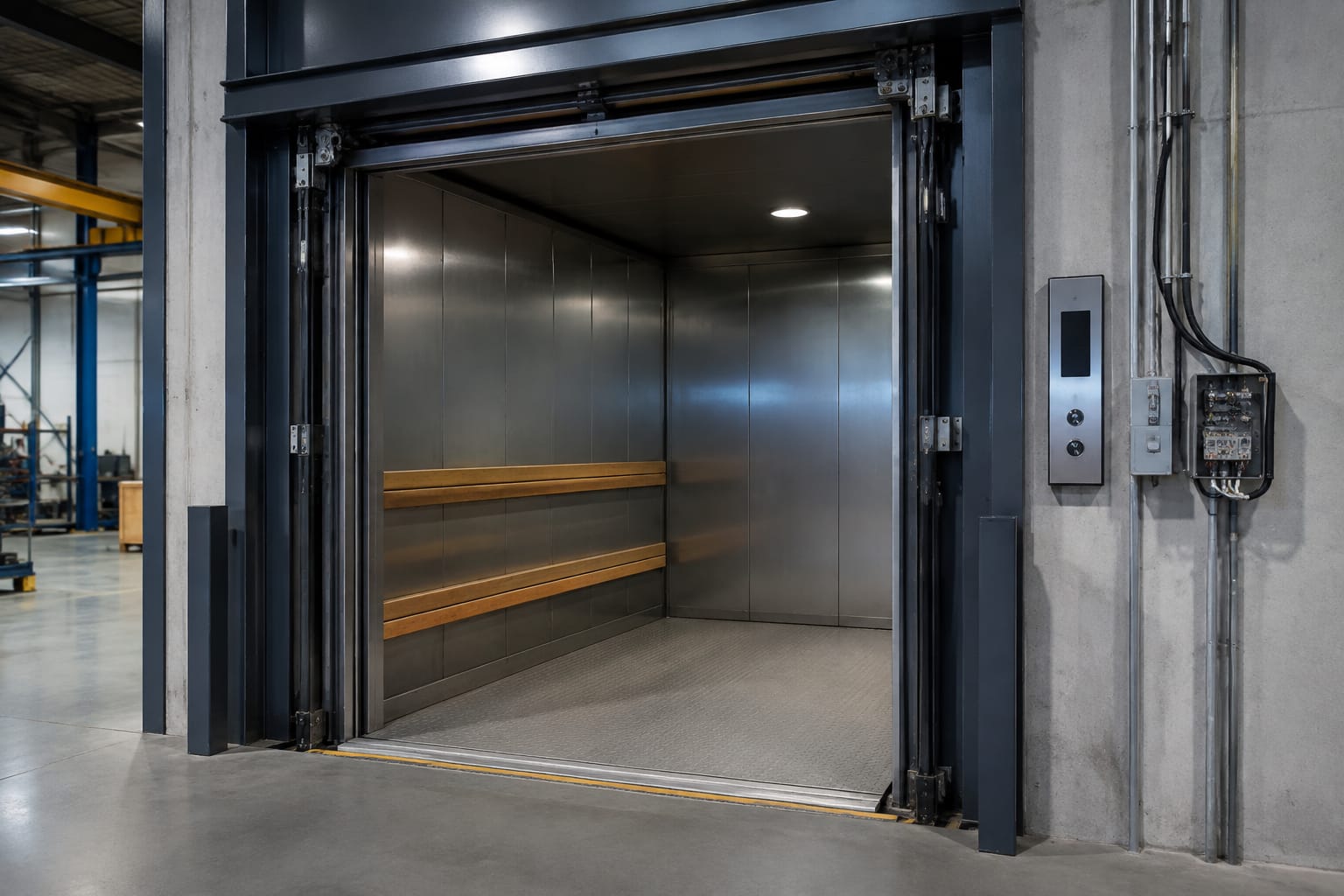
Freight elevator parts must be selected for the lift’s actual loading conditions, not only by the component’s appearance or basic dimensions. Door equipment, interlocks, guides and control devices on a goods lift may experience frequent impacts, vibration, dust and uneven loading. A part that fits physically but has the wrong handing, electrical rating, fixing pattern or duty capability can cause recurring faults and avoidable downtime.
For replacement work, start by identifying the failed component and then verify the complete interface around it: the door arrangement, lock type, controller circuit, mechanical travel, car and landing clearances, and available mounting points. Clear photographs, measurements and equipment data are usually more useful than a brief description such as “freight lift lock” or “door roller”.
How freight elevator duty changes part selection
Freight lifts are commonly used where pallets, trolleys, stock cages, equipment or materials move between levels. The load itself is only part of the selection question. The way it is loaded, positioned and handled affects which freight elevator parts wear first.
A passenger lift door may operate in a comparatively controlled environment. A goods lift can be exposed to fork-lift activity near landing entrances, wheeled loads crossing sills, dirty tracks, repeated door holds and occasional contact with door panels. In industrial, warehouse, retail back-of-house and service environments, these conditions can shorten the life of components designed around lighter duty.
When assessing a replacement, consider:
- Traffic frequency: A lift with many short delivery runs can cycle its doors and locks far more often than a lift used only for occasional goods movement.
- Load type and handling: Metal trolleys, pallet jacks and stock cages can strike door edges, sills and landing equipment.
- Door configuration: Centre-opening, side-opening, telescopic, vertically sliding and manually operated doors use different assemblies and motion paths.
- Environmental exposure: Dust, moisture, cleaning chemicals, cold-room conditions and airborne debris can affect rollers, contacts and electrical enclosures.
- Door mass and travel: Larger and heavier doors place greater load on hangers, tracks, rollers and closing equipment.
- Control logic: A replacement contact, lock or limit switch must work correctly with the lift’s existing safety circuit and controller design.
Do not assume that a visibly similar part is an equivalent replacement. For example, two door contacts can have similar housings but different terminal layouts, normal states, actuator travel or switching capacity. Similarly, a lock hook may be close in shape yet be incorrect for the door handing, hook engagement direction or sill arrangement.
Freight-door panels and tracks
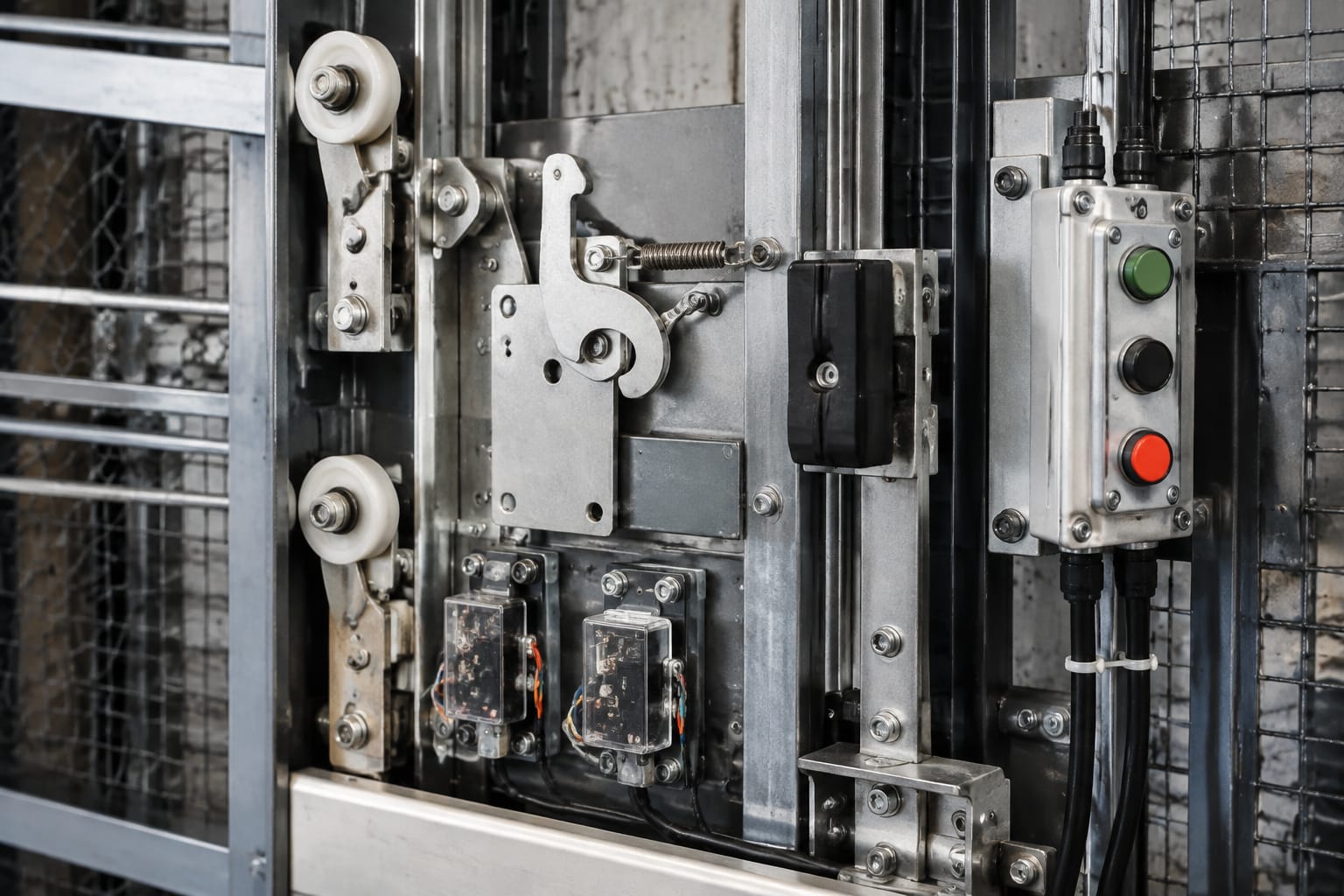
Freight door panels protect the landing opening and form part of the system that prevents access to an open hoistway. Their condition affects both reliable operation and the safety function of the door equipment.
Door panels and their interfaces
A replacement panel must match more than height and width. Confirm the panel construction, skin material, reinforcement positions, vision-panel cut-outs where applicable, hanger fixing centres, guide locations, interlock interface and closing edge arrangement. Slight variations in these details may prevent correct alignment even where the overall panel size appears right.
Inspect panels for:
- Bent or split edges that prevent a proper close.
- Damaged fixing points around hangers, guides or locks.
- Corrosion, particularly at bottom edges and in wet service areas.
- Loose or damaged reinforcement that allows the panel to twist.
- Impact damage that causes rubbing against adjacent panels, jambs or sills.
- Missing or unsuitable protective kick plates and edge protection.
Panel damage is often treated as a cosmetic issue until it starts affecting lock engagement. A distorted landing door can pull the lock relationship out of position, cause intermittent contact faults or make the operator work harder than intended.
Tracks, hangers and door alignment
The track carries the door through its opening and closing travel. Dirt, dents, loose fixings and worn running surfaces can all lead to poor door movement. The problem may show up as noisy travel, hesitating doors, repeated re-openings or a door that only locks after being pushed.
Before replacing rollers or hangers, inspect the track itself. A new roller on a damaged track may fail early and mask the original cause. Check that:
- The track is securely fixed and level across the full travel.
- Joints, brackets and stops are intact.
- The running surface is clean and free from burrs or impact dents.
- Door panels are plumb and correctly spaced.
- The panel does not bind at the sill, jamb or adjacent panel.
- The closing position aligns correctly with the lock and contact mechanism.
Door gear is an assembly. Replacing only the component that has visibly failed may be appropriate, but only after confirming that connected parts are not causing the failure.
Door locks, hooks and contacts
Door locking equipment is safety-critical. It prevents a landing door from opening when the car is not correctly positioned and confirms the required locked state to the lift safety circuit. Selection and installation should therefore be handled by competent lift personnel, with the lift safely isolated and tested according to the applicable site and equipment requirements.
A freight-door lock assembly may include a lock body, hook or vane arrangement, movable and fixed contacts, actuator, release components and mounting hardware. The exact construction varies significantly between manufacturers, door systems and installation eras.
Locks and hooks
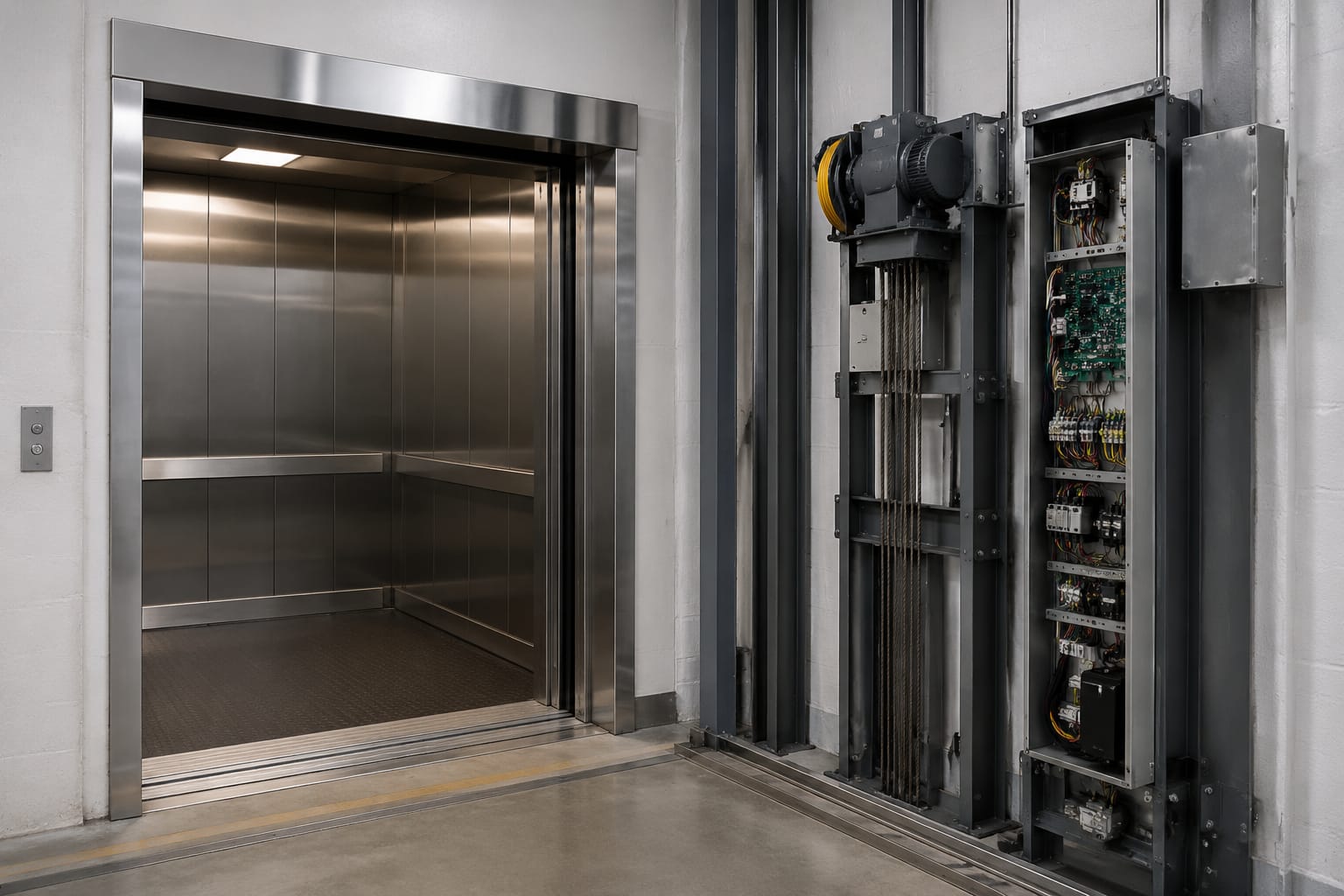
The hook is the mechanical element that retains the door in its closed and locked position. Correct engagement depends on geometry, alignment and adequate overlap. A worn hook, deformed keeper or loose mounting can cause inconsistent locking even if the electrical contact still appears to operate.
When sourcing a lock hook, verify:
| Check | Why it matters |
|---|---|
| Door handing and opening direction | Left- and right-hand parts may be mirror images and are not interchangeable. |
| Mounting-hole pattern | Incorrect centres can prevent secure fitment or force unsuitable modifications. |
| Hook profile and engagement depth | The hook must mate correctly with the existing lock or keeper. |
| Material and component thickness | A visually similar lighter component may not be suitable for the assembly. |
| Door system and lock model | The same lift brand may use different lock designs across installations. |
| Release arrangement | Emergency or authorised release features must remain compatible with the original system. |
For lock components where model identification is uncertain, detailed images of the fitted assembly are valuable. Photograph the front, rear, side profile, mounting area and the hook in its engaged position. A [hall-door lock hook for elevator spare parts](/products/hall-door-lock-hook-lift-accessories-elevator-spare-parts/) is easier to assess when these interface details are available.
Contacts and electrical proving
The electrical contact proves that the mechanical locking sequence has reached the required condition. It is not enough for the door to look shut. The contact must change state consistently at the intended point in the locking action, and the complete safety circuit must be verified after work is completed.
Key checks for replacement contacts include:
- Terminal count, terminal type and wiring orientation.
- Normally open or normally closed operating state.
- Contact arrangement and circuit function.
- Actuator style, position and required travel.
- Rated voltage and current appropriate to the original circuit.
- Mounting pattern, body dimensions and clearances.
- Compatibility with the lock body and moving mechanism.
Never bypass a door lock contact to keep a freight lift running. A bypass can conceal a mechanical lock problem and remove a safety condition intended to protect users at the landing. Intermittent door-zone or lock faults should be investigated at the component, alignment and wiring levels.
For common replacement requirements, a [freight elevator door lock contact switch](/products/freight-elevator-door-lock-contact-switch-lift-parts-elevator-accessories/) should be selected against the existing lock arrangement and electrical details rather than by photo alone.
Rollers, guides and closing components
Rollers, guides and closing components determine how smoothly a freight door moves and whether it reaches its closed and locked position reliably. They are often consumable wear items, but frequent repeat failures indicate an underlying alignment, loading or track problem.
Running rollers and guides
Door rollers support and guide the panel along the track. Bottom guides control lateral movement and help prevent the panel from swinging or rubbing. Their wear may show as excessive noise, wobble, scraping, uneven gaps or an erratic closing action.
Inspect rollers for flat spots, cracked wheels, loose bearings, worn axles and excessive side play. Inspect guides for worn contact faces, damaged retainers and evidence that the door is striking the guide rather than travelling centrally through it.
Confirm the following before ordering:
- Roller diameter, width and groove profile.
- Axle or bore size.
- Bracket shape and fixing centres.
- Offset from the mounting face to the running surface.
- Number of rollers or guides per panel.
- Door weight and panel configuration.
- Track profile and usable running surface.
It is often sensible to replace matched rollers as a set on the affected panel when they have experienced similar service. Replacing one severely worn roller can improve the immediate fault, but a second worn roller may soon create the same symptoms.
Closing devices and linkages
Closing action may come from an operator, clutch arrangement, spring device, counterweight, cable, chain, linkage or a combination of these. The correct component depends on the door design. Avoid treating springs or closing arms as generic hardware: force, travel, mounting orientation and connection points all affect performance.
A door that fails to close can be caused by insufficient closing force, but increasing force without identifying resistance can damage the equipment or create poor operation. First check for track contamination, panel distortion, sill obstruction, misaligned guides and lock interference. Closing components should compensate for normal movement, not force a damaged door through its travel.
Controls, buttons and limit switches
Freight lift controls need to withstand the operating environment while remaining compatible with the original electrical system. Buttons, selector switches, indicators, car-operating panels, relays and limit switches are not interchangeable merely because they share a similar faceplate or actuator.
Buttons and control stations
When replacing a push button or control-station component, confirm its function before choosing the replacement. A call button, car button, door-open button, stop switch and key switch can look similar but have different contact configurations and intended actions.
Check:
- Flush, surface or panel mounting method.
- Cut-out diameter and panel thickness.
- Legend, illumination requirement and colour where relevant.
- Momentary or maintained operation.
- Contact blocks and their normal state.
- Terminal arrangement and available wiring space.
- Voltage compatibility for lamps, LEDs or control circuits.
- Environmental protection suitable for the installation area.
In loading areas, damaged button surrounds and loose control panels can allow dust or moisture into electrical components. Replace damaged seals, gaskets and fixings where the original design uses them. A working button fitted into a badly damaged panel may still leave the station vulnerable to repeat faults.
Limit switches and position sensing
Limit switches are used for functions such as travel limits, door position, levelling-related interfaces or mechanism position confirmation, depending on the installation. Their actuation point and lever or plunger geometry matter as much as the electrical specification.
A replacement limit switch should be checked for:
- Actuator type: roller lever, plunger, adjustable lever or another form.
- Mechanical operating travel and overtravel.
- Contact configuration and switching sequence.
- Mounting orientation and fixing-hole spacing.
- Cable entry, terminal style and enclosure suitability.
- Position relative to cams, vanes or moving mechanisms.
Incorrect adjustment can cause a switch to operate too early, too late or inconsistently. Record the original mounting position before removal, but do not rely on markings alone where wear or previous incorrect adjustment is possible. Test the full intended movement after installation.
Wear caused by loading operations
Loading practices strongly influence freight elevator parts life. Many faults originate at the landing threshold rather than in the component that finally fails.
Common damage patterns include:
| Operating condition | Likely affected parts | Typical result |
|---|---|---|
| Trolleys striking door edges | Panels, guides, locks, jamb interfaces | Misalignment, poor closing, unreliable locking |
| Pallet jack wheels crossing damaged sills | Sills, bottom guides, door edges | Scraping, binding, door derailment risk |
| Doors held open during loading | Operators, closing devices, linkages | Slow closing, overload or repeat door faults |
| Loose packaging and debris in tracks | Rollers, tracks, guides, sills | Noise, resistance, incomplete closing |
| Repeated vehicle movement close to entrances | Panels, frames, landing equipment | Vibration, impact damage and loosened fixings |
| Damp or wash-down conditions | Contacts, terminals, metal components | Corrosion, intermittent electrical faults |
The practical response is not always a heavier replacement part. Where loading traffic is the cause, improve protection and housekeeping as well. Keep landing sills clear, prevent vehicles from striking door edges, repair damaged thresholds promptly and make door-condition checks part of routine site inspections.
A triangular release mechanism or lock-cylinder component also needs correct identification. Its profile, fixing arrangement and relationship with the lock body must match the installed equipment. Review the existing interface against the [hall-door triangular lock cylinder](/products/hall-door-triangular-lock-cylinder-lift-accessories-elevator-spare-parts/) before treating it as a standard replacement item.
Information needed for replacement
The best sourcing enquiry gives a supplier enough information to identify the correct freight elevator parts without guesswork. A part number is helpful, but older lifts may have worn labels, discontinued components or previous repairs that obscure the original specification.
Prepare the following information where available:
- Lift and door details: Manufacturer, model, installation type, door configuration and opening direction.
- Component identification: Part number, casting marks, label details, stamped codes and any electrical ratings.
- Clear photographs: Include the installed component, front and rear views, terminals, mounting face, surrounding assembly and any damage.
- Measurements: Overall dimensions, fixing-hole centres, roller diameter, shaft size, cable length or travel, as relevant.
- Electrical data: Circuit voltage, contact arrangement, terminal count and wiring diagram reference where available.
- Mechanical relationship: What the component engages with, which direction it moves and where it sits when the door is closed.
- Fault description: State what happens, when it happens and whether the fault is constant or intermittent.
- Quantity required: Identify whether one part, a matched set or spares for several lifts are needed.
Do not remove a safety component and send only a single close-up photograph if the assembly context can be documented first. The surrounding lock body, door panel, track or controller connections often reveal distinctions that are not visible on the loose component.
For B2B buyers managing multiple sites or customer contracts, standardise this information in a replacement-parts form. It reduces back-and-forth, improves comparison between quotations and makes repeat orders more consistent. Kelevator supplies multi-brand elevator spare parts to B2B importers, distributors, maintenance contractors and OEM buyers, so clear technical identification is particularly useful when sourcing across different lift makes.
Inspection and maintenance planning
A planned inspection approach helps identify wear before a door fault stops goods movement. The inspection interval should reflect traffic, environment, load handling and the lift maintenance programme rather than following one universal schedule.
Practical inspection points
During routine maintenance, review:
- Door panels, edges and frames for impact damage.
- Track cleanliness, fixings, wear and straightness.
- Rollers, hangers and bottom guides for play and abnormal wear.
- Sills for debris, deformation and wheel damage.
- Lock hook engagement, mounting security and alignment.
- Contact operation, terminals, wiring condition and secure covers.
- Door closing action through the complete cycle.
- Control buttons, labels, panel fixings and signs of moisture ingress.
- Limit-switch actuation and secure mounting.
- Unusual noise, rubbing or resistance during door travel.
Record the part identity and observed condition, not only “door checked”. A useful maintenance record notes which landing or car door was inspected, what was adjusted or replaced, the condition of associated components and whether a recurring defect is developing.
Avoid these common replacement mistakes
- Ordering from a description without checking dimensions and interfaces.
- Replacing a lock contact without correcting the misalignment that caused it to fail.
- Fitting a left-hand component on a right-hand door arrangement.
- Changing an electrical switch without confirming its contact state and circuit role.
- Replacing rollers without inspecting the track and bottom guide.
- Treating impact-damaged door panels as harmless cosmetic damage.
- Modifying safety locks, hooks or contacts to make an incompatible part fit.
- Returning a lift to service without testing the door and safety function through normal operation.
FAQ
Can freight elevator parts be matched from photographs alone?
Photographs can be useful, especially when they show markings, terminals, mounting faces and the surrounding assembly. They are rarely sufficient on their own for safety-related parts. Combine them with measurements, part numbers, door handing, electrical details and images of the installed position.
Should a worn door lock contact be replaced with the same-looking switch?
Only when its electrical and mechanical characteristics match the original requirement. Confirm the contact arrangement, actuator travel, terminals, mounting and its relationship to the lock mechanism. Similar-looking switches can behave differently in the safety circuit.
Why does a freight door keep reopening after a new roller is fitted?
The roller may not be the root cause. Check the track, bottom guide, sill, panel alignment, closing device and lock engagement. Resistance or misalignment elsewhere can prevent the door from reaching its final locked position.
When should a complete lock assembly be considered instead of one component?
Consider the whole assembly when several items show wear, the lock body is damaged, mounting points are distorted, the hook engagement is unreliable or individual replacement parts cannot be positively identified. The correct choice depends on the fitted equipment and the condition of connected components.
For a practical sourcing decision, document the existing component and its interfaces before removal, then compare replacement options against the lift’s door arrangement, safety circuit and operating duty. This gives maintenance teams and procurement teams a reliable basis for selecting freight elevator parts that fit and function as intended.