
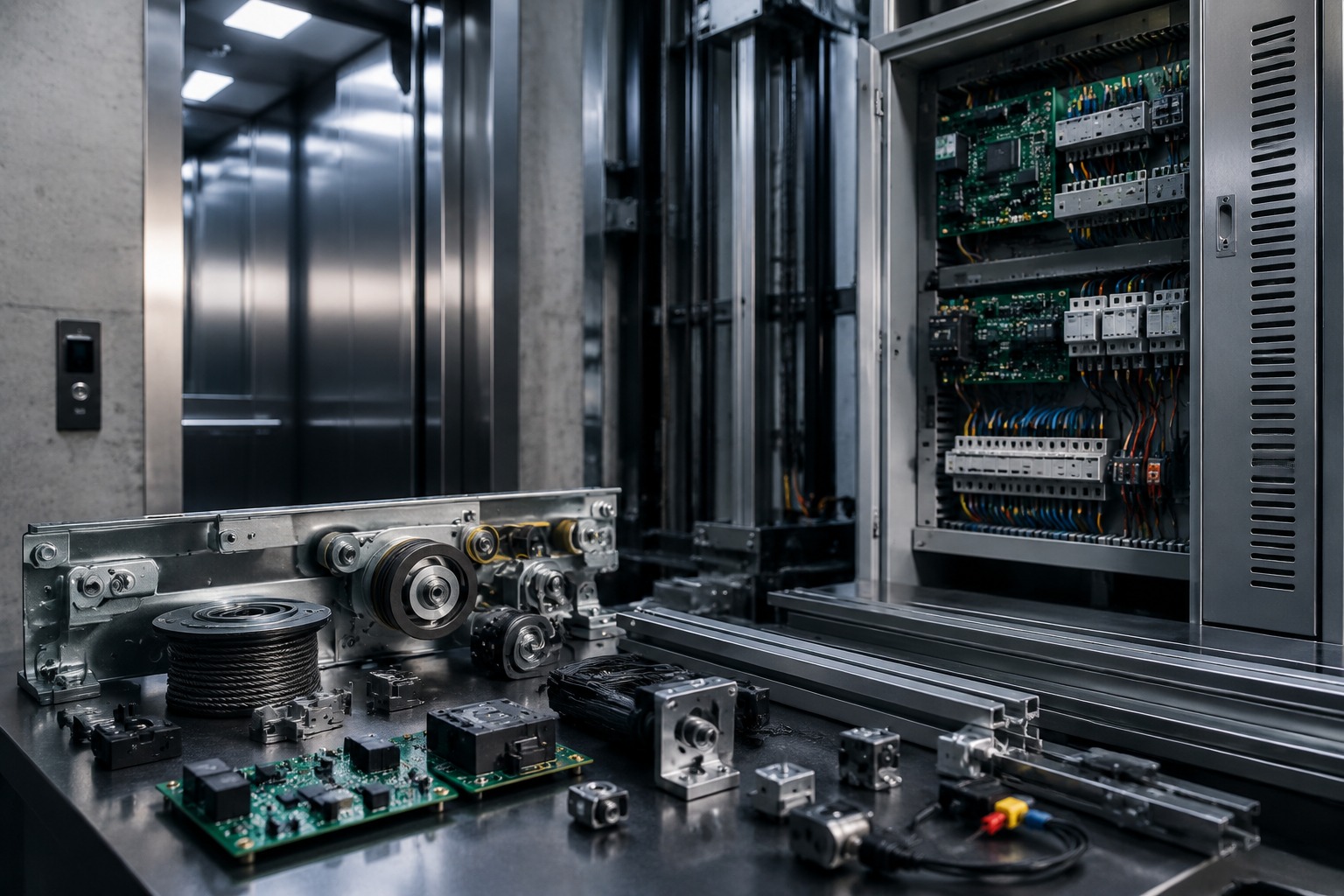
For South African repair teams, distributors, and building managers, sourcing the right Hitachi elevator parts is less about finding the lowest quote and more about getting the correct model match, traceable quality, and fast delivery that reduces lift downtime. In practical terms, the most requested items are usually control boards, encoders, sensors, door motors, power supplies, guide shoes, brake parts, door locks, buttons, and COP accessories. The safest buying process starts with identification of the lift model series, controller version, part code, voltage, connector layout, and installation environment before any order is placed.
Across Johannesburg, Cape Town, Durban, Pretoria, Gqeberha, and major commercial corridors linked to the Port of Durban and the Port of Cape Town, maintenance companies face the same challenge: older installed units often need compatible replacement parts quickly, while newer systems require tighter electronic matching. For this reason, procurement teams in South Africa increasingly prefer suppliers that can support photo-based verification, nameplate checks, board revision confirmation, packaging protection, and responsive after-sales communication.
This guide explains which Hitachi lift accessories are most in demand, how to identify the correct series and part number, what to review before replacing control electronics, and how to inspect supplier quality. It also covers common buying mistakes, local application scenarios, and 2026 trends in modernization, sustainability, and spare-parts planning.
South Africa market overview for Hitachi elevator spare parts
The South African lift maintenance market is shaped by a mix of commercial towers, hospitals, hotels, public infrastructure, residential high-rises, logistics sites, and modernization projects. In Sandton and central Johannesburg, office buildings often prioritize uptime, callback reduction, and quick door-system repairs. In Cape Town and Durban, hospitality properties and mixed-use buildings may place more emphasis on passenger comfort, door performance, and replacement lead time during peak occupancy periods. Government buildings, campuses, and hospitals also require dependable sourcing because shutdowns can affect safety and service continuity.
Several market factors drive demand for Hitachi elevator replacement parts in South Africa:
- Aging installations that need ongoing repairs rather than full replacement
- Rising modernization work where selected components are changed in stages
- Pressure to reduce downtime in office, retail, and healthcare properties
- The need for reliable import handling through key ports and inland transport routes
- Growing preference for suppliers that can verify compatibility before dispatch
One important procurement reality is that the same visible component type can differ by series, connector pinout, firmware revision, dimensions, or mounting pattern. This is especially true for boards, encoder assemblies, sensors, door operator parts, and power supply units. A maintenance team that buys only by product appearance can lose time and money. A better approach is to treat every request as a matching exercise that combines equipment data with application conditions.
| South African market segment | Typical building type | Common repair priority | Popular Hitachi parts | Buying focus | Risk if mismatched |
|---|---|---|---|---|---|
| Commercial offices | High-rise towers in Johannesburg and Pretoria | Fast restoration of service | Control boards, buttons, door sensors | Exact electronic compatibility | Extended downtime |
| Hotels and mixed-use sites | Cape Town and Durban hospitality properties | Smooth door performance | Door motors, light curtains, power supplies | Noise, comfort, response speed | Guest complaints and callbacks |
| Hospitals | Private and public medical facilities | Operational safety | Brake parts, sensors, intercom components | Reliability and inspection records | Service disruption |
| Residential towers | Urban apartment blocks | Cost control with stable quality | Guide shoes, oil cups, buttons, locks | Durability and value | Frequent repeat repairs |
| Retail and malls | Regional shopping centres | High traffic uptime | Door locks, COP parts, controller boards | Lead time and stocking strategy | Footfall impact |
| Modernization contractors | Multi-site projects nationwide | Planned phased replacement | Inverter parts, encoders, door operator units | Batch consistency | Installation delays |
The table above shows that procurement priorities differ by building segment. A hospital may accept a higher part price for better reliability and traceability, while a residential owner may need a balance of cost and service life. In every case, the best supplier is the one that can help confirm fitment before the shipment moves.
Popular Hitachi elevator replacement parts
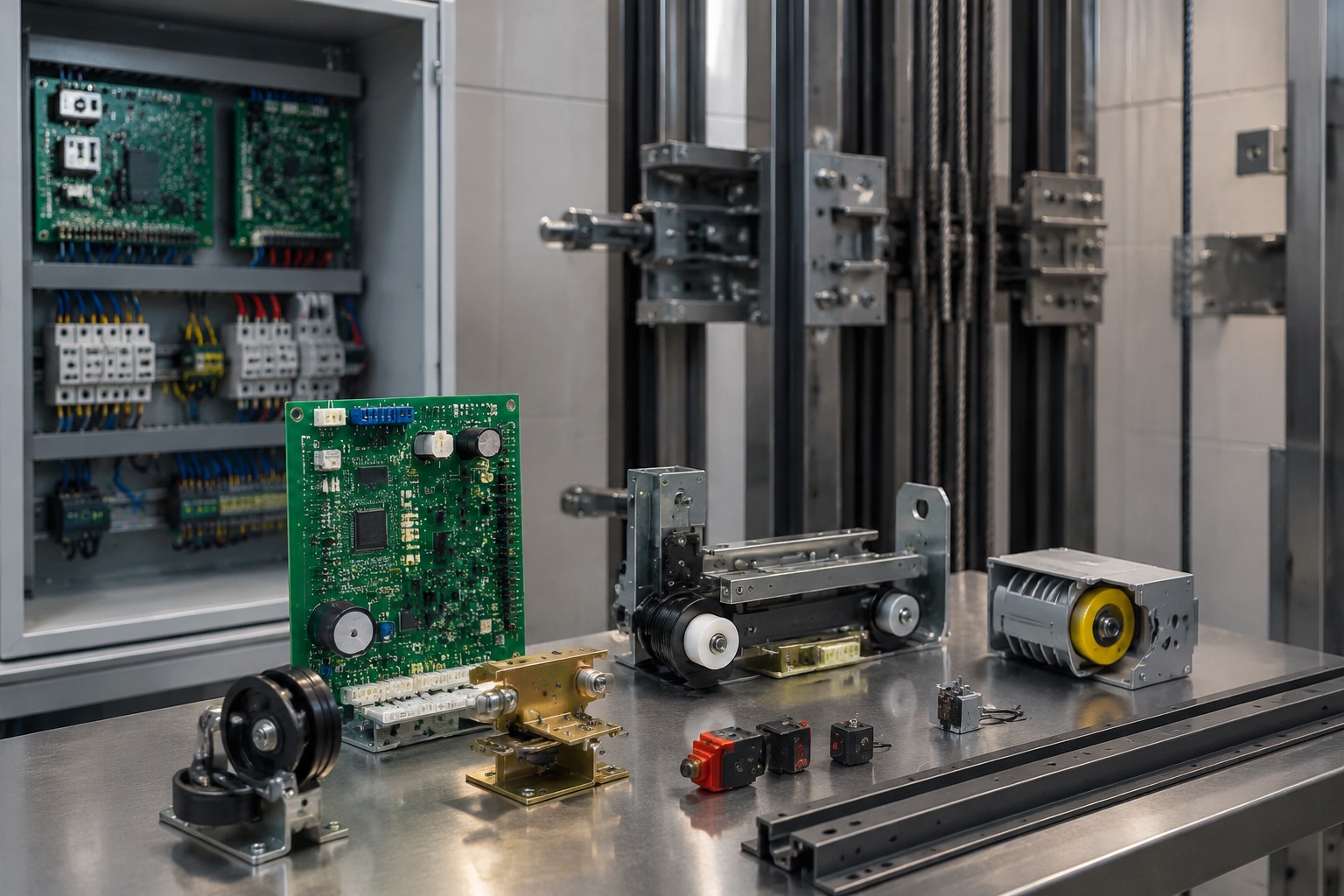
The most frequently purchased Hitachi lift spare parts are usually the components that directly affect elevator availability. Electronic control items are often the most urgent because one failed board or feedback device can stop the lift immediately. Door-related parts also rank high because landing and car doors experience frequent cycles and mechanical wear. Wear components such as guide shoes, oil cups, rollers, and some brake accessories are common in routine maintenance and planned refurbishment.
Typical high-demand product categories include:
- Controller and drive-related boards
- Inverter and frequency converter parts
- Encoders and speed feedback devices
- Door operator motors and related assemblies
- Emergency power supply units
- Sensors, switches, light curtains, and door locks
- Guide shoes, oil cups, rollers, and brake elements
- Buttons, indicators, COP panel parts, and intercom accessories
For buyers who need a verified electronic replacement, a Hitachi control board solution is often the first urgent inquiry. For motion feedback troubleshooting, teams may also need a matching Hitachi encoder replacement to restore stable operation and reduce repeat faults. These parts should never be selected by appearance alone; revision, connector style, and machine application must be checked carefully.
| Part category | Main function | Failure symptom | Urgency level | Data needed before order | Typical buyer |
|---|---|---|---|---|---|
| Control board | System logic and command control | Lift out of service, communication faults | Very high | Board code, revision, photos, lift model | Maintenance contractor |
| Encoder | Speed and position feedback | Leveling errors, drive alarms | High | Encoder model, connector, voltage | Repair technician |
| Door motor | Opening and closing door movement | Slow or failed door operation | High | Motor type, power, shaft details | Modernization team |
| Emergency power supply | Backup power support | Failure during outage response | Medium to high | Input/output ratings, cabinet layout | Building owner |
| Guide shoe | Car and counterweight guidance | Noise, vibration, poor ride quality | Medium | Dimensions, mounting, material | Maintenance planner |
| Brake component | Stopping and holding performance | Brake wear, inspection findings | Very high | Brake type, dimensions, machine info | Safety-focused site team |
This table helps buyers set priorities. If a board, encoder, or brake-related part is involved, the order usually needs more technical verification than a cosmetic or low-risk accessory. Procurement teams should also note whether the repair is reactive or part of a planned shutdown. Planned orders allow more time for cross-checking and batch consolidation.
How to identify model series and part numbers
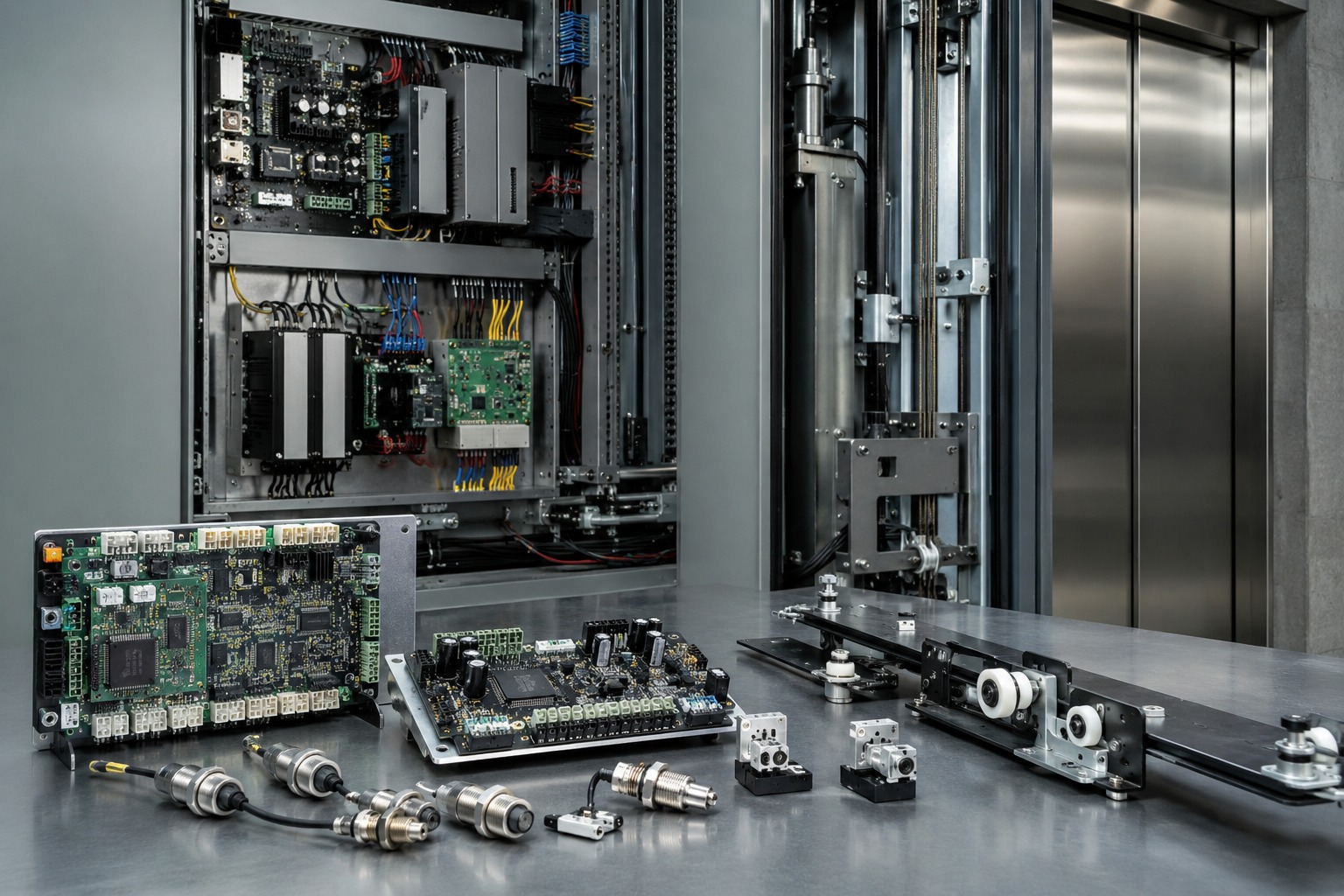
Correct identification is the foundation of safe elevator spare parts sourcing. In South Africa, many buying problems begin when a customer requests “a Hitachi door board” or “a brake part for a Hitachi lift” without equipment data. Since different series may share a similar external look, that description is not enough. The right process is to collect all available technical references before seeking a quote.
Start with the following items:
- Lift brand and complete model series
- Controller or drive cabinet nameplate data
- Original part number or label code
- Board revision or firmware marking where visible
- Clear photos of front, back, side, connectors, and labels
- Machine room or shaft application details
- Voltage, current, and connector count
- Car number and building site if multiple lifts exist
When the original label is unreadable, compare mounting points, terminal layout, heat sink structure, shaft dimensions, and related assembly dimensions. For mechanical items such as guide shoes and brake components, accurate measurements are essential. For electronic items, photos alone may not be enough if the revision code differs.
Good suppliers will ask detailed questions rather than rushing to quote. That is a positive sign, not a delay. It means they are trying to reduce the risk of a wrong shipment. In South Africa, where import lead times and transport costs matter, verification before dispatch is almost always cheaper than replacement after delivery.
| Identification checkpoint | Why it matters | Where to find it | Used for electronic parts | Used for mechanical parts | Procurement note |
|---|---|---|---|---|---|
| Lift model series | Separates similar-looking parts | Machine room documents or nameplate | Yes | Yes | Always record full series |
| Part number | Primary matching reference | Label on component | Yes | Yes | Check full code, not partial |
| Revision/version | Prevents connector or firmware mismatch | Board sticker or print | Yes | No | Very important for boards |
| Voltage and rating | Ensures safe electrical operation | Nameplate, printed markings | Yes | Sometimes | Never assume equivalence |
| Dimensions | Confirms physical fit | Measure item or compare drawing | Sometimes | Yes | Use mm and photos |
| Connector layout | Prevents wiring mismatch | Front and rear photos | Yes | No | Count pins and positions |
The checklist above is especially useful for maintenance buyers handling multiple service sites in Gauteng, KwaZulu-Natal, or the Western Cape. Standardizing the information you collect before requesting a quote shortens response time and improves accuracy.
Control board and sensor replacement planning
Replacing a Hitachi control board or sensor should be treated as a structured technical task, not a simple parts swap. Boards and sensors interact with controller logic, feedback loops, drive systems, and landing signals. A failed sensor may trigger door faults, leveling problems, or safety circuit alarms, while an incorrect board can create startup issues, communication errors, or unstable operation after installation.
Before ordering, maintenance teams should define the fault clearly. Ask whether the board is definitely defective, whether a related power issue is causing the symptom, or whether the root cause may be wiring, contamination, intermittent feedback, or a damaged connector. Where possible, confirm the diagnosis through inspection logs, alarm history, voltage tests, and substitution with a known-good unit under proper technical procedures.
For many teams, replacement planning includes deciding whether to buy only the failed component or hold one spare for future outages. This matters on high-traffic sites where downtime costs are high. A multi-building property operator in Johannesburg may prefer to stock one compatible board and one key sensor for critical lifts, while a smaller building may buy only when needed.
Board replacement planning should cover:
- Exact code and revision verification
- Static-safe packaging during transport
- Inspection for shipping damage on arrival
- Installation by qualified technical personnel
- Parameter backup where applicable
- Functional testing after installation
- Return analysis if root cause is still uncertain
Sensor replacement planning should cover:
- Sensor type and operating principle
- Mounting orientation and sensing distance
- Wiring length and connector style
- Environmental conditions such as dust, heat, or vibration
- Calibration or adjustment requirements
Where teams need support with electronic matching, a supplier that provides careful model verification and secure packaging adds real value. This is especially true when dispatching sensitive parts across long domestic routes or through air and sea logistics channels.
Door motor and power supply considerations
Door systems are among the highest-cycle elements in any elevator. Because of this, the door motor, door controller, belt or coupling components, sensors, locks, and light curtains often account for a large share of service calls. In South Africa’s retail centres, office towers, hotels, and apartment buildings, a door fault can make an otherwise healthy lift unusable. That is why door motor sourcing needs careful attention to motor type, electrical rating, mechanical fit, torque profile, and compatibility with the operator assembly.
For projects involving door operator upgrades, some teams look for a Hitachi permanent magnet synchronous door motor because it can support efficient and stable door performance when correctly matched. Buyers should still verify whether the motor is intended as a direct replacement or part of a broader door operator configuration.
Power supplies are equally important. A failing power unit can create intermittent alarms, controller instability, or failure in emergency functions. For buildings with power quality concerns or backup requirements, an emergency power supply for Hitachi lifts may be a critical item in maintenance planning. This is particularly relevant in facilities that prioritize continuity during utility interruptions.
| Door motor or power item | Main check point | Why it matters | Installation concern | Best use case | Buying reminder |
|---|---|---|---|---|---|
| Door motor | Power rating and shaft details | Correct movement and fit | Mounting alignment | Frequent door failures | Confirm operator model |
| Door controller | Compatible board version | Stable command response | Connector layout | Electronic door faults | Match revision carefully |
| Light curtain | Beam count and dimensions | Passenger safety and nuisance fault reduction | Wiring route | High traffic buildings | Measure full length |
| Door lock part | Mechanical type and switch arrangement | Landing door safety integrity | Adjustment precision | Repeated lock faults | Check side and hand |
| Power supply unit | Input/output voltage and load | Protects stable controller operation | Cabinet space and cooling | Intermittent control issues | Verify ratings exactly |
| Emergency power supply | Backup function and capacity | Rescue and continuity support | Integration testing | Critical buildings | Review complete system need |
The explanation behind this table is simple: door and power components affect both uptime and passenger experience. A slightly cheaper but poorly matched part may create repeated callouts, extra labour, and tenant complaints. In contrast, a well-matched part with clear pre-shipment checks usually lowers total maintenance cost over time.
Guide shoe and brake component checks
Guide shoes and brake components may not attract as much attention as boards or motors, but they are essential to ride quality and safe operation. Guide shoes help maintain proper guidance of the car and counterweight along the rails. When worn or incorrect, they can contribute to noise, vibration, instability, or accelerated wear. Brake parts are even more critical because they influence stopping performance and holding safety.
When inspecting guide shoes, verify dimensions, mounting pattern, material type, wear insert style, and the rail size they are designed for. Also consider the wear environment. Dust, poor shaft conditions, and deferred lubrication can accelerate deterioration. In coastal regions around Durban or Cape Town, environmental exposure may also influence component condition over time.
When inspecting brake components, maintenance teams should review the full brake assembly and not only the worn item. A replacement should fit the machine type, braking surface requirements, and overall lift duty. Documentation and technical confirmation are especially important because brake systems are directly linked to safety performance. If uncertainty exists, do not guess based on a visual match alone.
Recommended inspection points include:
- Visible wear pattern and measurement against service limits
- Mounting interface and retaining hardware condition
- Signs of uneven contact, contamination, or heat damage
- Matching of dimensions to the original component
- Operational noise, vibration, or braking irregularity reported by technicians
How to inspect supplier quality
Supplier quality inspection is one of the most important skills for buyers of Hitachi elevator parts in South Africa. A good supplier is not defined only by stock claims or a fast quote. Quality should be visible in the supplier’s process: technical questioning, traceability, packaging standards, document accuracy, and willingness to verify details before shipment.
When reviewing a supplier, consider the following quality indicators:
- They ask for model series, part code, and photos before confirming
- They can explain whether the part is exact-match, equivalent, or application-based compatible
- They use protective packaging for electronics and mechanical surfaces
- They provide clear labelling, quantity confirmation, and item photos if requested
- They communicate lead time honestly
- They respond to mismatch risks instead of ignoring them
From a technical capability perspective, our team supports model matching with a practical verification process that includes part-code review, image checks, connector comparison, and application confirmation for control boards, encoders, sensors, and other lift accessories. This helps maintenance companies reduce wrong orders, especially on urgent repairs where downtime pressure is high.
From a manufacturing capability perspective, we work with stable sourcing channels and structured quality checks across common product categories such as door operator components, power supplies, buttons, guide shoes, door locks, and controller accessories. Consistency matters for repeat orders and project batches, particularly for modernization contractors managing multiple installations across South Africa.
From a service capability perspective, we focus on responsive communication, protective packing for transport, and support for maintenance companies, distributors, building owners, and project buyers who need dependable replacement planning. Fast answers alone are not enough; the real value is in helping customers receive a part that is likely to fit the first time.
| Supplier review item | What good looks like | Warning sign | Why it matters in South Africa | Best question to ask | Decision impact |
|---|---|---|---|---|---|
| Technical verification | Requests full data before quote | Quotes from a vague description | Reduces import mistakes | What data do you need to confirm fitment? | High |
| Product traceability | Clear labels and part references | No code confirmation | Improves accountability | Can you provide part photos before dispatch? | High |
| Packaging quality | Anti-static and shock protection | Loose generic packing | Protects long-route shipments | How will electronic parts be packed? | Medium to high |
| Lead time transparency | Realistic dispatch schedule | Promises without evidence | Supports maintenance planning | Is the item stocked or made to order? | High |
| Communication speed | Clear and accurate replies | Slow or incomplete answers | Useful for urgent outages | Who handles technical follow-up? | Medium |
| After-sales support | Assists with issue review | Unreachable after payment | Important for fault resolution | What happens if matching needs recheck? | High |
This supplier inspection framework is useful for both one-off emergency purchases and long-term procurement relationships. It is especially valuable for distributors and multi-site service firms that want to standardize their buying process.
Common procurement mistakes
Many avoidable problems in elevator spare-parts purchasing come from incomplete information, rushed decisions, or overconfidence based on appearance. In a market where downtime can affect tenants, patients, staff, and visitors, these mistakes can become expensive quickly.
The most common procurement mistakes include:
- Ordering by photo only without checking part number and revision
- Using a partial code and assuming the rest is the same
- Ignoring voltage or connector differences
- Replacing one failed item without investigating the root cause
- Choosing the cheapest quote without evaluating supplier controls
- Failing to check whether the item is for left-hand or right-hand installation
- Ordering one urgent item at a time instead of planning critical spares
- Not protecting electronic parts adequately during transport
Another common mistake is not separating exact replacement from compatible replacement. In some categories, compatibility may be possible if dimensions, ratings, and application conditions match. In others, especially boards and some feedback devices, exact matching is usually safer. Procurement teams should ask the supplier to state clearly what kind of match they are offering.
A practical case from the South African market is a multi-lift office building that orders a board based on the controller family but ignores the revision label. The result may be a physically similar part that cannot communicate correctly with the existing system. The project then loses more time while arranging exchange or re-order. By contrast, buyers who submit full photos and cabinet details upfront usually avoid this problem.
Industries and applications across South Africa
Hitachi lift parts are used across a broad range of industries in South Africa. The application environment affects which parts fail most often, how urgently they are needed, and what the buyer should prioritize.
| Industry | Application example | High-demand part types | Main buying objective | Maintenance challenge | Suggested strategy |
|---|---|---|---|---|---|
| Commercial property | Sandton office towers | Boards, buttons, door parts | Minimize tenant disruption | High daily usage | Keep critical spares |
| Hospitality | Cape Town hotels | Door motors, indicators, light curtains | Passenger comfort and uptime | Peak guest periods | Pre-season inspection and stocking |
| Healthcare | Hospitals and clinics | Brake parts, sensors, intercom items | Safety and continuous operation | Service-critical movement | Use traceable suppliers |
| Residential | Urban apartment blocks | Guide shoes, buttons, locks | Cost-effective reliability | Budget constraints | Plan periodic replacements |
| Retail | Malls in Durban and Pretoria | Door locks, light curtains, COP parts | Reduce passenger complaints | Heavy traffic and door cycles | Focus on door system health |
| Industrial and logistics | Goods lifts and service elevators | Power supplies, sensors, brake items | Stable operational support | Harsh duty conditions | Check environment-specific wear |
The table shows why the same brand of lift may require different spare-parts strategies in different sectors. Traffic intensity, operational criticality, and environmental conditions all shape the best procurement decision.
Case examples and local sourcing considerations
Consider a Durban mixed-use property with repeated door closing faults. The initial assumption might be a bad sensor, but a proper review reveals a worn door motor assembly combined with unstable power conditions. Buying only the cheapest sensor would not solve the issue. A better outcome comes from reviewing the full door system, confirming the operator model, and checking whether the power supply also needs replacement.
In another example, a Johannesburg office complex with several lifts experiences intermittent leveling alarms. A technician suspects the encoder, but the maintenance team first verifies the exact code, connector configuration, and related feedback history. Because the supplier requests detailed photos and model information, the correct replacement is sourced in one cycle, reducing repeat downtime.
Local sourcing considerations in South Africa also include delivery planning. Buyers should ask whether the shipment will move by air for urgent outages or through standard freight for planned stock replenishment. Protective packaging matters even more when electronic parts travel long distances inland after arrival at Durban or Cape Town. Clear item labelling also helps receiving teams at local workshops and site stores avoid mix-ups.
Why many buyers choose structured parts support
Repair teams often work under pressure, but structured sourcing still saves time. Buyers benefit when a supplier can support three practical areas at once: technical accuracy, consistent product quality, and responsive service. That combination is especially useful for South African maintenance companies covering wide service territories, where a wrong part may cost an extra trip, lost time, and a dissatisfied client.
Our approach is built around those three areas. Technologically, we support detailed part matching for electronic and mechanical lift accessories, including boards, encoders, door components, sensors, and power units. From the production and sourcing side, we focus on stable quality checks, batch consistency, and product protection. From the service side, we respond quickly, confirm critical details, and package parts carefully so buyers can source with greater confidence for repair, stock, or modernization work.
Future trends for 2026: technology, policy, and sustainability
Looking ahead to 2026, the South African elevator parts market is likely to be influenced by three major trends.
First, technology will continue shifting demand toward smarter diagnostics and more precise electronic replacements. More buyers will request better fault identification before ordering boards, sensors, and inverter-related parts. This means suppliers with stronger model-matching capability and clearer technical communication will gain an advantage.
Second, policy and compliance expectations are likely to place greater attention on documented maintenance, safe component replacement, and building reliability. Buyers will increasingly prefer traceable sourcing, especially for parts connected to control, braking, and emergency operation.
Third, sustainability will become more relevant in modernization and lifecycle planning. Rather than replacing complete systems immediately, many building owners will continue extending equipment life through targeted component renewal. Efficient door motors, dependable power supplies, and planned replacement of wear items can support lower waste, improved reliability, and better use of maintenance budgets.
For procurement teams, this means the future is not only about price. It is about compatibility, service life, and choosing replacement parts that support long-term building performance.
FAQ about Hitachi elevator parts
1. What are the most commonly requested Hitachi elevator replacement parts in South Africa?
The most common requests are control boards, encoders, sensors, door motors, power supply units, guide shoes, brake-related parts, door locks, light curtains, buttons, and COP accessories.
2. How do I identify the correct Hitachi part number?
Check the original label, controller cabinet data, lift model series, revision code, voltage rating, connector layout, and clear photos of the part. If the label is damaged, collect measurements and full equipment information before ordering.
3. Can I buy by appearance if the old part looks the same?
No. Many parts look similar but differ in revision, pinout, dimensions, firmware, or application. Visual similarity alone is not a safe basis for ordering.
4. Are control boards and encoders the highest-risk items to mismatch?
Yes, along with some sensors and drive-related parts. These components require careful verification because incorrect matching can keep the lift out of service.
5. What should I check before replacing a door motor?
Confirm the operator model, motor type, power rating, shaft details, mounting pattern, and whether the replacement is exact or application-compatible.
6. Why is an emergency power supply important?
It supports continuity and emergency response during power interruptions, which is especially important for critical buildings and sites with backup planning requirements.
7. How can I judge whether a supplier is reliable?
Look for technical verification, traceable product details, proper packaging, realistic lead times, and responsive after-sales communication.
8. What is the biggest procurement mistake buyers make?
Ordering too quickly with incomplete information. The most expensive mistake is often not a high price but a wrong part that causes more downtime.
9. Should building owners keep spare parts in stock?
For high-traffic or critical buildings, keeping selected critical spares such as common boards, sensors, or door items can reduce downtime significantly.
10. Is planned sourcing better than emergency buying?
Yes. Planned sourcing allows better technical verification, shipment planning, and budget control. Emergency buying is sometimes necessary, but it carries more risk if details are incomplete.
In summary, successful procurement of Hitachi elevator parts in South Africa depends on accurate identification, realistic technical review, and supplier quality control. Whether the need involves a control board, encoder, door motor, emergency power supply, guide shoe, or brake component, the safest path is to confirm the data first, buy from a supplier that values matching accuracy, and consider the operational conditions of the building where the part will be used.