
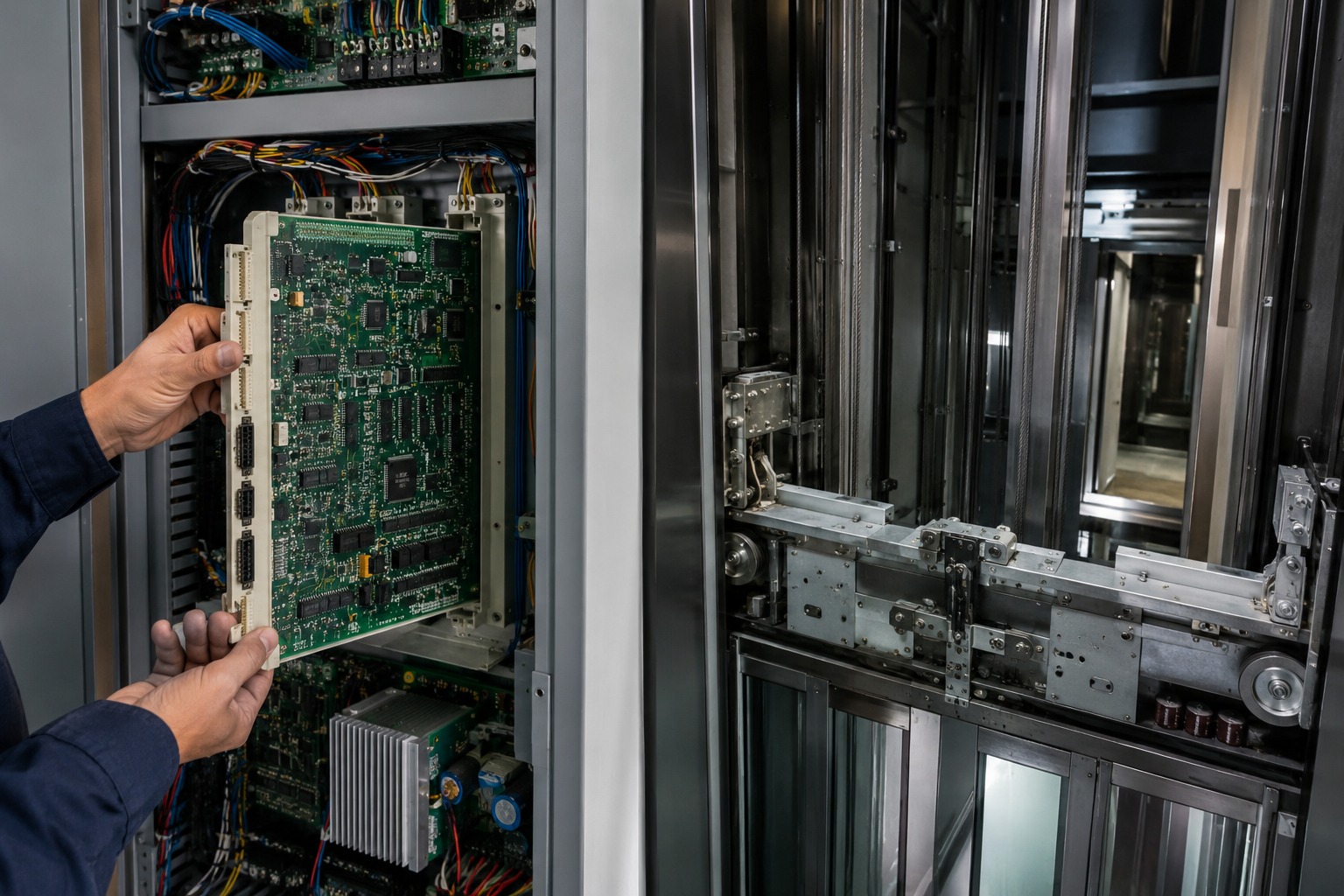
For technicians, maintenance firms, building owners, and modernization contractors in South Africa, selecting the right Toshiba elevator board is not simply a purchasing task. It is a repair decision that affects passenger safety, controller stability, downtime, return visits, and long-term maintenance cost. The most reliable approach is to identify the exact board function first, verify the part number and controller generation second, inspect the fault history and surrounding hardware third, and only then choose a replacement board that matches the application and operating environment.
Across Johannesburg, Cape Town, Durban, Pretoria, Gqeberha, and growing commercial nodes near Sandton, Midrand, and Centurion, many elevator systems are expected to operate under heavy daily traffic, inconsistent power quality, and challenging service intervals. In these conditions, a Toshiba elevator control board, inverter board, driver board, expansion board, safety circuit board, or car top communication board must be selected with close attention to compatibility, connector layout, software version, load profile, and packaging protection during inland and port-linked transport through Durban Port, Cape Town Port, and OR Tambo logistics routes.
This guide explains Toshiba elevator board types, when replacement is justified, how to inspect a board before ordering, what South African buyers should check before accepting a shipment, and how a professional supplier can support faster model matching. It also covers future trends through 2026, including modernization demand, sustainability pressure, and the increasing need for accurate retrofit compatibility in mixed-brand maintenance portfolios.
Direct answer for South African buyers
If you need a quick answer, the best way to select a Toshiba elevator board is to confirm six points: controller model, board part number, software or firmware label, connector orientation, fault code history, and the condition of related components such as power supply modules, inverters, encoders, relays, and communication cables. A motherboard should be replaced only after confirming that the fault is not caused by external short circuits, poor grounding, moisture, unstable incoming voltage, or failed peripheral boards. Expansion boards and driver boards should be checked for burnt traces, swollen capacitors, damaged terminals, oxidation, and input-output abnormalities. Safety circuit boards should only be purchased after confirming safety loop logic, relay rating, and application within the original system architecture. Car top communication boards are especially important where door signals, landing calls, inspection functions, and cab communication must remain stable during travel.
For local projects in hospitals, apartment towers, office buildings, logistics sites, universities, shopping centres, and hotels, technicians should prioritize traceable parts, anti-static protection, and responsive after-sales support. When sourcing for South Africa, it is also practical to discuss shipping method, customs handling, replacement lead time, and whether the board will be used for immediate repair, stock holding, or modernization planning.
South Africa elevator repair market and sourcing reality
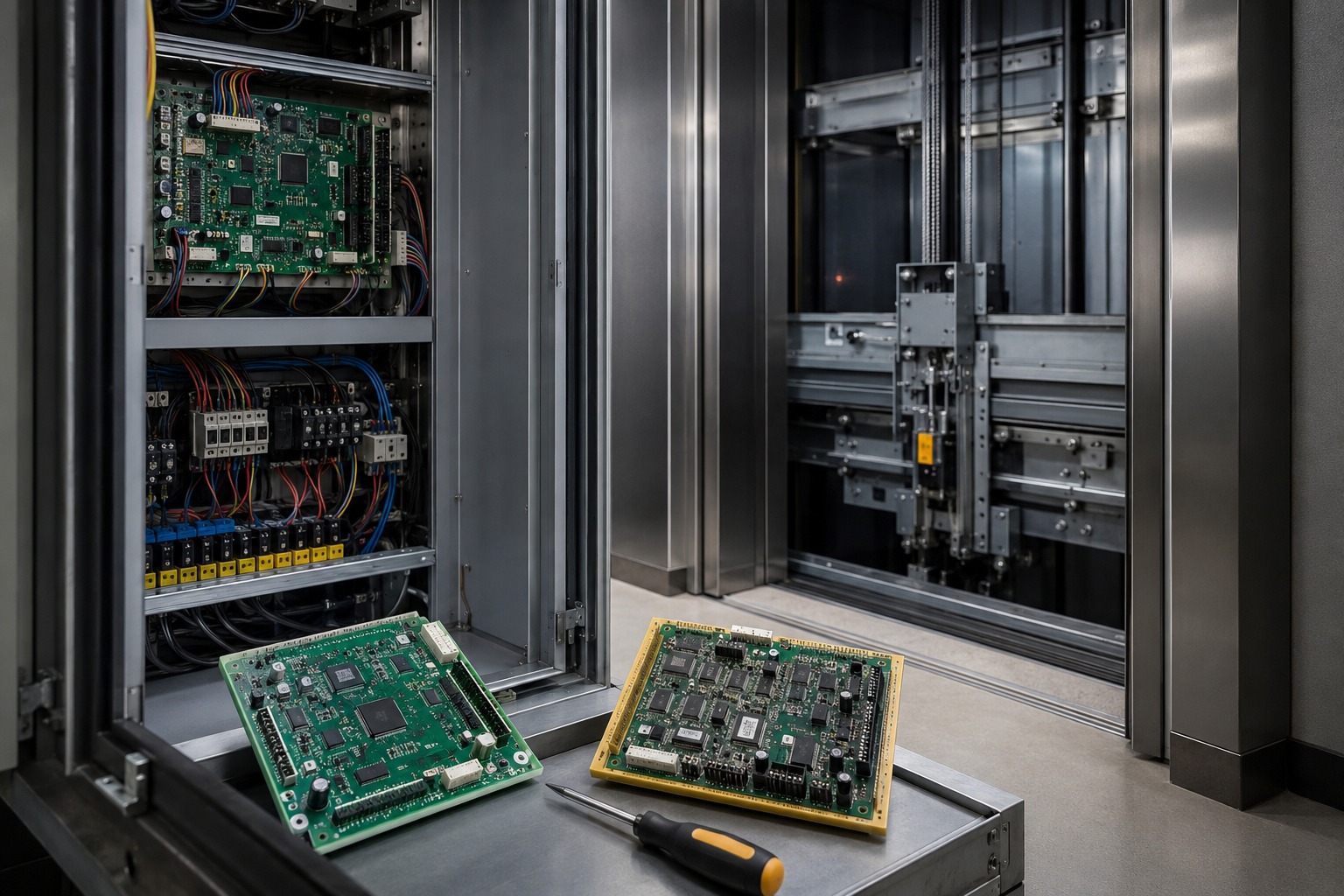
South Africa remains one of the most important elevator service markets on the continent, with strong demand concentrated in commercial buildings, public infrastructure, mixed-use developments, healthcare, hospitality, and residential high-rise assets. Many elevators now face aging controller systems, intermittent shutdowns, and modernization pressure. This creates steady demand for Toshiba replacement boards, especially for properties where a full controller replacement is too costly or too disruptive.
In Johannesburg and Pretoria, service demand is often tied to dense office and residential building stock. In Cape Town, hospitality, residential developments, and waterfront commercial assets create a different demand pattern, often with a stronger focus on appearance, uptime, and tenant experience. Durban adds a logistics and port-adjacent service profile, where freight lifts and mixed-duty passenger lifts often experience heavy operation cycles. These local differences matter because the same Toshiba board family can perform differently depending on traffic density, dust levels, coastal humidity, and maintenance quality.
South African buyers also face a practical issue: not every local stockist keeps deep inventory across older and newer Toshiba controller generations. That is why technical matching, careful visual verification, and a supplier that understands serial labels, board photos, and application notes can make the difference between a successful repair and an expensive mismatch.
The chart above reflects a realistic growth pattern in replacement board demand. The increase is driven by aging installed equipment, rising downtime sensitivity, and the common preference for targeted component replacement before full modernization.
| Region | Main building types | Typical board demand | Common issue drivers | Buying priority | Logistics note |
|---|---|---|---|---|---|
| Johannesburg | Office towers, apartments, malls | Motherboards, driver boards | High traffic, aging controllers | Fast technical matching | Road delivery to major service hubs is efficient |
| Pretoria | Government, education, healthcare | Safety boards, expansion boards | Mixed-use systems, legacy assets | Reliability and documentation | Good access for consolidated shipments |
| Cape Town | Hotels, residential, commercial | Communication boards, door-related boards | Humidity, uptime pressure | Packaging and corrosion protection | Port-linked import handling is common |
| Durban | Warehousing, hospitals, retail | Driver boards, inverter boards | Heavy cycles, coastal conditions | Stable quality and anti-moisture packing | Strong port logistics advantage |
| Gqeberha | Industrial and residential | Expansion boards, relay boards | Spare availability constraints | Accurate part substitution guidance | May require planned lead times |
| Bloemfontein | Healthcare, public buildings | Control boards, safety boards | Smaller service network | Remote support and photo verification | Packaging for long-distance inland transit matters |
This table shows why there is no single buying rule for every city. Local environment, building type, and transport route all influence the best sourcing approach.
Toshiba elevator board types explained
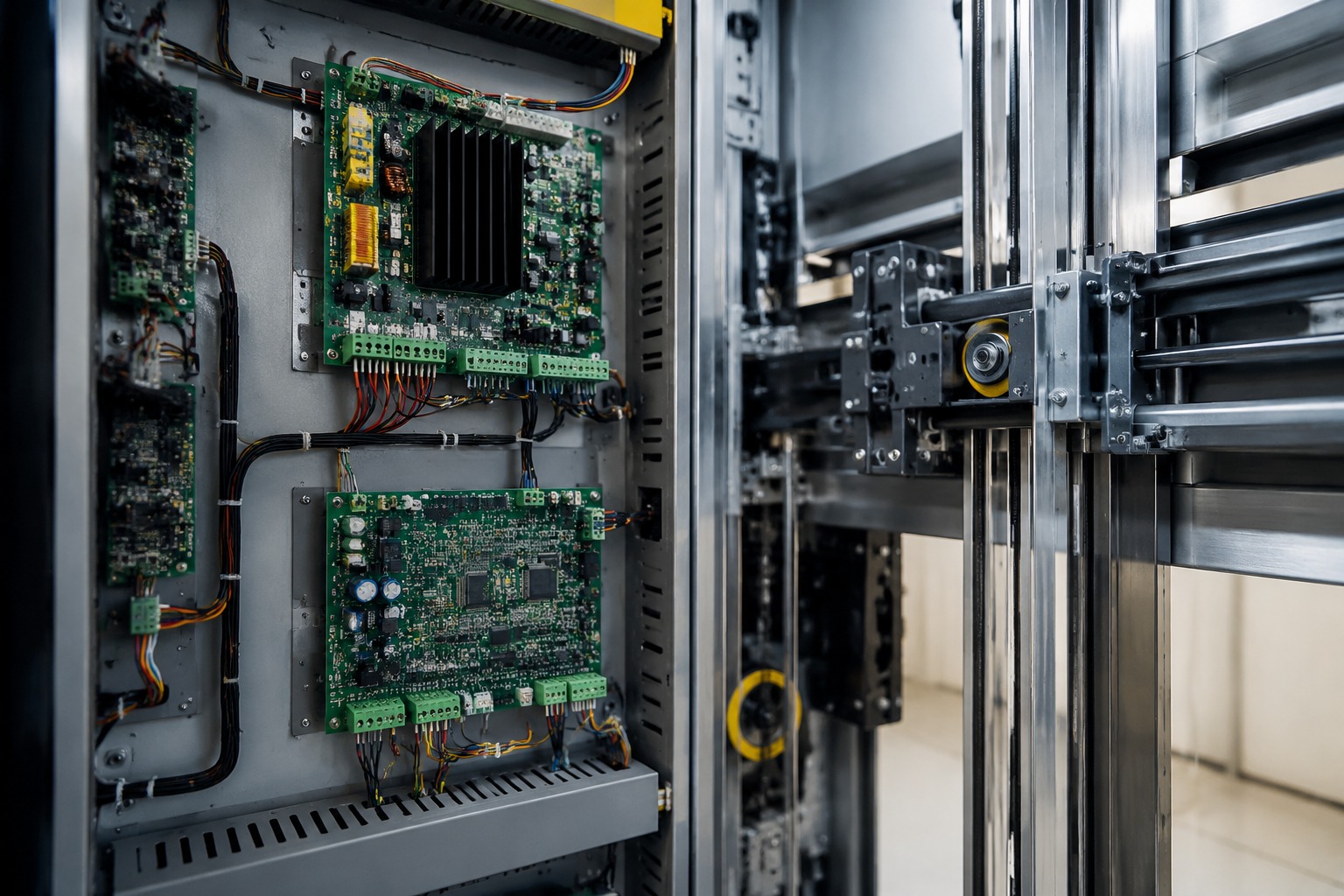
Toshiba elevator systems use multiple board categories, and each plays a different role inside the control architecture. Understanding these categories helps prevent the common mistake of replacing the wrong board based only on a generic fault description.
The motherboard or main control board is usually the decision centre of the system. It processes logic, safety interactions, signal management, and communication with subordinate boards. When the motherboard fails, symptoms may include repeated resets, no response to commands, unstable floor registration, or communication loss across several subsystems at once.
Expansion boards add extra input and output capacity or support specific features. They are commonly used when the elevator system requires more signal handling for floors, doors, calls, indicators, or auxiliary control functions. When expansion boards fail, technicians may see selective signal loss rather than complete controller shutdown.
Driver boards and inverter-related boards are associated with motor control, output stage coordination, and power electronics management. These are especially sensitive to heat, voltage variation, insulation failure, and incorrect load conditions. If you are comparing motor-side components, you may also need to review the matching of a Toshiba elevator inverter board or a Toshiba elevator inverter driver board depending on the exact fault chain.
Safety circuit relay boards manage or assist critical safety loop logic. They are not interchangeable by appearance alone. Relay rating, signal architecture, and system generation must be checked carefully. Where the issue involves safety chain processing or relay instability, technicians often inspect the Toshiba elevator safety circuit relay board together with associated connectors and field wiring.
Car top communication boards are used to support communication between the travelling car top area and the main control system. They can affect inspection mode, door zone signals, limit information, and communication continuity for movable components. In some service cases, an apparently random door or inspection problem turns out to be a communication board issue.
Expansion logic can also be important for signal-heavy systems, and a properly matched Toshiba elevator expansion board may solve floor call or interface limitations where the core controller remains healthy.
| Board type | Primary function | Typical symptoms when faulty | Inspection focus | Replacement urgency | Compatibility risk level |
|---|---|---|---|---|---|
| Main control board | Central logic and coordination | System resets, no run, communication errors | Processor area, memory labels, power inputs | High | Very high |
| Expansion board | Additional inputs and outputs | Missing floor calls, partial signal failure | Terminal blocks, I/O channels, interface plugs | Medium | High |
| Driver board | Drive signal and output control | Motor irregularity, trip faults, unstable run | Heat marks, gate drive section, connectors | High | High |
| Inverter board | Variable speed and frequency control support | Speed faults, acceleration issues, power trips | Capacitors, power stage, error history | High | High |
| Safety circuit relay board | Safety loop switching and relay logic | Safety open, relay chatter, no start | Relay contacts, coil ratings, trace damage | Critical | Very high |
| Car top communication board | Signal exchange on car top and travelling cable side | Inspection loss, door signal interruption | Communication ports, moisture, cable condition | Medium to high | Medium to high |
This classification helps maintenance teams avoid oversimplified decisions. A signal problem does not always mean a motherboard failure, and a motor fault does not always start at the drive board.
When a motherboard should be replaced
A motherboard should be replaced when tests show that the main board itself has lost stable processing ability, communication control, or signal integrity and the failure cannot be resolved by connector cleaning, parameter correction, peripheral repair, or power supply stabilization. In South Africa, premature replacement sometimes happens because an intermittent site fault is mistaken for permanent board damage. Good practice is to isolate the board from external influences before ordering a replacement.
Typical reasons to replace a Toshiba motherboard include visible burnt components, repeated rebooting after stable power confirmation, damaged processor sections, corrupted communication with multiple subordinate boards, unrecoverable memory errors, severe water or carbon contamination, and recurring faults that remain after peripheral boards have tested correctly.
However, replacement may not be necessary if the root cause is a failed encoder, unstable SMPS output, poor earthing, damaged travelling cable, shorted hall signal, or relay board fault feeding bad status to the controller. In older installations, loose terminals and field wiring errors can imitate motherboard failure surprisingly well.
| Observed condition | Likely interpretation | Should motherboard replacement be immediate? | Other items to test first | Risk of misdiagnosis | Recommended action |
|---|---|---|---|---|---|
| No power LED and confirmed input present | Possible board power stage damage | Often yes | Fuse, incoming supply, power supply board | Medium | Bench test and compare voltage rails |
| Repeated resets across all operations | Main logic instability | Possible | Grounding, voltage ripple, watchdog events | High | Stabilize power and inspect processor section |
| Only some floor calls fail | More likely I/O or expansion issue | No | Expansion board, hall fixtures, wiring | Very high | Trace signal path before replacing main board |
| Communication alarms with several boards | Main board bus fault or cable issue | Not always | Harnesses, connectors, address settings | High | Verify network and board-to-board communication first |
| Severe moisture corrosion | Board integrity likely compromised | Usually yes | Cabinet sealing, environment source | Low | Replace board and correct moisture pathway |
| Recurring unexplained processor errors | Memory or logic failure | Often yes | Firmware label, backup data, parameter load | Medium | Match exact version before replacement |
The table makes one point very clear: the motherboard is important, but it should not become the default suspect in every shutdown case.
How to inspect expansion boards and driver boards
Inspection should start with safety isolation and proper ESD handling. Before touching the board, document the controller model, photograph each connector, record the fault code history, and note whether the issue is constant or intermittent. A good visual inspection can eliminate many wrong orders.
For expansion boards, look for damaged terminal blocks, cracked solder joints at heavier connectors, oxidation from humidity, and channel-specific burns that indicate field wiring overload. Use a methodical signal map. If only one landing input or one output bank is not responding, the fault may be localized.
For driver boards, pay close attention to heat stress, discoloured sections around gate drive components, bulging capacitors, resistor damage, optocoupler condition, and connector pin degradation. Driver boards often fail under electrical stress rather than purely age-related wear, so technicians should inspect surrounding components such as fan performance, cabinet ventilation, power quality, and motor insulation feedback.
In coastal South African environments, especially around Durban and Cape Town, salt-laden air and humidity can accelerate oxidation. In inland areas with dust-heavy conditions, contamination can create leakage paths and thermal problems. Inspection therefore has to account for local environment, not just electrical measurements.
The industry comparison above reflects where replacement board demand is strongest. Commercial towers and high-rise residential buildings often lead because uptime pressure is high and controller stress is constant.
| Inspection item | Expansion board concern | Driver board concern | What it may indicate | Field action | Replacement impact |
|---|---|---|---|---|---|
| Connector pins | Loose I/O channels | Intermittent control signal | Vibration or wear | Clean, tighten, compare continuity | May avoid unnecessary replacement |
| Burn marks | Overloaded output trace | Power stage stress | Short circuit or surge event | Inspect mating device and wiring | Often supports replacement decision |
| Capacitor condition | Signal instability | Drive instability and trips | Aging or heat exposure | Check ripple and thermal history | High importance |
| Solder joints | Partial channel failure | Intermittent run command failure | Thermal cycling | Magnified visual inspection | Can sometimes be repairable |
| Corrosion | Input-output misread | Control drift or loss | Humidity, moisture ingress | Assess cabinet sealing and route cause | High for coastal installations |
| Error history correlation | Mismatched signal events | Drive trip sequence | Board may not be root cause | Compare logs with operating conditions | Critical for correct diagnosis |
Using a structured checklist reduces guesswork. It also helps procurement teams order the right board the first time.
Safety circuit board buying notes
Safety circuit boards deserve the highest caution because they sit close to the safety logic chain of the elevator. These boards should never be treated as generic relay carriers. The relay arrangement, contact configuration, board revision, controller family, and wiring interface must all match the original application or a validated substitute approved for that system.
When buying a Toshiba safety circuit board, start with the exact board code and a clear cabinet photo. Confirm whether the board is part of the main safety loop, door safety processing, or an auxiliary relay interface. Ask whether relays are equivalent in rating and whether connector keying is the same. If a board has been modified in the field, document that before sourcing a replacement.
Technicians in South Africa should also consider the electrical environment. Sites with unstable power quality can shorten relay life and stress protective circuits. In older buildings, unrecorded historical repairs may have changed jumper settings or terminal allocations. That is why the best buying process combines visual verification, label confirmation, and a basic logic review with the supplier.
| Check point | Why it matters | Potential risk if ignored | Best verification method | Who should confirm | Priority level |
|---|---|---|---|---|---|
| Exact board code | Prevents wrong system match | Installation failure | Label photo and cabinet record | Technician and supplier | Critical |
| Relay specification | Safety switching must be equivalent | Unsafe operation or nuisance trips | Part marking review | Technical buyer | Critical |
| Connector layout | Ensures plug compatibility | Miswiring risk | Front and rear board photos | Technician | Very high |
| Board revision | Older and newer versions may differ | Signal mismatch | Revision print and supplier cross-check | Supplier | Very high |
| System application | Passenger and freight systems can vary | Functional incompatibility | Controller model confirmation | Technician | High |
| Site fault history | Confirms board is the real cause | Unnecessary expense | Fault log and relay behavior review | Maintenance team | High |
This table highlights the buying discipline required for safety-related boards. Fast ordering is useful, but accurate ordering is more important.
Car top communication board use cases
A car top communication board is often overlooked until technicians face inconsistent signals during inspection mode, door operation irregularities, or communication faults linked to moving cab components. In practice, these boards support an important bridge between the car top environment and the main controller.
Common use cases include communication for inspection controls, status exchange for door zone and top-of-car devices, transmission of signal states from moving assemblies, and reliable operation where multiple inputs must be interpreted while the car is travelling. In modernization work, these boards also matter because interface changes can create communication instability if the original logic path is not preserved correctly.
In service situations, a failing car top communication board may present as door reopen anomalies, inspection station unresponsiveness, intermittent top limit feedback, or communication alarms that appear only when the cab is moving. That movement-dependent fault pattern is a useful clue. It can point to the board itself, but also to connectors, travelling cable issues, or vibration-related solder weakness.
For South African properties with high passenger turnover, such as shopping centres in Johannesburg or hotel lifts in Cape Town, communication reliability on moving assemblies is directly tied to user experience and maintenance response time.
The area chart shows a realistic market trend: more buyers are choosing targeted board replacement before committing to complete controller modernization, especially where budgets and downtime windows are tight.
Compatibility questions for technicians
Compatibility is the core technical issue in Toshiba elevator board replacement. Even when a board appears physically similar, hidden differences in firmware, connector assignment, logic revision, communication protocol, or parameter expectation can make a direct replacement unreliable.
Technicians should ask the following questions before ordering:
- What is the exact controller model and board code?
- Is the replacement board from the same Toshiba series or a validated substitute?
- Are firmware labels, PROM chips, or memory modules the same?
- Do all connector positions and pin counts match?
- Is the board used in passenger, freight, hospital, or service lift configuration?
- Have any field modifications or jumper changes been made?
- Is the fault definitely on the board and not in the wiring, sensor, or inverter chain?
These questions are especially important for maintenance companies managing mixed portfolios with Toshiba, KONE, Mitsubishi, Hitachi, and other brands in the same service network. The pressure to restore operation quickly can lead to assumptions, but assumptions are costly in electronic control repair.
This comparison chart reflects what technicians usually value most: correct matching first, technical support second, then responsive logistics and protected shipping.
Packaging and shipping protection
Packaging matters more than many buyers expect. A correctly selected Toshiba board can still fail on arrival if it is packed poorly. Sensitive electronic boards should be sealed in anti-static packaging, cushioned against shock, isolated from moisture, and supported inside a rigid outer carton or crate where needed. Connector edges and protruding components need protection against compression.
For South African deliveries, packaging needs to account for multiple transport stages. A board may move from warehouse handling to air cargo or sea freight, then through customs processing, local transfer, and final road delivery to Johannesburg, Cape Town, Durban, Pretoria, or inland sites. Each stage adds vibration, stacking pressure, and environmental exposure.
Moisture control is especially important for port-linked shipments entering via Durban or Cape Town. For urgent jobs moving by air through OR Tambo or Cape Town International, anti-static protection remains essential even if transit time is shorter. Good suppliers provide clear labeling, internal cushioning, and shipment photos where needed.
| Protection element | Purpose | Best use case | Risk if absent | Recommended for South Africa? | Notes |
|---|---|---|---|---|---|
| Anti-static bag | Protects electronics from ESD | All control and communication boards | Latent electronic damage | Yes, always | Basic minimum requirement |
| Foam cushioning | Absorbs impact and vibration | Driver boards, relay boards | Cracked solder joints, component stress | Yes | Prefer fitted internal support |
| Moisture barrier packing | Reduces humidity exposure | Sea freight and coastal delivery | Oxidation and corrosion | Strongly recommended | Useful for Durban and Cape Town routes |
| Rigid outer carton | Prevents crush damage | All shipments | Connector and board flex damage | Yes | Double-wall carton preferred |
| Clear labeling | Improves handling and identification | Multi-item orders | Picking errors, handling mistakes | Yes | Include part code on outer label |
| Shipment photo record | Confirms condition before dispatch | Urgent and high-value orders | Dispute difficulty | Recommended | Helpful for remote buyers |
This table is practical because many failures blamed on product quality actually happen during handling or transport. Protection is part of quality.
Applications and industries using Toshiba replacement boards
Toshiba replacement boards are used across a wide range of properties in South Africa. In commercial towers, the key concern is passenger flow and minimal downtime. In hospitals, stable operation and quick fault recovery are vital. In residential towers, service interruptions create direct tenant pressure. Hotels require both reliability and comfort. Industrial and logistics facilities may involve freight lifts with heavier duty cycles. Educational and public buildings often combine tight budgets with a need for dependable service continuity.
The replacement strategy varies by application. A premium office tower in Sandton may prioritize immediate sourcing and preventive spares. A hospital in Pretoria may require careful verification and planned installation windows. A residential complex in Durban may prioritize corrosion-resistant storage and dependable packaging. A modernization contractor in Cape Town may require mixed batches of control boards, communication parts, door components, sensors, and power supplies aligned with a phased retrofit schedule.
Case studies from the field
Case 1: A commercial property in Johannesburg reported recurring shutdowns and random communication faults. The initial assumption was motherboard failure. After review of photos and fault descriptions, the problem was traced to a corroded communication interface path and unstable connectors on a subordinate board. Replacing the correct board reduced downtime and avoided an unnecessary main board order.
Case 2: A hotel lift in Cape Town experienced intermittent inspection mode loss and occasional door signal problems. Because the fault appeared mainly during movement, the investigation focused on the car top communication path. A matching replacement communication board, together with connector cleaning and cable inspection, resolved the issue.
Case 3: A hospital service lift in Pretoria had persistent safety loop interruptions. The maintenance team verified relay behavior, connector layout, and board code before sourcing a replacement safety circuit board. The accurate match prevented repeated call-backs and restored stable operation under a controlled maintenance window.
Case 4: A freight lift near Durban showed drive instability and fault trips under load. Instead of replacing multiple parts at once, the team reviewed the error pattern, inspected thermal marks, and identified the driver board as the true weak point. With the right part match and improved cabinet ventilation, the lift returned to service more reliably.
Local suppliers, technical support, and what buyers should expect
South African buyers often compare local stock availability with imported sourcing. Local availability can shorten delivery time, but technical depth and model matching support matter just as much. The best suppliers do more than quote a part number. They ask for board photos, cabinet labels, connector details, and fault symptoms. They explain whether the part is a direct match, whether related boards should be inspected, and how the part will be protected for transit.
Good supplier support is especially valuable for maintenance companies managing urgent shutdowns in multiple cities. A building owner in Johannesburg may need rapid dispatch, while a distributor in Durban may need bulk consolidation, and a modernization contractor in Cape Town may need staged shipments with careful model segregation. Buyers should expect traceability, packaging discipline, and responsive communication before and after shipment.
Our company: technology, manufacturing, and service strengths
From a technology perspective, we support elevator parts sourcing with careful model matching, cross-checking based on board labels, photos, controller references, and application details. This helps maintenance companies and distributors reduce ordering errors when sourcing Toshiba boards and related elevator electronic components. For technicians dealing with urgent repairs, we focus on practical compatibility review rather than generic catalog-only responses.
From a manufacturing and quality control perspective, we pay close attention to stable sourcing channels, product identification, visible condition checks, connector integrity, and protective handling standards for electronic boards and lift accessories. This is important not only for Toshiba control boards, but also for inverter and frequency converter parts, door operator components, intercom parts, sensors, encoders, power supplies, COP panels, buttons, light curtains, guide shoes, oil cups, and other replacement items used in daily elevator maintenance and modernization work.
From a service perspective, we work to help maintenance firms, distributors, building owners, and modernization contractors reduce downtime through responsive communication, protective packaging, and shipment planning suited to the destination. For South Africa, this means attention to route practicality, customs-related timing, and the need for boards to arrive ready for efficient on-site installation. The goal is not only to sell a part, but to support a successful repair outcome.
2026 trends: technology, policy, and sustainability
Looking toward 2026, three trends will shape Toshiba elevator board sourcing in South Africa. First, modernization will continue to accelerate as aging lift systems remain in service longer than originally planned. This will increase demand for precise board replacement and hybrid retrofit solutions. Second, energy efficiency and sustainability pressure will push building owners to combine targeted electronic repairs with smarter drive and control upgrades rather than full asset replacement whenever possible. Third, compliance and safety expectations are likely to become more structured, making documentation, traceability, and fit-for-application sourcing even more important.
Digital fault reporting and remote support will also become more useful. Technicians increasingly send high-resolution board photos, fault logs, and cabinet labels before ordering. This trend improves first-time match accuracy. At the same time, buyers will continue expecting suppliers to provide better packaging, clearer tracking, and faster response for urgent maintenance events.
In practical terms, 2026 will reward suppliers and maintenance teams that combine technical understanding, disciplined verification, and sustainable repair planning. Replacing the right board at the right time is more efficient than repeated site visits, unnecessary scrapping, or broad component swapping.
FAQ about Toshiba elevator boards
How do I know which Toshiba elevator board I need?
Start with the board label, controller model, clear photos, fault codes, and connector arrangement. Part number alone is best, but photo-based verification is also very helpful.
Can a motherboard be replaced without checking other parts?
It should not be the first step. Always check power supply stability, communication cables, connected boards, grounding, and environmental damage before replacing the main board.
What is the difference between an expansion board and a driver board?
An expansion board mainly adds input-output or feature capacity. A driver board is associated with drive or motor-control-related signal handling and is usually more sensitive to heat and electrical stress.
Are safety circuit boards interchangeable if they look similar?
No. Safety boards require strict verification of board code, relay type, connector layout, and system application.
Why do car top communication boards fail?
Common causes include vibration, connector wear, moisture, cable movement stress, and age-related solder weakness.
What details should South African technicians send before ordering?
Send board photos front and back, part numbers, controller labels, fault code information, site application, and any known previous modifications.
How should elevator boards be packed for shipment?
They should be packed in anti-static bags with cushioning, moisture protection where needed, and a rigid outer carton with clear labeling.
Is it better to keep spare Toshiba boards in stock?
For high-traffic buildings, hospitals, hotels, and premium commercial properties, keeping critical spare boards can reduce downtime significantly.
What related parts are often ordered with control boards?
Technicians often source inverter parts, door operator components, sensors, encoders, power supplies, intercom parts, buttons, COP items, and protective electrical accessories at the same time.
What is the biggest mistake in board replacement?
The biggest mistake is ordering based on symptom alone without verifying the exact board function and the surrounding fault chain.
Choosing Toshiba elevator boards for controller repair in South Africa is a technical process, not a guess. If the board type is correctly identified, the fault is properly isolated, compatibility is verified, and packaging is handled professionally, maintenance teams can restore safe and stable operation with much less risk, cost, and downtime.